The Wallace & Gromit YouTube channel is currently running a 24/7 livestream. I’m not sure what the occasion is or how long the stream’s available, so tune in while you can. Now playing as I write this is the first short, A Grand Day Out.
(Curiously, the YouTube description mentions the four shorts and The Curse of the Were-Rabbit feature film, but not Vengeance Most Fowl, which was released in 2024.)
I’m suddenly in the mood for cheese, but there’s not a bit in the house.
If you borrow books from your local library, you may already use Libby to read them on your phone, Kindle, or other digital device. You may also already know that Libby lets you enter and easily switch among multiple library cards, and that several libraries have reciprocal agreements with other libraries, so a card from one could unlock access to another. ReciproCard, a “community-driven discovery tool,” makes finding those reciprocal agreements easier. Type in the library where you already have a card and see a list of other libraries that offer access, either directly or by applying for a new card online or in person based on residency.
(There are also a handful of libraries that provide cards to anyone for a small fee. For example, Broward County Library in Fort Lauderdale offers access to its 2.8M-item digital collection for $38 a year.)
Thanks to ReciproCard, I learned that as a cardholder at San Mateo Public Library, I also have access to the digital collections of MARINet (2.8M items) and NorthNet Library System (207K items). I was also reminded that as a resident of California, I can get a card from any library in the state with proof of state residency and a visit to the local branch.
There are some inaccuracies, being a community-driven tool. For example, it shows San Francisco Public Library has a reciprocal agreement with Santa Clara County Library, but SCCL requires a valid local address when you apply online. (SCCL does not appear to require confirmation of that address. Neither did the Queens Public Library when I tried an old Brooklyn address—purely for testing purposes, naturally. Both cards will likely expire without a visit to a branch, however.)
I now have six library cards in Libby and plans to acquire a few more. Just in time for summer reading season.
Will Bunch, in his weekly newsletter for The Philadelphia Inquirer (gift link):
For months, there’s been a heated, endless online conversation between those fearing that an autocratically inclined Donald Trump will find a way to cancel or spoil the November midterm election, versus those who say such an extreme attack on constitutional law in the United States simply isn’t possible.
It is possible! In fact, thanks to the SCOTUS Gang of Six and some diehard Southern reactionaries, four U.S. elections have come undone already this month […]
Bunch notes Louisiana, Alabama, and Virginia (but not Tennessee). The fourth that Bunch mentions, also in Louisiana, relates to the election of Calvin Duncan, a wrongly convicted Black man who, after his release, was elected clerk of court in Orleans Parish. Lawmakers promptly abolished the position and barred Duncan from taking office.
This is straight out of the right-wing Republican playbook: make it harder to vote, gerrymander districts in their favor, litigate and legislate away unfavorable results, and, when all else fails, simply ignore the law.
Democrats as a whole believe in the rule of law and are thus reticent to follow this playbook, but the game Republicans are playing only superficially resembles the “free and fair elections” of representative democracy. Democrats need to either play the game by the same rules or change the game, because the alternative is for them to never again wield power.
Once a year, in the northern hemisphere, something quietly extraordinary happens in the night sky. For a brief window of a few days each March, it becomes possible to witness both arms of the Milky Way above the horizon on the same night, not simultaneously, but within the same rotation of the Earth. The winter arch, a quieter, less dense band of stars, rises in the first half of the night. Then, as the Earth turns, the summer arch climbs from the other direction, carrying with it the galactic core, that unmistakable dense river of light. Together, they form what is called the double Milky Way arch.
Fux traveled via helicopter to the 4,200-meter (13,780-foot) summit of Dent d’Hérens, behind the Matterhorn on the Italian–Swiss border, and spent the night in temperatures of −25 to −28 degrees Celsius (−13 to −18 degrees Fahrenheit). Her plan was to photograph the double Milky Way arch from a never-before-seen vantage; she captured an even rarer triple arch:
While reviewing the winter arch panorama, I noticed a faint oval arch extending in the direction opposite to the sun, crossing the frame in a subtle but unmistakable gradient. This is called the Gegenschein, or counterglow, which is a diffuse brightening of the night sky caused by sunlight backscattering off interplanetary dust, directly opposite the sun’s position. It is extremely faint and rarely captured in photography. It was there, visible even in the unprocessed files, which told me immediately that the final image would contain more than I had planned for.
What I set out to make as a double arch became a triple arch: the Gegenschein, the winter Milky Way, and the summer Milky Way, all in a single frame of sky above the Alps.
The summer and winter arms of the Milky Way Galaxy, with the Gegenschein between them. Photo by Angel Fux.
The Virginia State Court, on a 4–3 party-line split, invalidated millions of votes cast in favor of a redistricting amendment that could have given Democrats a significant congressional advantage. To do so, explains Jamelle Bouie in a terrific breakdown of this absurdity, the Republican majority on the Court redefined what constitutes an “election,” arguing that the 45 days of early voting before Election Day are part of the election, in contravention of the plain language of the relevant statute, and setting up a paradox where an election “is a process that begins with early voting, but early voting must precede an election by 45 days.”
No one believes, as Bouie notes, that the Court would have ruled the same way had the roles been reversed, with Republicans following the same process and timing. I’ll add that had the referendum’s map given the electoral advantage to the Republicans, it would have also survived the Court.
Bouie reminds us:
[…] a referendum on a Constitutional level is not just any other vote. It is a vote of the people in their capacity as sovereign, and “sovereign” simply means “ultimate authority.” The Constitution, both the federal Constitution and state Constitution, get their authority from the fact that they’re creations of the sovereign people, ratified by the sovereign people. And the courts, which are meant to enforce these Constitutions, also get their power from the fact that they’re creations of the sovereign people. So what business does a court have overriding the people in their capacity as sovereigns?
[…] the appropriate response for [Virginia Governor Abigail] Spanberger, for the House speaker, for any Democrat, is to say, in effect, they made their ruling; they can enforce it. And we’re gonna continue with these maps, because three million people voted. They voted and we got a result. And those votes matter. That result matters. And no court, seven people—four people—cannot invalidate the decisions of a couple million.
He concludes:
The proper response is to do what Republicans in Ohio and Florida have done, just ignore court decisions, ignore even state constitutions, and pursue this project, because anything else is unilateral disarmament. […]
And I think that if Democrats lay down and refuse, because of some commitment to norms that are no longer in operation, because of some commitment to a notion of fair play that is no longer in operation, if in this game of hardball, they refuse to play in turn, then you just gotta get rid of them.
[T]hat, to me, is the baseline for support now. Are you willing to fight? Are you going to stand up for people’s rights? Are you willing to allow unelected judges, and unaccountable and runaway state legislatures, and power-hungry presidents gobble up all the power, and leave tens of millions of Americans at the mercy of would-be authoritarians? Are you gonna do that? Because if you are, if that’s where your inclination lies, I think you should find another job and make way for people who are actually interested in trying to save this democracy from its enemies.
Bouie continues to be my favorite voice of reason and resistance. If you’re not already subscribed to his Takes™ by Jamelle Bouie YouTube channel, do it now.
Dallas Taylor, of Twenty Thousand Hertz fame, all-too-briefly tours the Hamilton orchestra pit with current musical director and conductor Roberto Sinha. Peeks behind the curtains always fascinate me, as both a theater nerd and a technology nerd. One unexpected tech tidbit: the different piano sounds for the show are actually played through Apple MainStage, not the keyboard itself.
Taylor promises more Hamilton episodes and thank goodness, because I could watch this stuff for hours. (I also really enjoyed the episodes for Wicked and The Tonight Show with Jimmy Fallon.)
Elie Mystal, writing in his weekly Elie v. US newsletter for The Nation, on the rapid redrawing of congressional maps following the Callais v. Louisiana decision:
Predictable, too, has been the reaction from the right. White supremacists and, to the extent there’s a difference, Republicans have been giddy. I read one particularly risible piece of trash in National Review crowing about how the Supreme Court’s decision will allow Republicans to gerrymander away Black political power while stopping Democrats from restoring that power. I think that legal analysis is wrong. But what struck me was not the stupidity of the argument but how happy they were to make it.
That happiness, from whites, is something that most of the articles and analyses, including mine, have failed to capture sufficiently. […]
It’s not just that we’re going back to a Jim Crow state of affairs—it’s that white people are happy about it. As if the 60 years of post-apartheid America that were ushered in by the VRA were just an unfortunate detour, and now white people can get back to their preferred route.
I’m also struck by the undisguised enthusiasm (white) Republicans are exhibiting as they race to claw back every shred of voting power held by Black-I-mean-Democrat voters in their states. Giddy and gleeful only begin to describe it. They’re practically euphoric.
The Tennessee Legislature passed a new U.S. congressional map that will favor Republicans in all nine of the state’s districts ahead of this year’s midterm election.
The bill passed Thursday and is expected to be quickly signed by Gov. Bill Lee, as state lawmakers faced a tight deadline to get the maps approved ahead of the state’s August primary election, set to take place in 90 days.
Gov. Lee signed the bill almost immediately. The Legislature also passed—and Gov. Lee signed—a bill nullifying a five-decade Tennessee law that prohibits mid-decade redistricting and removes a provision requiring voter notification when their designated polling place changes.
One week from Supreme Court decision to redrawn maps. I’ve never seen Republicans move as quickly as when they’re eliminating rights and consolidating power.
The new map splits the state’s last majority-minority U.S. House district in Memphis across three seats as Republicans attempt to flip the last Democratic-held district. […]
About 60% of voters in the current U.S. House District 9, which includes the whole city of Memphis, are Black.
Leaders of the state legislature, where Republicans hold a supermajority, said they redrew the map based on partisan politics, not race, to comply with the Supreme Court decision.
“It was absolutely drafted on politics,” said State Representative Jason Zachary, a Knoxville Republican.
We compiled a list of the greatest whiskeys released since 2000, no easy task given the number of bottles to choose from. “Greatest” is a subjective term, of course, but for this list it means whiskeys that had some impact on consumers, the industry, or the general trajectory of the category, and most importantly tasted really, really good.
Many of the picks are absurdly priced, and few mere mortals will ever quaff them (the Yamazaki 50 for $80,000, the Midleton Very Rare 40th Anniversary Ruby Edition at $19,888, and The Macallan M for $6,742, for example), but even some of the otherwise attainable bottles remain overpriced, like the Jack Daniel’s 12 Year for $360 and Russell’s Reserve 13 for $296 (despite that last one being one of my top picks in a blind taste test).
Still, there are some genuinely good (and more reasonably priced) selections here: Crown Royal Northern Harvest Rye ($50), Elijah Craig Barrel Proof ($80), Redbreast 12 Cask Strength ($100), High West A Midwinter Night’s Dram ($160), New Riff Single Malt ($111), WhistlePig Old World Rye Aged 12 Years ($139), and Highland Park 18 ($140). A few can even be picked up for less than listed (my local Costco has the Elijah Craig Barrel Proof available for $60, for example).
I’m now crossing my fingers that recent favorites Westward Whiskey and Found North will find their way onto a future Greatest Whiskeys list.
The latest location for Apple’s Elevated series of immersive flyovers for Vision Pro is New York City, the description for which reads:
Glide above the Big Apple’s shimmering spires and down its iconic streets. From the neon sizzle of Times Square to the Statue of Liberty’s beacon of hope, let the voices of New York—and songs celebrating the city’s magic—be your guide.
Elevated is much like the Aerials Cityscape screensavers on Apple TV, but with narration and music and, of course, the immersive experience of Vision Pro, which makes it feel like you’re in the scene, rather than merely observing it.
Unlike the other Elevated shorts (Hawai’i, Maine, Switzerland), New York City’s entry takes you down to street level, not just hundreds or thousands of feet in the air. New York was my home for nearly two decades, and flying through the neighborhoods to the sounds—and, I swear, smells—of New York made me surprisingly nostalgic for my old stomping grounds, to the point of almost wanting to move back. Say what you will about the modest success of Vision Pro, but it totally nails the immersive part. I was completely transported. (The first company to do immersive walking tours of New York and other cities can take all the money. immersivewalkingtours.com, anyone?)
WKRP isn’t dead — as of Monday, it’s living on the air in Cincinnati.
The call letters from the fictional radio station featured in a CBS sitcom were adopted by a trio of real “adult hits” stations in time for Monday’s morning drive, and co-owner Jeff Ziesmann described listeners as “stoked.”
If the new DJs need musical inspiration, they can start with Dr. Johnny Fever and Venus Flytrap’s six-hour DJ set.
Astronomers have discovered 27 new potential planets that orbit two stars, like the fictional desert planet Tatooine from the Star Wars universe.
To date, only about 18 circumbinary planets – which orbit around two stars – had been identified in the universe. […]
In a timely publication for 4 May, also known as Star Wars Day, scientists have identified nearly 30 more candidate planets, whose distances range from 650 to 18,000 light years away from Earth.
“There are many things in astronomy that aren’t very tangible,” said Associate Prof Ben Montet of the University of New South Wales (UNSW), the study’s senior author. But thanks to the famous Tatooine sunset scene in the first Star Wars film, “everyone has a picture of what a circumbinary planet looks like and what would it mean to stand on a planet with two suns”.
Kay Ivey, Republican Governor of Alabama, on Wednesday, in the immediate aftermath of Callais v. Louisiana:
Litigation surrounding Alabama’s congressional district is pending before the U.S. Supreme Court and Alabama is currently under a court order prohibiting the use of new congressional districts until after the 2030 census. While we are not in position to have a special session at this time, I hope in light of this new decision, the court is favorable to Alabama.
By calling the Legislature into a special session, I am ensuring Alabama is prepared should the courts act quickly enough to allow Alabama’s previously drawn congressional and state senate maps to be used during this election cycle. If the court-ordered injunction is lifted, Alabama would revert to the maps drawn by the Legislature for congressional districts in 2023 and state senate districts in 2021.
During this special session, I have called on the Legislature to address legislation to provide for a special primary election for electing members of the U.S. House of Representatives and the Alabama State Senate in districts whose boundary lines are altered by court action.
Translation: I have reason to believe the Supreme Court will soon grant us the ability to enact blatantly partisan voting districts that give Alabama a 100% Republican caucus in Congress, reversing the maps that courts previously determined were racist and stripped Black and minority voters of their electoral power.
Rep. Terri Sewell, another Democratic House member, called Ivey’s decision “corrupt.”
“Despite Black voters making up nearly one-third of Alabama’s electorate, Republican state leaders are desperate to revert us back to a map that silences our voices, dilutes our power and denies us a fair seat at the table,” she said in a statement Friday.
According to the Independent Voter Project, Democrats make up about 36% of Alabama’s registered voters.
Greg Sargent, writing at The New Republic, in the wake of Callais v. Louisiana:
Democrats will have to enter into a new era of procedural total war. That might make many of them uncomfortable, but when it comes to the future of the liberal agenda, the stakes are enormous. […]
“Democrats have a clear path to neutralize this GOP power grab if they want to take it,” Max Flugrath, senior communications director of Fair Fight Action, told me. “This is the ‘break glass in case of emergency’ moment for American democracy.”
Fair Fight Action, a voting rights group, determined that Democrats:
[…] could redraw anywhere from 10 to 22 additional congressional seats for the party in time for the 2028 elections if they push hard with redistricting in seven blue and swing states.
Twenty-two more seats is a great start, but woefully insufficient. I say the Democrats should go maximalist and squeeze out every possible Republican district they can, even if it means carving up a state until it looks like Zendaya.
Robert B. Hubbell (on Substack, alas), after Callais v. Louisiana, which he argues (convincingly) “is nothing less than the resurrection of the Jim Crow Era” and places “the profound constitutional injury inflicted by Callais” squarely on the shoulders of Chief Justice John Roberts:
Whatever we call it—Jim Crow 2.0, the John Roberts Jim Crow Era, or the John Crow Era—no person in America is more responsible for the return to the Jim Crow Era than John Roberts. The resurrection of the post-Civil War Jim Crow brand of racism is the crowning achievement of John Roberts’ life work—and we should make him wear it as a badge of shame for the rest of his days. He should understand that centuries hence, he will be remembered as the legal architect of the virulent racism that saw a rebirth as white Christian nationalism, which then shape-shifted into the MAGA movement under Donald Trump.
Let the record reflect that Chief Justice John G. Roberts devoted his considerable legal talents to a rebirth of state-sanctioned racism that will forever bear his name. The John Crow Era.
Hubbell traces the history of the 15th Amendment, the laws created to enforce it, and the “bad-faith strategies” former Confederate states used to circumvent those laws. He notes:
The anti-voting artifices of the Jim Crow era employed the fiction that voting requirements like literacy tests, poll taxes, and property ownership were race-neutral. They were not. Their intent and effect were to discriminate.
John Roberts has resurrected that fiction by destroying the Voting Rights Act—which attempted to reach racial discrimination by examining intent and effects. […]
We have come full circle to the Jim Crow Era, where states are engaging in bad-faith strategies to frustrate Congress’s constitutional authority to enforce the 15th Amendment.
I support saddling Roberts with “John Crow Laws,” even if it’s not as catchy as “Kavanaugh Stops.” We’ll just have to rely on repetition and history to make it stick.
Callais is a profound constitutional injury that requires structural reforms of the Supreme Court. […]
“Structural reforms” include the next Democratic president appointing “12 or more justices all at once by breaking the filibuster for good.”
If those measures seem too extreme for you, do not tell me. Instead, tell your Black friends and neighbors that their right to vote must be subordinated to political decorum, that they must be patient enough to wait decades for 18 year term limits to result in a modest turnover in the Court, that their right to vote must respect the “legitimacy” of the Court and the ossified rules of the Senate, and that change must be slow and incremental because that’s the way Democrats do things. Tell them, not me, that we must be “nice” to Republicans because if we aren’t, Republicans will do mean things like ignore the Constitution, suppress voting rights of Black Americans, tell women they are not in charge of their reproductive choices and bodies, and deny LGBTQ people the right be free from discrimination by businesses offering services to the public.
Republicans don’t believe in democracy, only in power. With the Callais decision enabling extreme Republican gerrymandering, it’s incumbent upon Democrats, in defense of democracy, to aggressively wield the same power for themselves.
New York Times reporters Rebecca Robbins and Gina Kolata with a great write-up (gift link) about Revolution Medicines, daraxonrasib, and the recently FDA-granted expanded access to the drug:
Many patients and families have pleaded for daraxonrasib to be offered through expanded access, saying they do not have time to wait for the drug to win regulatory approval. […]
“We are in a situation where Ian could be dead before this comes on the market,” said Emily Solari, whose husband, Ian Spradlin, 46, has metastatic pancreatic cancer.
Mr. Spradlin, who has already tried three lines of chemotherapy and two experimental drugs, said in an interview last weekend that he would be eager to try daraxonrasib under expanded access if he could get it that way.
Former Republican Senator Ben Sasse is dying of pancreatic cancer. He appeared on 60 Minutes in an interview with Scott Pelley earlier this week to talk about his terminal diagnosis and how it has altered his outlook on the short amount of time he has left. Sasse touches on matters of faith, philosophy, and politics, and while we disagree on specifics, he strikes me as someone willing to engage intellectually and not just ideologically. It was a surprisingly open and emotional conversation that’s worth watching, regardless of your political leanings. My heart goes out to him and his family.
Asked by Pelley, “You were expected to be dead by now… what’s changed?” Sasse answered, “Let’s go with providence, prayer, and a miracle drug.”
That “miracle drug” Sasse is taking, daraxonrasib, is the one my wife has been working on at Revolution Medicines (RevMed) for almost five years and was the impetus for watching the 13-minute interview (the main link is to the longer 41-minute interview). The drug could extend his life by several months; in a recent announcement, RevMed reported that the drug almost doubled how long patients lived, to a median of 13.2 months, compared to 6.7 months for patients who received chemotherapy.
The company received an FDA fast-track designation in November, and was the subject of takeover rumors in January. Most recently, the FDA issued a “safe to proceed” letter, allowing the company to “initiate an expanded access treatment protocol (EAP).” This gives patients with previously treated pancreatic cancer a chance to get access to daraxonrasib without needing to be accepted into a clinical trial—sometimes known as “compassionate use”—potentially offering more people a few more precious months with their loved ones.
Sasse is a deeply religious man. Asked by Pelley, “God, you believe, has a plan?” Sasse replied:
Absolutely. There are no maverick molecules in the universe.
Sasse puts his faith in God. I put my faith in science. But on this, we can both agree.
Allowing elections to proceed under an unconstitutional map would undermine the integrity of our system and violate the rights of our voters. This executive order ensures we uphold the rule of law while giving the Legislature the time it needs to pass a fair and lawful congressional map.
Translation: The current congressional map gives too much—and by “too much” I mean “the slightest bit of”—electoral power to Democratic voters (who, in an inexplicable coincidence, happen to be mostly minorities). We are creating a new map that consolidates power in the hands of conservative Republicans (who, again coincidentally, happen to be mostly white).
(In their rush to release this executive order, they misspelled “executive” in the filename: JML-Exective-Order-26-038.pdf.)
AP News reports that early voting was set to start May 2 for the May 16 primaries. Absentee ballots were already mailed out and some have already been returned. Only voting for the U.S. House of Representatives was canceled; Senate and state offices remain eligible. I’m confident this won’t be the only election suspended in 2026. Naturally, a lawsuit was immediately filed, reports Democracy Docket:
The lawsuit filed Thursday, claims Louisiana crossed various Constitutional lines by stopping an election in progress. […]
“Suspending only the U.S. House primary while leaving in place” all other races “supports a strong inference of intentional discrimination on the basis of race,” the plaintiffs wrote.
I’m eager to see how Louisiana defends itself. My guess is it’ll be something classic, like, “When the Supreme Court says you can do it, it’s not illegal.”
Wednesday’s 6–3 party-line decision in Louisiana v. Callais will go down in history as one of the most pernicious and damaging Supreme Court decisions of the past century. All six Republican-appointed justices on the court signed onto Justice Samuel Alito’s opinion gutting what remained of the Voting Rights Act protections for minority voters, while pretending they were merely making technical tweaks to the act.
This decision will bleach the halls of Congress, state legislatures, and local bodies like city councils, by ending the protections of Section 2 of the act, which had provided a pathway to assure that voters of color would have some rudimentary fair representation. It’s the culmination of the life’s work of Chief Justice John Roberts and Samuel Alito, who have shown persistent resistance to the idea of the United States as a multiracial democracy, and a brazen willingness to reject Congress’ judgment that fair representation for minority voters sometimes requires race-conscious legislation. It gives the green light to further partisan gerrymandering. It protects Alito’s core constituency: aggrieved white Republican voters. It’s a disaster for American democracy.
Hasen concludes:
The Supreme Court itself has shown itself to be the enemy of democracy. If and when Democrats retake control of the political branches, it will be incumbent on them not only to write new voting legislation protecting minority voters and all voters in the ability to participate fairly in elections that reflect the will of all the people; they will also have to consider reform of the Supreme Court itself, a conclusion I had been resisting until the court made this unavoidable.
I have nothing to add other than this decision utterly destroys what little remaining optimism I’ve held for this country. We’ve lost so much of the ideals of a “democracy” in the last few years (longer, if I’m being completely honest) that I’m no longer confident we have the capacity—or the inclination—to restore and defend it. At least not in my lifetime. I’m not quite ready to give up the fight, but I’m awfully tired of fighting for something so few others seem to care about.
Apple today announced financial results for its fiscal 2026 second quarter ended March 28, 2026. The Company posted quarterly revenue of $111.2 billion, up 17 percent year over year. Diluted earnings per share was $2.01, up 22 percent year over year.
Apple is also raising its dividend to $0.27 per share, up 4%.
iPhone saw a quarterly revenue record, fueled by “extraordinary demand” for the iPhone 17 family, reaching $57 billion in revenue (up 22%), while Services hit yet another all-time record ($31 billion in revenue, up 16%). Mac revenue was up 6% (to $8.4 billion), iPad revenue was up 8% (to $6.9 billion), and Wearables, Home, and Accessories were up 5% (to $7.9 billion). Apple’s installed user base also reached a “new all-time high” of 2.5 billion active devices.
The company gave unexpectedly strong guidance for the June quarter, with expectations of 14–17% total revenue growth, in spite of uncertainty surrounding tariffs, wars, and RAMageddon. AAPL briefly touched $284 after hours before settling in around $276.
As is tradition, Tim Cook led the earnings call, and also welcomed future CEO John Ternus to the proceedings for the first time. Ternus offered a brief statement (calling Cook “one of the greatest business leaders of all time” and expressing excitement for the “incredible roadmap ahead”) before turning it back over to Cook. This was Cook’s penultimate earnings call. His final call, for the June quarter, will be his 90th. Leave it to Cook to exit on a quarterly cycle.
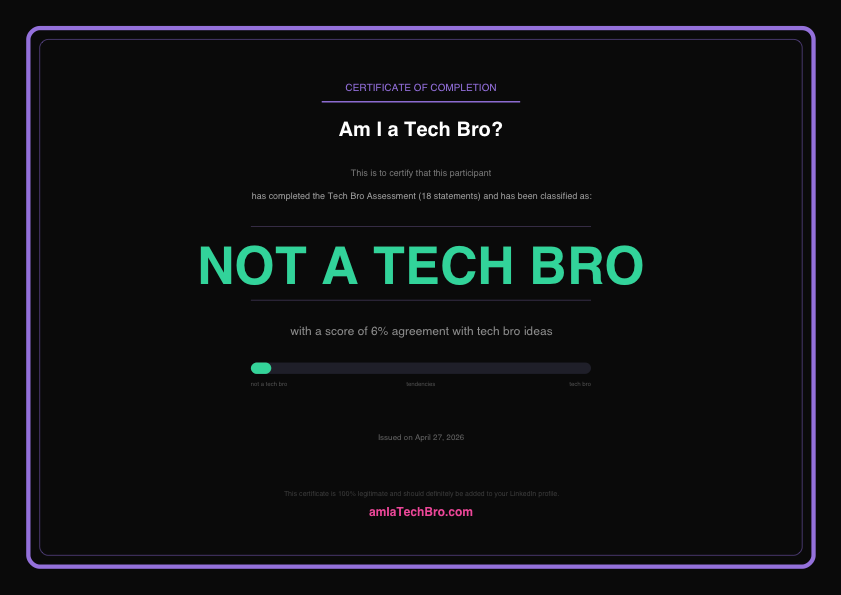
This quiz created by Felicitas Strickmann has been floating around the socials since at least March, but is new to me:
18 statements. Just agree or disagree.
I’m pleased to say I am not a tech bro, with a score of 6%.
The one tech bro statement I agreed with? Disruption:
Sometimes existing industries and institutions need to be destroyed so something better can emerge.
Am I A Tech Bro? quotes the Cambridge Business English Dictionary’s definition of disruption: “The action of completely changing the traditional way that an industry or market operates by using new methods or technology”—a perfectly reasonable definition. The reason why agreeing with the Disruption statement gives a tech bro point is this:
Critics argue this narrative romanticizes destruction, ignoring the jobs lost, communities displaced, and regulations bypassed in the name of innovation.
Although I understand and somewhat agree with the critics, this argument doesn’t quite align with the definition or with the statement I agreed with, which starts with a qualifying “sometimes” and is vague about which industries and institutions are being destroyed.
Travis Kalanick (Uber), Mark Zuckerberg (Meta/Facebook), and Sam Altman (OpenAI) would likely also agree with the statement, yet they most certainly think about disruption quite differently from how I do.
Sometimes it is necessary for incumbent industries to be destroyed—supplanted, if you prefer—for new industries and ideas to emerge, and yes, that does, perhaps inevitably, lead to the elimination of entire classes of jobs and massive societal upheaval that can last for decades. Whether that’s good depends on who benefits from the disruption.
Slavery and the slave trade are institutions that needed to be destroyed. When it happened, it caused massive disruptions to society, with tremendous pain and suffering, the effects of which are still being felt generations later. Disruption is often deeply harmful and destructive as it’s happening, and positive only in retrospect.
Beyond that deliberately incendiary example, the list of obsoleted industries, technologies, and jobs is vast. Cars supplanted horse-drawn carriages. Refrigerators bested ice delivery. Oil, natural gas, and renewable energy are supplanting coal. The Pony Express, floppy disks, film projectionists, and switchboard operators… all gone because something better—disruptive—came along. Yet no one is suggesting we bring back the floppy or revive slavery or the coal industry. (Well, no one serious.)
The problem with tech bros and disruption is their belief that disruption is universally good, as long as the benefits accrue to them, with no nuance or consideration for those disrupted. (Unless, of course, the tech bros are the ones being disrupted.) Not all disruption is universally good. One example: Interstate freeways offered tremendous benefit to the country but disproportionately carved up poor and Black neighborhoods, stripping them of their home, churches, and untold generational wealth. Tech bros only consider the purported benefit, never the impact.
I might have received a point for agreeing with a tech bro sentiment, but tech bros and I are not alike.
Ky Decker quit their job due to “the psychic toll” of AI-induced burnout and the dismantling of tech idealism, and now wonders, “Do I belong in tech anymore?”:
I keep asking myself:
What happened to the principles that were professed a decade ago? To address climate change? To reduce racial, gender, and economic inequality? To “don’t be evil”?
Were these principles abandoned, or were they merely born of convenience?
Has tech always been like this? Was I just blind to it before?
I love designing and building things for the web, but I’m mourning an industry that does not share the ideals I once thought it did.
I left Apple before the explosion of chatbots and AI coding tools, so I never went through the existential crisis some of my friends and colleagues are experiencing as they are forced into using tools that might one day eliminate their jobs.
I can, however, absolutely identify with the feeling of burnout caused, at least in part, by the sense that the idealism and progressiveness of the tech space have waned significantly, especially in the last half-decade. We’ve gone from angry declarations about the bloody ROI to tacky appeasement trophies; from humbly acknowledging diversity issues to cynically dismissing them. Today, if you are anything other than a young, wealthy, straight, cis, white male, it feels like the tech industry has angrily turned against you, and you’re no longer welcome.
The collective sense of insignificance is further magnified by the imposition of AI into our professional and personal lives, whether we welcome it or not. Developers and designers are compelled to build the very shovels they’ll use to dig their own graves. I continue to embrace technology as a tool that amplifies our individual efforts, but I’m happy that I no longer depend on technology for my livelihood. Even as I’m fascinated by the potential of AI, I find the business and ethics of AI appalling.
The entire Norah O’Donnell–Donald Trump 60 Minutes interview, following the security breach at the White House Correspondents’ Dinner, is worth watching, if only to see how glum Trump often looks throughout, but I especially wanted to highlight this exchange between Trump and O’Donnell, which could be a textbook example of consciousness of guilt on Trump’s part, and a masterful moment of feigned innocence by O’Donnell, who is otherwise gratuitously deferential toward Trump, but for this moment, chef’s kiss.
Will Bunch writes a brilliant dissection of Saturday’s security breach at the White House Correspondents’ Dinner for The Philadelphia Inquirer (gift link):
Right outside the ballroom at the Washington Hilton, the gunfire was still echoing, a Secret Service agent whose bulletproof vest apparently deflected a bullet was speeding to the hospital, and the stripped-naked alleged shooter, a 31-year-old Californian, was pressed facedown into a plush carpet. Yet inside, the first instinct of the president and the media superstars of an America comfortably numb to gun violence was to party on.
“Please take your seat,” a disembodied voice announced over the ballroom loudspeaker. “Dinner service will resume momentarily” — even as some trays had toppled over from waitstaff who’d been ducking and covering moments earlier. Trump agreed, as the former TV reality-show star posted that he wanted to “LET THE SHOW GO ON.”
Avert your eyes?
It’s not lost on me that this latest apparent presidential assassination attempt came the same day that I linked to MAGA supporters embracing Trump assassination conspiracies. We have become so inured to mass shootings and political assassinations that the first reaction of many was to decry the entire incident as “staged.” The muted reaction by the press and the president—including the president’s immediate call to build his ballroom, rather than, say, for better gun control—certainly did nothing to lend an air of urgency or danger.
In linking up the MacBook Neo behind-the-scenes short, in which I referenced the recently updated Apple TV logo, I realized I hadn’t previously linked to that making-of video. To make up for that oversight, here’s a link to the behind-the-scenes video again, plus Grace Snelling’s piece in Fast Companydetailing the design process:
From the beginning, the team knew they wanted to shoot the Apple TV animatics using only practical effects. The goal was to embrace the craft of filmmaking by capturing the organic behavior of light that digital simulations can’t entirely perfect.
This process started with a series of physical versions of the Apple TV logo, each sculpted from solid glass and made in partnership with the London-based creative studio Optical Arts. Every piece was cut and polished differently to study how it interacted with light, reflections, and depth.
Once the final version of the logo was selected, it was filmed several times under specific lighting conditions. The team embarked on a weekslong series of experiments with light angles, diffusion, movement, and color, refining exactly how each shot should reflect and refract on camera.
Apple could have opted to use computer-generated graphics for the logo, and no one would have cared (or even noticed). Making it the old-fashioned way is a statement.
I love Apple’s “A peek at some handmade magic” on the making of the delightful MacBook Neo intro ad. When the Neo was announced, I described the ad as “kinetic and playful, and the animations feel grounded and physical.” This YouTube Short shows why: many of the animations start as physical objects and practical effects. The exploding confetti rocket, for example, is stop-motion animation and actual confetti. I love that in a world of AI ads, Apple is embracing old-school, handcrafted art. (See also: the new Apple TV logo, which is polished glass and colorful lighting.)
I somehow missed that there’s a new Toy Story about to be unleashed on us. The trailer’s version of You’ve Got a Friend in Me already had me welling up, but it was the shot of the four kids ignoring each other with their LilyPads in hand that broke my heart. I’m not sure we need another installment in the franchise, but yes, of course I’ll watch it, and I suspect it’ll make me sob.
In recent weeks, as criticism of President Donald Trump from his own supporters has reached a fever pitch, a new conspiracy theory has taken hold: Some of the president’s biggest supporters are now claiming, without evidence, that Trump staged the assassination attempt on his life in Butler, Pennsylvania, in 2024 and is covering it up.
It’s hardly a new conspiracy theory; people on both sides of the MAGA divide have made the claim over the years. What’s new is that prominent, “mainstream”-by-some-definition MAGA zealots are now openly promoting it—or at least, “just asking questions.”
What do you expect? When you’ve trained your followers to see a conspiracy in everything, it shouldn’t be surprising when they start seeing everything as a conspiracy.
Meta plans to lay off 10% of its workforce, about 8,000 employees, as it continues ramping up investments in artificial intelligence.
The cuts will begin May 20, and the company is scrapping plans to hire people for 6,000 open roles, according to a Thursday memo to employees. […]
Meta’s latest round of cuts follows several smaller job reductions that the company said was necessary to improve efficiency while focusing its efforts on generative AI, where it’s lagged OpenAI, Google and Anthropic.
Affected employees get “16 weeks of base pay plus two weeks for every year of employment.” For a recent hire—someone who may have only recently upended their life to work at Meta—that’s about four months to find a new job before their lease is up for renewal. Someone with five years at the company, who has established roots, perhaps with a kid just entering first grade, gets six months to restabilize their life. A Meta veteran of 18 years—I’m guessing there are very few of those—will have a year to determine if they still have a viable career in technology. If they’re under 50, they have a shot. If they’re not, well, good luck, I hope you’ve invested well.
All of this upheaval because Mark Zuckerberg chases technological fantasies with the attention span of a gerbil.
I have every confidence that he’ll be as successful with his AI machinations as he was with virtual reality.
Good news for the remaining employees, though: as a reward, they’ll be surveilled to train Meta’s AI, reports Katie Paul and Jeff Horwitz at Reuters, presumably so Meta can eventually lay them off, too:
Meta is installing new tracking software on U.S.-based employees’ computers to capture mouse movements, clicks and keystrokes for use in training its artificial intelligence models, part of a broad initiative to build AI agents that can perform work tasks autonomously, the company told staffers in internal memos seen by Reuters.
The tool, called Model Capability Initiative (MCI), will run on work-related apps and websites and will also take occasional snapshots of the content on employees’ screens, according to one of the memos, posted by a staff AI research scientist on Tuesday in a channel for the company’s model-building Meta SuperIntelligence Labs team.
The purpose, according to the memo, was to improve the company’s AI models in areas where they struggle to replicate how humans interact with computers, like choosing from dropdown menus and using keyboard shortcuts.
Perhaps the thousands of people losing their jobs are the lucky ones.
Why spy on only U.S.-based employees?
In some countries, such as Italy, using electronic monitoring to track employee productivity is explicitly illegal, while in Germany, courts have held that employers can deploy keystroke logging only in exceptional circumstances, such as suspicion of a serious criminal offense.
Additionally, [York University law professor Valerio] De Stefano said, the practice would likely be considered a violation of Europe’s General Data Protection Regulation.
As annoying as those GDPR-inspired cookie banners are, I’d welcome the privacy safeguards that law enables.
Many of the lucky American employees reacted negatively, with the top-rated comment on their internal chat system, according to Charles Rollet at Business Insider, being “This makes me super uncomfortable. How do we opt out?”
Meta CTO Andrew Bosworth responded in the thread that “there is no option to opt out of this on your work provided laptop.” This comment received a mix of crying, shocked, and angry-face emojis.
Meta’s entire business is predicated on tracking vast amounts of data about its users—sometimes surreptitiously—so it’s perplexing that any employee would react negatively when Meta decides to collect vast amounts of data about them. Or to put it more blithely:
Few decisions by the U.S. Supreme Court have had a greater impact on the nation’s political landscape than the 2010 ruling in Citizens United v. Federal Election Commission. The 5–4 decision allowed corporations and other outside groups including labor unions to spend unlimited money on elections. […]
But what if the states took the initiative to limit the impact of Citizens United by passing their own laws to change the way corporations are defined?
That is the purpose of Senate Bill 2471, which would emphasize that corporations are “artificial persons” created by state law and granted powers and privileges by it — something SB 2471 points out is already part of Hawaiʻi’s constitution.
The bill would make clear that the powers of corporations do not include spending money or contributing “anything of value” to influence elections or ballot measures, as the bill’s language explains.
Corporations exist because states define the rules of their existence. In theory, that should mean corporations have only the rights granted to them by the states—and states therefore can redefine, or eliminate, those rights.
While the law targets the “dark money” unleashed by Citizens United, should it pass and survive the inevitable legal challenges (which I hope it does, as corporations do not have the right to vote and therefore should not wield such tremendous power over our elections), a similarly innovative approach could be used to redefine all manner of corporate “personhood” issues—including making their top officers legally and morally responsible for corporate malfeasance.
Hawaiʻi is the first state to attempt this novel maneuver, but it’s not the only one considering it:
[…] legislation based on this framework has now been introduced in 13 states besides Hawaiʻi: Arizona, California, Georgia, Kansas, Maryland, Minnesota, Missouri, New York, Oklahoma, Rhode Island, Vermont, Virginia and Washington.
That’s a surprisingly bipartisan bloc potentially uniting against Citizens United.
For the first time in France, and possibly for the first time ever, anywhere, an entire corporation had been put on trial and found criminally liable for enabling terrorism.
The corporate defendant was “one of the world’s largest cement manufacturers, Lafarge,” and the men on trial were Bruno Lafont, the 69-year-old former chief executive, and Christian Herrault, the 75-year-old former deputy head of operations.
The court had concluded that between 2013 and 2014, the cement maker paid about $6.5 million to the Islamic State and other terrorist groups in Syria, to facilitate the company’s operations there. Lafarge — now owned by the Swiss conglomerate Holcim — will have to pay about $1.3 million in fines for the crime of financing terrorism and $5.3 million for violating international sanctions. In another case, Lafarge is facing charges of complicity in crimes against humanity. If that case goes to trial and Lafarge is again found guilty, a new chapter in the prosecution of war crimes may begin.
The fines are, of course, a mere “cost of doing business” for the company. The conviction of the two executives, who will be serving six and five years, respectively, is a game-changer.
I find it absurd that the American legal system has deemed that corporations are people, with all of the attendant rights, but few of the responsibilities or consequences. A “natural person” can be prosecuted, fined, and jailed—even executed in some especially regressive jurisdictions. A corporation faces only prosecution and fines, and corporate officers, not even that.
My hope is that the U.S. will someday follow in France’s footsteps. The first U.S.-based executive to be convicted for the illegal acts of their company will send reverberations across Wall Street and, perhaps, usher in a new day of corporate responsibility.
I’ve long thought Wile E. Coyote should sue ACME for all the failed products he’s bought from them, so it’s great to see he’s getting his long-delayed day in court in the long-delayed Coyote vs. Acme. I’m getting big Who Framed Roger Rabbit? vibes from the mix of live action and animation. Lots of laughs in the trailer (Daffy Duck: “Ac-me? Ac-you!”), but I chortled the most at the meta-dig at Warner Bros. as being a “wholly owned subsidiary of ACME Corporation,” which is “releasing this film for accounting purposes only” (see also this 15-second teaser). The movie’s Wikipedia entry provides context if you aren’t up on the real-world corporate shenanigans that led us here.
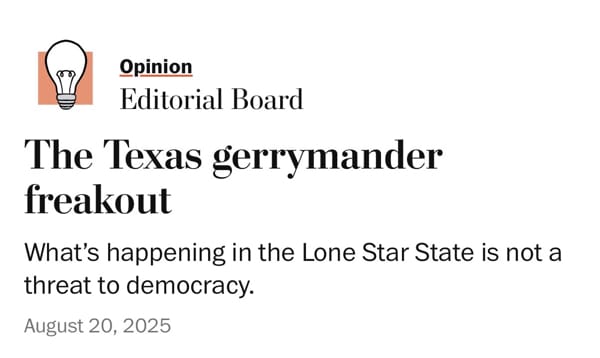
What’s happening in the Lone Star State is not a threat to democracy.
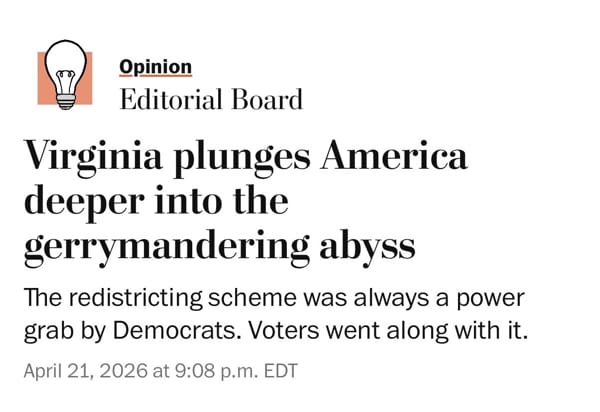
Washington Post Editorial Board Headlines
Virginia’s gerrymandering comes after Missouri, North Carolina, Ohio, Texas, and Utah all implemented Republican-friendly gerrymandered maps, but sure, blame Virginia for the “power grab” that’s plunging us into the “gerrymandering abyss.”
The Washington Post Editorial Board has become a fetid corpse, rotting under Jeff Bezos. I would find it farcical if it wasn’t so pathetic.
Bryce P. Tetraeder, CEO, Global Tetrahedron, with an update to its plans for the odious Alex Jones’ InfoWars:
Such is the InfoWars I envision: An infinite virtual surface teeming with ads. Not just ads, but scams! Not just scams, but lies with no object, free radical misinformation, sentences and images so poorly thought out that they are unhealthy even to view for just a few seconds. The InfoWars of old was only the prototype for the hell I know we can build together: A digital platform where, every day, visitors sacrifice themselves at altars of delusion and misery, their minds fully disintegrating on contact. […]
The InfoWars of tomorrow will converge into a swirling vortex of content about content, talent acquiring talent, rings of concentric media mergers processing all human artistry into one endlessly digestible slurry. This will be a dank, sunless place, one where panic and capital feed on each other like twins in the womb of a hulking, unknowable monster—a monster known by many names, but which I like to call modern-day America.
Anil Dash, perhaps the most unexpected authority on Prince, catalogues his many writings about the legendary artist on this, the tenth anniversary of Price’s passing. It’s “a chance to explore some aspect of [Prince’s] artistry or legacy that you haven’t yet had a chance to discover”.
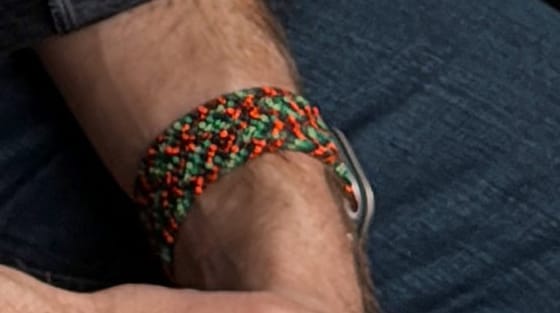
Inspired by the power of connection, this striking band uses an advanced braiding technique to unite multiple yarns in a Pan‑African color palette of red, green, and black — creating a vibrant and tactile dimensionality. […]
Three bands, one community. The Black Unity Collection continues to support organizations dedicated to advancing racial equity and justice. […]
The band was designed by Black creatives and allies at Apple.
I’m sure Ternus rotates his watchbands regularly, so I don’t want to read too much into his selection, but I want to believe he either wears this band regularly or chose to wear it for these photos.
The Black Unity band is a deeply meaningful artifact for Apple’s Black community. I recall an October 2017 meeting between Apple’s Black employee association and its then-executive sponsor, Lisa Jackson, where we explored creating a “Truth” watchband to celebrate Black history and culture. Three years later—after I’d stepped down as co-chair, to be clear—Apple announced its first Black Unity Collection band, with the words “Truth. Power. Solidarity.” laser-engraved onto the fastening pin. It was a significant achievement for the many people who worked tirelessly to bring the long-gestating project to life, and a symbol of Apple’s commitment to inclusion and diversity.
Ternus led that Product Design team.
Whether Ternus is wearing the latest iteration by choice or by chance, I’m taking it as a sign that he’ll continue that commitment.
Apple Newsroom, in a stunner for its timing, if not it’s matter-of-factness:
Apple announced that Tim Cook will become executive chairman of Apple’s board of directors and John Ternus, senior vice president of Hardware Engineering, will become Apple’s next chief executive officer effective on September 1, 2026. The transition, which was approved unanimously by the Board of Directors, follows a thoughtful, long-term succession planning process
Cook will continue in his role as CEO through the summer as he works closely with Ternus on a smooth transition. As executive chairman, Cook will assist with certain aspects of the company, including engaging with policymakers around the world.
This is not goodbye. But at this moment of transition, I wanted to take the opportunity to say thank you. Not on behalf of the company, this time, though there is a wellspring of gratitude for you that overflows inside our walls. But simply on behalf of me. Tim.
Apple today announced that, effective immediately, Apple executive Johny Srouji will become chief hardware officer. Srouji, who most recently served as senior vice president of Hardware Technologies, will assume an expanded role leading Hardware Engineering, which John Ternus most recently oversaw, as well as the hardware technologies organization.
My only question: will Cook or Ternus open WWDC26?
Each winter, Harbin, in northeast China, hosts the International Ice and Snow Sculpture Festival, featuring enormous buildings and sculptures constructed from blocks of ice carved from the nearby river. A fascinating 36-minute video details the stunning amount of logistics, creativity, and ingenuity that goes into building this ephemeral megacity (it exists for a mere two months).
(I once visited the Harbin ice festival in 2012 with my wife and friends. I remember being awed by the beauty and astounded by the scale—massive, though not yet the world’s largest ice and snow festival that it is today. I also recall it was bloody cold. I mean brutal.)
In a prayer delivered by [Defense Secretary Pete] Hegseth during a Pentagon worship service on Wednesday, he read a fake Bible verse from Tarantino’s 1994 “Pulp Fiction.” It was the altered version of Ezekiel 25:17 that is righteously delivered by Samuel L. Jackson’s character in the movie just before he shoots a man to death. […]
What Hegseth read was nearly word-for-word the line delivered by Jules Winnfield, Jackson’s hitman in “Pulp Fiction” […]
Secretary Hegseth on Wednesday shared a custom prayer, referenced as the CSAR prayer, used by the brave warfighters of Sandy-1 who led the daylight rescue mission of Dude 44 Alpha out of Iran, which was obviously inspired by dialogue in Pulp Fiction. However, both the CSAR prayer and the dialogue in Pulp Fiction were reflections of the verse Ezekiel 25:17, as Secretary Hegseth clearly said in his remarks at the prayer service. Anyone saying the Secretary misquoted Ezekiel 25:17 is peddling fake news and ignorant of reality.
First, yes, I recognize the utter inanity of the Secretary of Defense quoting Bible verses—real or otherwise—at a military “prayer service.”
Second, Hegseth absolutely misquoted Ezekiel 25:17, and I’m not sure he knows he did so.
Hegseth said the prayer was “delivered from the lead mission planner of Sandy-1,” the rescue mission that located and extracted the Air Force members who were shot down over Iran. He says, with a slight chuckle—as the audience chuckles along—that he thinks it “is meant to reflect Ezekiel 25:17.”
What I think happened: The Sandy-1 planner obviously and deliberately appropriated the Pulp Fiction quote and altered it to fit their mission. They then shared it with Hegseth, expecting him to appreciate the artful alterations to the well-known speech. Hegseth, apparently devoid of any culture, didn’t recognize it as a Pulp Fiction reference, and presumed it to be a lightly revised version of the actual Ezekiel 25:17.
Had his spokesperson simply left his statement as the “custom prayer … was obviously inspired by dialogue in Pulp Fiction,” and added “which Secretary Hegseth delivered with a chuckle,” then, despite Hegseth’s earnest delivery, there’d be plausible deniability, and this would have been simply one more example of Hegseth’s use of inappropriately violent imagery. But since no one in this administration can be wrong (and not just “not wrong,” but “arguably right”), the statement had to include a positive spin on Hegseth’s flub.
A heads-up for Whiskey Pete: “I love the smell of napalm in the morning.… smelled like… victory” is not the heroic quote you think it is.
I missed David Price’s Macworld piece from earlier this month, where he counted down Apple’s 50 “most important people who made it all possible.”
I must have been number 51.
The top four are who you’d likely expect, and I’m thrilled to see Lisa Jackson on the list (No. 24), but you’re unlikely to recognize a third of the names, and there are some questionable inclusions and rankings here. Al Gore (No. 49) and Dieter Rams (No. 22)? Really? And Phil Schiller (No. 40) and Jeff Williams (No. 35) should be way higher, top 20 at least. And it’s a damn shame that Tony Fadell is (deservedly) on the list (No. 5), but the just-retired and equally-important-to-iPod (and Apple) Stan Ng isn’t.
After 31 years at Apple, today was my last day. I think I got in everything I wanted to do on my last day before retiring […]
His bucket list included eating “from the last station I had never eaten from at Caffe Macs”—the pizza station, a favorite of many an Apple employee—and watching the “sunrise at Apple Park while listening to my original iPod.”
(Coincidentally, I recently found my 2nd- and 5th-generation iPod nano. Alas, unlike Stan’s iPod, whose original battery “still held up for several hours,” my batteries die immediately.)
Stan was the original product marketing manager for iPod, before taking on iPhone, Apple Watch, Health, Home, and AirPods. I never had the pleasure of working with him in a direct capacity, but our teams collaborated often. He is, as one former colleague put it, “legendary.” My congratulations to Stan on a stellar career. I wish him the best of luck after Apple.
Anthropic is requiring a “valid government-issued photo ID” for some users, a new support document reveals:
We are rolling out identity verification for a few use cases, and you might see a verification prompt when accessing certain capabilities, as part of our routine platform integrity checks, or other safety and compliance measures. […]
We selected Persona Identities as our verification partner based on the strength of their technology, privacy controls, and security safeguards. Follow the steps below to complete your identity verification process.
The change lands less than two months after Claude drew a surge of users from OpenAI’s ChatGPT during Anthropic’s public fight with the Pentagon over mass surveillance and autonomous weapons.
This applies to a small number of cases where we see activity that indicates potentially fraudulent or abusive behavior, which is against our usage policy.
An identity verification prompt would be a hard pass for me, and I’m guessing many others. This is a surefire way to kill Claude. What is Anthropic thinking?
Opus 4.7 is a notable improvement on Opus 4.6 in advanced software engineering, with particular gains on the most difficult tasks. Users report being able to hand off their hardest coding work—the kind that previously needed close supervision—to Opus 4.7 with confidence. Opus 4.7 handles complex, long-running tasks with rigor and consistency, pays precise attention to instructions, and devises ways to verify its own outputs before reporting back.
The model also has substantially better vision: it can see images in greater resolution. It’s more tasteful and creative when completing professional tasks, producing higher-quality interfaces, slides, and docs. And—although it is less broadly capable than our most powerful model, Claude Mythos Preview—it shows better results than Opus 4.6 across a range of benchmarks […]
The forbidden Mythos model is included in the comparison table, a not-so-subtle reminder of how great Mythos supposedly is—access to which is limited to Project Glasswing partners.
John Sharp, reporting for AL.com on the case of Renea Gamble:
A Fairhope municipal judge on Wednesday acquitted an Oct. 18 “No Kings” protester who was arrested for wearing a giant inflatable penis costume, a case that has drawn national attention, laughter and debate over First Amendment rights.
That this even made it to trial is its own absurdity. The trial only lasted about two hours, though the judge seemed reluctant to rule in Gamble’s favor.
Fairhope city attorney Marcus McDowell said he did not believe the arrest involved any First Amendment violation.
“There is no constitutional right to wear a total erect penis on the side of the road,” he said. “I’m sorry.”
No word if a semi-erect or flaccid penis is constitutionally protected.
Allbirds, the once-darling shoemaker beloved by tech bros (and my wife), with an announcement that’s not satire:
Allbirds, Inc. (Nasdaq: BIRD) (the “Company”) today announced the execution of a definitive agreement with an institutional investor for a $50 million convertible financing facility (the “Facility”). The Facility, which is expected to close during the second quarter of 2026, will enable the Company to pivot its business to AI compute infrastructure, with a long-term vision to become a fully integrated GPU-as-a-Service (GPUaaS) and AI-native cloud solutions provider. In connection with this pivot, the Company anticipates changing its name to “NewBird AI.”
Missed opportunity to go with “AIIBirds.”
Allbirds was worth $4 billion a few years back, and a couple of weeks ago sold its brand and assets for a mere $39 million to American Exchange Group. Instead of selling shoes to tech bros, they’ll sell AI cloud compute to… tech bros.
My wife broke the news of the AI pivot this morning, as she owns several pairs of Allbirds shoes and an equal number of shares—an investment that’s lost 99% of its value. Well, 98% now, I suppose. Bryce Elder, reporting in the Financial Times (email-gated):
The announcement was enough to establish Allbirds as a meme stock. At pixel time, the shares are up 774 per cent at $21.76, to give the soon-to-be shell a market cap of slightly more than $184.5mn.
We’d suggest running away as quickly as possible, if anyone can suggest a suitable brand of footwear for the task.
A fake version of Ledger Live distributed via Apple’s App Store has been linked to at least $9.5 million in crypto theft, with victims now coming forward describing devastating losses, including entire retirement funds wiped out “in an instant.” […]
The phishing campaign, active between April 7 and April 13, impacted more than 50 suspected victims across Bitcoin, Ethereum-compatible networks, Tron, Solana and XRP. […]
Apple removed the fake Ledger Live app from the App Store, but questions remain about how it passed review and how long it was available.
This was the Mac App Store. It’s a team I’m extraordinarily familiar with and have tremendous affection for. I still have many friends working in App Review and I’m excruciatingly aware of their workload and the pressure to review and approve apps quickly.
Kudos to Apple for acting quickly to pull the app, but c’mon y’all. Shame on you—the individual reviewers, the managers, all the way up—for approving this app. What’s especially frustrating is the app was approved not once, but several times over the course of a week.
Any app that touches the financial system in any capacity should receive extraordinary vetting during the app review process—including by subject matter experts—and should never receive approval without positive confirmation that the app is legitimate. Is it more work? Absolutely, but it’s the right tradeoff for such an important category, and the alternative—as here—is so much worse.
As a reviewer, you should always ask yourself “Am I OK with my loved ones using this app?” If not, flag it. I’d rather read about the real Ledger app taking weeks to get approved than about fake apps scamming people out of their savings.
Adobe has patched a vulnerability in its flagship document-reading apps, Acrobat DC, Reader DC and Acrobat 2024, that hackers have been actively exploiting for at least four months.
The vulnerability, officially tracked as CVE-2026–34621, allows hackers to remotely plant malware on a person’s device by tricking them into opening a maliciously crafted PDF file on their Windows device or macOS computer. The exploit targets a vulnerability in some versions of the Adobe Reader software.
It is not yet known how many people have been affected by this hacking campaign. In a note on its website, Adobe said it was aware that the bug is being exploited in the wild, known as a zero-day, indicating that hackers have been using it to break into people’s computers before Adobe could fix it.
I can’t recall the last time I used Adobe’s PDF reader apps, as I open 99% of PDFs using Apple Preview, Files or QuickLook, and most of the rest in Safari.
The defeat of Hungary’s prime minister, Viktor Orbán, should deliver a sharp jolt to one of America’s two major political parties.
Oddly, it’s not the Republicans, deeply invested though they were in Orbán as a fellow traveler. […]
[…] the sharpest message from Budapest should be for the Democrats, strange as that may sound.
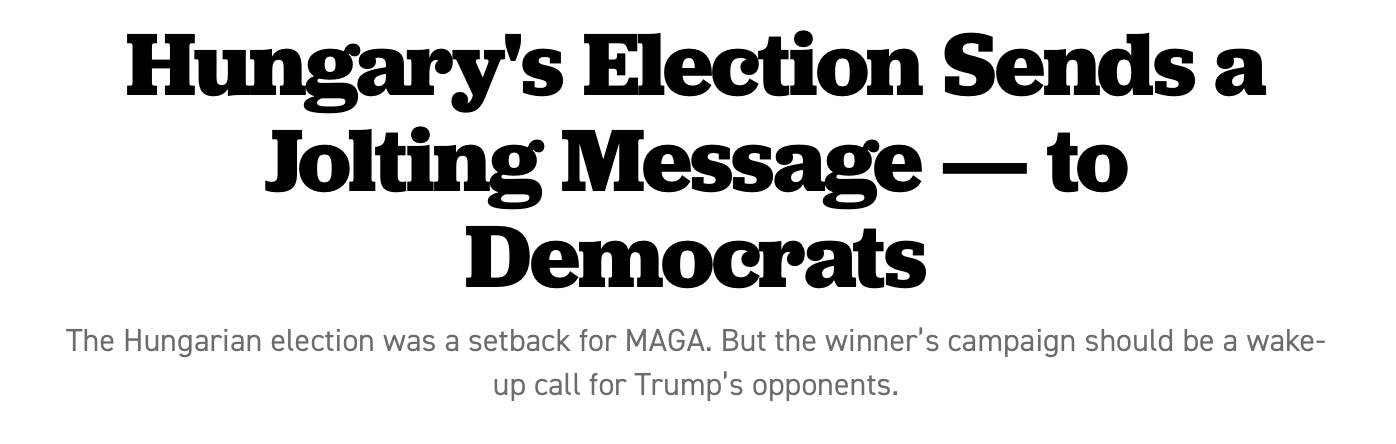
Politico’s original headline.
This bad-for-Democrats headline is very New York Times. Politico changed the headline shortly after publication to “Orbán's Defeat Shows What Trump's Opponents Keep Doing Wrong” (screenshot of original above—some telltale evidence of which remains visible in the URL: hungary-election-orban-defeat-message-democrats). That’s a (slightly) better match for the article (700 words flagellating Democrats for the party’s “command-and-control mindset” and “reverence for norms over original thinking and big ideas” and exhorting them to find “insurgents” in this “age of convulsion.”)
Ashifa Kassam and Flora Garamvolgyi, reporting for The Guardian:
Hungary’s opposition Tisza party, led by Péter Magyar, has won the election, bringing an end to Viktor Orbán’s 16-year grip on power, in a result that is likely to rattle the White House and reshape the country’s relationship with the EU.
Less than three hours after polls closed on Sunday, Orbán conceded defeat after what he described as a “painful but unambiguous” election result.
The Portraits of Another Life YouTube channel has a lovely profile of Disney Imagineer Ray Kinman, who created several of the beautiful wood carvings for Disneyland attractions (including Indiana Jones Adventure Outpost and The Many Adventures of Winnie the Pooh). Three wonderful quotes that resonated:
I learn to do what I do by making mistakes, just by screwing it up—well that didn’t work—and trying something else. Embrace the mistakes. […] I think we’re kind of trained in school and in life to get the right answers and get rewarded for those and penalized for mistakes, but mistakes are where that really great learning and growth comes.
And:
Talent, I believe, is mostly a myth, because I hear that a lot—oh you’re so talented—and it’s not really true. Your greatest asset isn’t your good looks, it’s not education, it’s not who you know, it’s none of those things. The greatest asset you have is your persistence, and it’s the one thing that you’re fully in control of. When you see someone who really excels at something, it’s persistence and staying with it and repetition over a long period of time. That’s what you’re looking at.
And:
My definition of an artist is someone who creates.
Taken together, they form a terrific precept for creativity of any sort: Do the work, make mistakes, learn, repeat. Great advice whether you’re whittling wood, writing words, painting pictures, or crafting code.
If you enjoy this curated collection of eclectic ephemera,
subscribe by email or follow in RSS to get new posts automatically.