Paul Kafasis engages in some excellent, self-inflicted nerd-snipping on One Foot Tsunami:
I asked my iPhone who won Super Bowls 1 through 60 (that’s “I” through “LX” in Super Bowl styling) and captured a screenshot of each result.
The results are utterly appalling:
So, how did Siri do? With the absolute most charitable interpretation, Siri correctly provided the winner of just 20 of the 58 Super Bowls that have been played. That’s an absolutely abysmal 34% completion percentage. If Siri were a quarterback, it would be drummed out of the NFL.
Some of the results are especially awful. For example, to the question “Who won Super Bowl XXIII?”, Siri responds with the number of times Bill Belichick has won or appeared in the Super Bowl—completely irrelevant.
John Gruber at Daring Fireball wrote a brutally (but fairly) titled follow-up, Siri Is Super Dumb and Getting Dumber, sharing the appalling results to his own query, “Who won the 2004 North Dakota high school boys’ state basketball championship?”
New Siri — powered by Apple Intelligence™ with ChatGPT integration enabled — gets the answer completely but plausibly wrong, which is the worst way to get it wrong. It’s also inconsistently wrong — I tried the same question four times, and got a different answer, all of them wrong, each time. It’s a complete failure.
We’ve all had the Siri experience of getting a clearly wrong or patently useless answer to our query. It’s gotten to the point where I merely roll my eyes and move on—I rarely even screenshot mistakes anymore.
But I do feel sorry for the Siri team. I have some good friends who work there, and I had occasion to work with the team on Siri responses a few years back. I know they cringe every time these failures hit the blogs. They know more than anyone just how much Siri needs to improve.
The latest scuttlebutt (from Mark Gurman at Bloomberg) is that longtime Apple exec Kim Vorrath is moving to Apple Intelligence in an effort to whip it into shape. I’ve watched Vorrath and her Program Office teams operate from the inside for many years. The biggest impact she and her team had across engineering was instilling discipline: every feature or bug fix had to be approved; tied to a specific release; and built, tested, and submitted on time. It was (is!) a time-intensive process—and engineering often complained about it, sometimes vocally—but the end result was a more defined, less kitchen-sink release each year. To a significant extent, her team is the reason why a feature may get announced at WWDC but not get released until the following spring. She provided engineering risk management.
I hope the Vorrath and the Siri team can make this work. I need them to make this work. The future promised by Apple Intelligence is too compelling for it to fail.
I’d like you to take a listen to this eleven-minute podcast; it’s a “deep dive” into JAG’s Workshop:
It might sound like a pair of professional podcasters decided to talk about this humble site, but no—it is, as you may have already sussed out, completely AI-generated. Every word, every breath, every “ummm,” “ahh,” and “like.” From voices to content to structure, it’s AI all the way down.
Last fall, the tech-adjacent world went gaga over the release of these “audio overviews” from Google NotebookLM. The idea is, you toss data (articles, URLs, audio, and so on) into NotebookLM, and Google’s AI “becomes an instant expert in those sources”, allowing you to query it for insights—or generate these two-person podcasts.
I pointed it at my site and grinned giddily as I listened to the result. Even knowing it was entirely made up, I found it remarkable for how real it sounded. I was impressed by the audio quality, the conversational style, and the “insights.” It made the site (and its author!) sound extraordinarily impressive and worth reading.
It wasn’t perfect, but I loved so much about this podcast. The opening description is an ego-stroke of massive proportions, capturing what I think is the essence of the site:
Host A: Ever get the feeling your brain just kinda bounces between totally different things? One minute you’re knee-deep in some tech spec from, like, the 90s, next you’re trying to perfect a vintage cocktail recipe?
Host B: And then bam! You’re analyzing political commentary, but through the lens of, like, The West Wing or something.
Host A: Tell me about it! Well, get ready for that times a thousand. We’re diving into JAG’s Workshop, the digital playground of this guy, Jason Anthony Guy, and trust me, it’s a wild ride.
Host B: This isn’t your grandma’s blog, that’s for sure. It’s tech nostalgia, it’s cocktail culture, it’s—honestly, it’s all over the map, but in the best way possible.
They also call me a “tech geek political junkie” and “a storyteller at heart.” It’s something I’d write about myself, were I a tad less modest. I like it so much though, I may clip some of it for my About page (it’s OK: someone else said it, not me!).
From a pure “does it sound like a podcast?” perspective, it hits all the expected notes: two surprisingly enthusiastic hosts bouncing off each other on a series of loosely related topics they awkwardly try to transition between while adding personal takes meant to sound insightful. The only thing missing was a sponsor break from Squarespace, the all-in-one platform for creating your website[1].
Using the posts on this site as their starting point, the hosts added context, connected ideas, and drew conclusions in ways that sounded remarkably human. They even added facts that were not part of the original content, but which reflected the knowledge a real person might have about the topic.
For example, when introducing my post on the death of John Amos, they say:
Host A: Remember John Amos? Played James Evan Sr. on Good Times.
I hadn’t included the character’s full name, only “Amos as James was my first TV dad”; the host added that extra detail. They also riffed on my passing references to Amos’s other roles, recognizing Good Times, Die Hard 2, Coming to America, and Psych as movies and TV shows of different genres and time periods, and used that knowledge to add a reflective coda:
Host A: It’s like how one actor’s career can have this crazy impact even across, like, completely different genres and decades.
These small moments added to the believability of “two people talking.”
I also enjoyed the range of emotion the hosts expressed: disbelief, empathy, even exasperation—which you can hear during their discussion of my The West Wing obsession:
Host A: There’s another pop culture thing this guy is all about: The West Wing.
Host B: Oh, tell me about it!
They’re also imperfect speakers, interjecting “ums,” “uhhs,” and “likes” as they speak. These disfluencies made them sound more human and conversational, and the “audio production” added to this humanness; at one point toward the end, as one of the hosts tries to remember a supposed quote (I’ll get to that later), they say “... wait, I wrote it down...,” and their voice fades off slightly as if leaning away from a microphone to reach their notes.
Host A: He goes from loving The West Wing—this very idealized view of politics—to sharing a Downfall parody video about Trump... it’s like he’s holding up this mirror, right: this is what we wish for, this is what we got.
I’ve been talking about the hosts as if they’re human, because it’s hard to listen to them and think of them as AI. But AI they are, so not everything’s perfect, or even true.
There were a few speech oddities you probably caught. Multiple times the hosts spell out words, like “a-n-d” or “u-s-e-d” instead of saying “and” or “used.” They also overstate and embellish a lot in their efforts to sound erudite[2]; for example, three sentences linking to a YouTube video becomes “a whole post about the Nintendo Gameboy,” where I go “deep” about how these games “are what I grew up with” and “shaped me.” While I did admit I still have several Nintendo systems, the idea that these games shaped me is a bit of lily gilding.
And of course, being AI, they simply make stuff up. I mentioned earlier a moment when a host appeared to lean away from the microphone to retrieve a quote they attributed to me. That quote was “Life’s too short to be a snob about your passions.”
Except… I never wrote it. It’s a complete and utter fabrication. It was presented so convincingly that I briefly believed I’d forgotten writing it—but it seemed too turgid, even for me. Only a search through my entries convinced me it wasn’t mine.
They also bestow on me “degrees in both computer science and theatre arts.” While I studied both in college, I hold degrees in neither. (Indeed, I hold no degrees at all.) This invention is clearly a misinterpretation of my About page, where I write that “In college, I pursued degrees in both computer science and in theatre, television and film production.” Of course, pursued does not mean completed.
There are a dozen or more of these embellishments and outright fabrications throughout the podcast, which, taken together, help make this site (and this author) seem utterly fascinating, maybe more than is warranted[3]. But despite these examples of AI bullshit—or maybe because of them!—I found the discussion delightful.
I’m excited about the future of this technology. The quality of the podcast is already good enough to convince some that it’s two real people having an engaging discussion. My good friend Ron shared with me his experience of driving his daughter to school and listening with her to a podcast study guide for her AP Psychology class. Only after it was done did he learn from her that it was AI generated.
A former co-worker uses this technology to create podcasts on a wide range of topics. He spends a few hours on a weekend filling out spreadsheets with sources of information, pours them into NotebookLM, adds intros and music, and uploads the results to Apple Podcasts and Spotify. The results are credible and riveting. (No link because he doesn’t disclose it’s AI generated, and I don’t want this to be the thing that outs it!)
Over the next couple of years, the audio will only improve; it’s already nearly indistinguishable from human voices today, though NotebookLM is currently limited to just two English-speaking, American-accented voices. Other companies offer more voice options—accents, languages, tonality, and so on. I expect those to eventually find their way into NotebookLM.
I also anticipate more control over the kind of podcast (or more broadly, audio) that’s generated. A one-person podcast, perhaps; or a panel discussion where one person acts as host to a team of opinion-makers; maybe even a round-table style discussion where each person brings a topic and gives their takes. Video would be a natural next step.
And, of course, some much-needed improvements to the AI’s “intelligence.” Inaccurate summaries and hallucinations continue to be among the biggest issues in the industry—especially when presented as fact—and it’s not clear how long it will be before these issues go away.
Despite this—and the many other issues AI has—I’m excited about the game-changing potential of using AI as a personal knowledge base and information retrieval system, especially when paired with audio and video as the method of sharing the results.
Directed by Ridley Scott, the advertisement was designed to highlight the Macintosh as a groundbreaking computer that offers freedom and individuality in a market dominated by corporate conformity. It drew inspiration from George Orwell’s dystopian novel Nineteen Eighty-Four, with Apple positioning itself as a liberator from the homogenized control represented by the fictional “Big Brother,” a veiled allegory for IBM.
A lot has changed since this ad first aired. Foremost is that IBM is no longer the tech behemoth to be feared; Apple has indisputable taken on that role, and is now seen by many as the company we need to be “liberated from.” Meanwhile, in the politics sphere, every day feels more and more like Nineteen Eighty-Four.
And of course, the Super Bowl, which used to air in mid-to-late January, has crept later and later, with this year’s game being held on February 9.
Can a place be defined by a beverage? If I mention champagne, you must think of France. If I say mint julep, you’re thinking of the South. If you hear Malört, and you know what that is, you know I’m talking about Chicago. So, what’s San Francisco’s defining drink? If you ask some people, especially bartenders, it’s Fernet-Branca.
It’s true. You won’t find many San Francisco bars without Fernet-Branca on the shelves. If you do, maybe walk out.
If there’s one thing people will tell you about Fernet-Branca, it’s that it’s very much an acquired taste. It is a dark, syrupy-looking liqueur with a strongly medicinal smell and taste, and unlike other similar herbal digestifs, it is not sweet at all. […]
[Antoinette Cattani, former sales and marketing rep for Fernet-Branca] said she’ll never forget the time she was at the legendary Key Club in Los Angeles and when she gave someone a shot of Fernet-Branca, “This guy literally wiped his tongue and said, ‘Why would you do that to me?’”
I’m a spirits enthusiast, and I appreciate a good Amaro, but even this long-time San Francisco resident can’t quite bring himself to enjoy Fernet-Branca.
This episode of Last Week Tonight offers useful context for TikTok’s stunt shutdown on Sunday. John Oliver delves into the issues—including national security, privacy, and First Amendment concerns—with his trademark nuance and humor. It first aired in November but remains relevant.
(Also good: John Gruber’s piece from Sunday, which focuses on the immediate effect of the takedown, and Donald Trump’s “pinkie-swear promise” to indemnify companies like Oracle and Akamai that re-enabled TikTok in violation of the law. The fines are $5,000 per user, amounting to $850 billion for TikTok’s 170 million U.S. users. And that’s for each company in violation.)
Education must also train one for quick, resolute and effective thinking. To think incisively and to think for one’s self is very difficult. We are prone to let our mental life become invaded by legions of half truths, prejudices, and propaganda. At this point, I often wonder whether or not education is fulfilling its purpose. A great majority of the so-called educated people do not think logically and scientifically. Even the press, the classroom, the platform, and the pulpit in many instances do not give us objective and unbiased truths. To save man from the morass of propaganda, in my opinion, is one of the chief aims of education. Education must enable one to sift and weigh evidence, to discern the true from the false, the real from the unreal, and the facts from the fiction.
The function of education, therefore, is to teach one to think intensively and to think critically. But education which stops with efficiency may prove the greatest menace to society. The most dangerous criminal may be the man gifted with reason, but with no morals.
From time immemorial men have lived by the principle that “self-preservation is the first law of life.” But this is a false assumption. I would say that other-preservation is the first law of life. It is the first law of life precisely because we cannot preserve self without being concerned about preserving other selves. The universe is so structured that things go awry if men are not diligent in their cultivation of the other-regarding dimension. “I” cannot reach fulfillment without “thou.” The self cannot be self without other selves. Self-concern without other-concern is like a tributary that has no outward flow to the ocean. Stagnant, still and stale, it lacks both life and freshness. Nothing would be more disastrous and out of harmony with our self-interest than for the developed nations to travel a dead-end road of inordinate selfishness. We are in the fortunate position of having our deepest sense of morality coalesce with our self-interest.
I came to the conclusion that there is an existential moment in your life when you must decide to speak for yourself; nobody else can speak for you.
Education against propaganda, the importance of thinking critically, concern for others, the dangers of selfishness, and using your voice… I can’t definitively say Apple intended these quotes to speak to the challenges this country faces at this moment, but I’m confident they were chosen deliberately.
The anniversary date of “Field Notes” varies a bit, depending on who you ask. Aaron Draplin first used the name (typeset, of course, in all-caps Futura Bold) on a customized one-off red hardcover notebook in 2002. Our “official line” sets the birth of the company in mid-2007, when Coudal Partners and Aaron first printed a batch of 3-Packs for the “Swap Meat,” followed shortly by the establishment of “Field Notes Brand” as an actual thing.
But a good case can be made that the very first Field Notes were made in “early January 2005,” making this, January 2025, an important 20th anniversary.
I’ve been using Field Notes since September 2007[1], and a subscriber to their gorgeous quarterly Limited Editions since at least June 2016 (possibly 2014)—though I reluctantly admit that most of them have become collector’s items rather than daily carries.
Field Notes and a favored pen[2] have long been my preferred capture tools. Even as I’ve shifted toward using my iPhone as my primary capture device[3], I still gravitate toward Field Notes for capturing unstructured notes (like whiskey tastings) where I might need to scratch out, annotate, or revisit an entry, or for times when fumbling with a phone might seem boorish. (No one has ever raised an eyebrow as I scribbled in my notebook—except, perhaps, in appreciation on those occasions when it’s impeccably dressed in rich leather attire.)
Tapping on a phone feels weightless—ideas are recorded, then dismissed, permanent yet inconsequential. Scratching words onto paper feels momentous, at once discursive and considered, ephemeral yet archival.
Unsheathing my Field Notes is a declaration: This moment matters.
I know because three days after my first order, I received an unsolicited (Unconfirmed Opt-In) email from Coudal Partners, sparking righteous indignation and a 500-word rant on my now-defunct personal blog. ↩︎
A helpful explainer[1] from Emily Amick on the history of the ERA, and the legal issues that suggest President Biden’s recent assertion is legally meaningless, in large part due to the amendment’s ratification deadline—plus an interesting take:
Legally, I think it’s pretty clear the congressional ratification deadline is law, and therefore needs to be extended in order to ratify the ERA. There is a political argument here to push for ratification, and even to steamroll Biden into doing this to force Trump’s hand-picked Supreme Court to overturn it (under Trump’s watch). This could create a galvanizing moment for further political organizing.
The problem is that this isn’t who Joe Biden is. He isn’t someone who will do something contravening Supreme Court precedent, and I don’t think this is the issue he is going to evolve for.
She wrote this in December, 2024 and later added a postscript:
The more I’ve thought about this the more I’ve realized what a terrible strategic move this idea was. If Biden were to force the Archivist to publish the ERA, it would have gotten litigated and gone to the majority-conservative Supreme Court. They would undoubtedly overturn the decision, and in doing so would likely make arguments similar to those we saw in the 2020 Trump OLC memo. They would give us a binding decision that Congress can’t fix the ratification deadline. The actual result of this would be to make it nearly impossible to ever get the ERA as an actual part of the Constitution. This strategic mess is emblematic of the leadership we’ve seen from feminist organizations who oversaw the fall of Roe, legally, politically and optically flawed.
I don’t think President Biden was “steamrolled” into this, and clearly he’s “evolved” at least a little bit on the matter. While he hasn’t pushed the Archivist to ratify, I agree with Amick’s assessment that Biden’s decision was meant to create a “galvanizing moment,” but I don’t agree that it was a strategic blunder.
Time will tell, but I’m glad President Biden is doing something to nudge along a 50-plus-year amendment.
I originally read this on Ms. Magazine, but I’m linking to the original Substack article because Amick seems to be updating it as needed. ↩︎
On January 27, 2020, the Commonwealth of Virginia became the 38th state to ratify the Equal Rights Amendment. The American Bar Association (ABA) has recognized that the Equal Rights Amendment has cleared all necessary hurdles to be formally added to the Constitution as the 28th Amendment. I agree with the ABA and with leading legal constitutional scholars that the Equal Rights Amendment has become part of our Constitution.
The New York Times, in a multi-bylined article notes:
Under the Constitution, however, the president has no direct role in approving amendments and his statement has no legal force by itself. The archivist of the United States, a Biden appointee, has refused to formally publish the amendment on the grounds that it has not met the requirements to become part of the Constitution.
President Biden did this knowing there’d be court and congressional battles, and is effectively daring them to argue that women aren’t equal under the law, rather than cowering behind “there’s no law that says they are, so who can tell?” Such battles could force many national and state leaders to go on the record and might prove quite distracting to the incoming regime.
To which I say: Fantastic! Do more! President Biden should throw more progressive-but-controversial acts behind him as he strides out of the Oval Office, like caltrops strewn in front of a speeding car.
Milwaukee Brewers radio broadcasts will, sadly, never sound the same.
Bob Uecker, the voice of the team on the airwaves for 54 years, a Baseball Hall of Famer and local, statewide and national icon, died Thursday, the Brewers announced.
He was 90 years old.
I didn’t listen to many Brewers games growing up in New York (they were in the American League then, and I was a National League fan), but I still knew Bob Uecker. Ueck was a part of my baseball adolescence. As the Brewers’ team statement notes:
He was so much more than a Milwaukee Brewers icon. He was a national treasure. Bob entertained us with his words and storytelling, so it is no surprise that his passing now leaves us at a loss for our own words.
Fifty-four years broadcasting the sport, Miller Lite commercials, and Major League movies will do that. I’d also forgotten he starred in Mr. Belvedere for six seasons.
His voice and humor will be missed. A huge loss for baseball fans everywhere.
American flags at the US Capitol will fly at full-staff for President-elect Donald Trump’s inauguration in Washington DC on Monday, despite a White House order for flags to remain at half-staff for 30 days after the death of former president Jimmy Carter last month.
The House speaker, Mike Johnson, first announced the change on Tuesday. In a post on social media he wrote: “On January 20th, the flags at the Capitol will fly at full-staff to celebrate our country coming together behind the inauguration of our 47th President, Donald Trump.” He added: “The flags will be lowered back to half-staff the following day to continue honoring President Jimmy Carter.”
How does the Speaker of the House get to decide what happens to flags on the Capitol? Isn’t that federal property, under the control of (still) President Joe Biden?
This, of course, follows Donald Trump’s childish griping about the flags being flown at half-staff during his inauguration, calling Democrats “giddy” about it. As I noted previously, no one is giddy, it’s the law. But apparently no one has to follow the law anymore if it makes them feel insecure.
It’s not just Trump and his Johnson worried about being at half-staff. Robert Jimison at the New York Timesreports:
Republican governors in Alabama, Iowa, Nebraska and Florida also announced that flags in their states would be raised on Monday and returned to half-staff the next day.
Plus the Republican governors of Texas, North Dakota, Idaho, and Tennessee, according to Iris Seaton at the Asheville Citizen Times.
These “leaders” have no respect for the flag or the laws of this country. They’ve pledged fealty to one man, patriotism or common decency be damned.
[…] the Flag may, for the first time ever during an Inauguration of a future President, be at half mast.
He’s wrong, of course. From the January 21, 1973 edition of the New York Times, in which R. W. Apple Jr. wrote about the second inauguration of Richard Nixon:
The President spoke from temporary portico erected adjacent to the Capitol, with the United States Marine Band, in scarlet tunics, arrayed before him. All flags on the Capitol were still at half‐staff in memory of former President Harry S. Truman, who died last Dec. 26.
Harry Litman disputes, in an article for The New Republic, the very common criticism (including my own) that Merrick Garland slow-walked the Trump investigation:
The charge of foot-dragging has become a meme. Elie Honig, writing in New York magazine, was particularly cocksure: "The debate about whether Garland took too long to charge the Trump cases—or to appoint a Special Counsel to get the job done—is over. Exhibit A: there's not going to be a federal trial before the 2024 election. End of story."
But the charge is a bum rap.
The record demonstrates that Garland made investigating Trump a top priority, even as he also focused on restoring integrity to the Justice Department. The investigation was extraordinarily complicated and slowed by unusual and unpredictable obstacles, including the Supreme Court's lawless immunity ruling. Moreover, events entirely outside of Garland's control ensured that Trump would not have been held accountable before the election. Finally, Garland's efforts, among others, made Trump's criminality more than clear to the voters, but they nevertheless were content to reelect a felon and serial sexual offender.
The storyline that Garland let moss grow on the investigation—some say until Jack Smith came aboard, others until the work of the January 6 committee embarrassed the department—doesn’t gibe with even the publicly available evidence, which likely will be supplemented over time with details that we still don’t know.
Litman outlines a compelling rebuttal, suggesting Garland may deserve more credit for pursuing this case than I (and others) have given him.
He concludes:
It’s understandable that some of the frustration over Trump’s escape from justice has been displaced onto Garland. We put our hope in him to bring Trump down, and it didn’t happen. It’s easy to make him a scapegoat. But once you factor in all the other reasons for delay, it never was in the cards to bring Trump to justice before Election Day. And that was notwithstanding an overall diligent focus on the prospect from Garland’s first days in office.
Perhaps instead we should focus our ire on those who allowed Trump to remain a politically viable candidate after January 6, 2021, like Mitch McConnell and the 42 other Senators who voted to acquit Trump in his second impeachment trial.
Donald Trump would have been convicted of crimes over his failed attempt to cling to power in 2020 but for his victory in last year’s US presidential election, according to the special counsel who investigated him.
The Department’s view that the Constitution prohibits the continued indictment and prosecution of a President is categorical and does not turn on the gravity of the crimes charged, the strength of the Government’s proof, or the merits of the prosecution, which the Office stands fully behind. Indeed, but for Mr. Trump’s election and imminent return to the Presidency, the Office assessed that the admissible evidence was sufficient to obtain and sustain a conviction at trial.
While every prosecutor is expected to claim “we would have won,” the depth and scope of the report suggests an extremely solid case—unsurprising, considering we all watched the events it charges unfold live as they happened.
But Donald Trump did exactly what he set out to do: Delay, delay, delay, and hope to convince a plurality of Americans to grant him a get-out-of-jail-free card. And while I can’t say definitively, I think it’s reasonable to suggest that had Attorney General Merrick Garland appointed a special prosecutor a year earlier—or perhaps had President Biden nominated someone else for AG—Trump would have likely been convicted of his attacks on democracy, or at least found himself severely weakened politically, well before the election, and we would not be in the nightmare position we now find ourselves of having a convicted felon, adjudicated rapist, and clearly criminal politician as president.
The American people were denied justice, and democracy might be Donald Trump’s next victim.
Jamison Foser over at Finding Gravity brings the receipts in a great takedown of the aforelinkedWashington Post’s all-but-useless capsule approvals of Trump’s nominees, highlighting their five worst endorsements. I only wish he'd done all of them.
The Washington Post Editorial Board weighed in over the weekend on Donald Trump’s cabinet picks:
We would not have picked any of his choices for our hypothetical Cabinet. But, as we have argued for decades, that is not the standard we — or U.S. senators — should apply when evaluating potential executive nominees for Senate confirmation. The president-elect won the election. He deserves deference in building his team, and the Americans who elected him deserve an operational government, absent disqualifying deficiencies in competence, temperament or philosophy.
By that standard, all but two of Trump’s planned Cabinet nominees seem confirmable — as well as all but two of his picks for Cabinet-rank jobs that require confirmation.
These are little more than thumbs-up or thumbs-down for each, with a sentence or two capsule review (at best; some have no commentary at all).
For example, for Doug Burgum, nominee for Secretary of the Interior:
The outgoing North Dakota governor and Stanford MBA built a successful software company that he sold to Microsoft.
I’m unclear how this is relevant experience for running the Department of the Interior—unless, perhaps, there’s a plan to sell federal land to Microsoft.
Or for Sean P. Duffy, nominee for Transportation:
The former reality TV star is also a former congressman from Wisconsin. He’ll still need to study.
That’s it. Remember, the Post Editorial Board’s criteria for approval is they’re “absent disqualifying deficiencies in competence, temperament or philosophy.” I guess “reality TV star” is the new mark of competence in the coming Trump regime.
I wasn’t expecting to link to a five-year-old video of a conversation about grief today, yet here we are. The topic has been on my mind a lot recently as close friends have lost their parents (and I start contemplating the inevitable loss of my mother, aunts, and uncle) and in the wake of the devastating, ongoing Los Angeles fires.
It’s a beautiful and touching conversation between two men who experienced heart-rending grief at an early age—both Cooper’s and Colbert’s dads died when they were 10 (about the age I lost my dad and grandfather)—and the difficult-yet-invaluable act of sharing our losses with others.
One thing that makes Apple products so distinctive is their iconic sounds, from the Mac start-up chime, to the distinctive iPhone ringtone, to the sad tones AirPods play when their batteries run low. Twenty Thousand Hertz explores these sonic landscapes in two beautifully produced episodes of their podcast. If you use Apple products, or just appreciate great sound design, you’ll enjoy these:
Mark Zuckerberg's Meta is terminating major DEI programs, effective immediately — including for hiring, training and picking suppliers, according to a new employee memo obtained by Axios. […]
From the memo itself (reportedly written by Janelle Gale, vice president of Human Resources):
The legal and policy landscape surrounding diversity, equity and inclusion efforts in the United States is changing. The Supreme Court of the United States has recently made decisions signaling a shift in how courts will approach DEI. It reaffirms longstanding principles that discrimination should not be tolerated or promoted on the basis of inherent characteristics. The term "DEI" has also become charged, in part because it is understood by some as a practice that suggests preferential treatment of some groups over others.
Every word of this is utter bullshit. It falsely equates “DEI” with “discrimination”, when DEI programs are about providing opportunity and ensuring equality. It uses a deeply conservative, far-right Supreme Court to buttress the company’s (and by that I mean Mark Zuckerberg’s) own believes about the value of these programs. You could win good money betting these folks also think Dred Scott v. Sanford and Plessy v. Ferguson were decided correctly.
Meta (Facebook, Instagram, WhatsApp, Threads, Meta Quest, Ray Ban Meta Glasses) is just the latest in a long list of companies which never really believed in these programs. As I wrote back in July when Microsoft announced their DEI dissolution,
It was always just lip service. Companies never really bought into the progressive ideals. They just wanted to shut up Black folk.
Last month, Costco strongly defended its DEI practices. They’re the only large company I’ve seen take a (semi-) public stance in favor of inclusion and diversity. Even Apple, which I (still) believe takes DEI seriously, has been quiet (while they seem to be hiring for I&D roles, they’ve quietly ended Apple Entrepreneur Camp). Will Apple ever make a public statement about the importance of inclusion and diversity?
These companies are merely using the Supreme Court and “changing landscapes” as convenient cover. The programs are being rolled back because the class of people most affected by a push for equality are those who’ve benefited from a lack of it. Once again, when you’re accustomed to privilege, equality feels like oppression.
In the middle of his fascinating piece “A Day in the Life of a Prolific Voice Phishing Crew”, Brian Krebs (Krebs On Security) writes about a victim getting scammed because the scammers successfully posed as Apple customer support:
In the first step of the attack, they peppered the target's Apple device with notifications from Apple by attempting to reset his password. Then a "Michael Keen" called him, spoofing Apple's phone number and saying they were with Apple's account recovery team.
The target told Michael that someone was trying to change his password, which Michael calmly explained they would investigate. Michael said he was going to send a prompt to the man's device, and proceeded to place a call to an automated line that answered as Apple support saying, "I'd like to send a consent notification to your Apple devices. Do I have permission to do that?"
The victim gives his permission. The scammers then call Apple’s customer support number while spoofing the victim’s phone number and use Apple’s automated system to trigger an alert on all the victim’s devices. The message that appears is legitimately “from Apple”:
In essence, the voice phishers are using an automated Apple phone support line to send notifications from Apple and to trick people into thinking they’re really talking with Apple.
I can understand why someone who is busy or distracted or just unaware of the potential for being scammed can fall for this. To be (somewhat) fair to Apple, the message says (emphasis added):
Would you like to confirm your Apple Account and allow Apple to access your device serial numbers to expedite your interaction? If you did not contact Apple, do not confirm this request.
with two buttons, “Confirm” and “Don’t Confirm”. A close reading suggests you should select Don’t Confirm, as you did not contact Apple (“Apple” contacted you), but most people will either misread—or not read—the full dialog, relying on the logical progression of:
I’m talking to someone who says they’re from Apple;
They say they’ll send me a confirmation;
Here’s a confirmation request on my devices.
As Krebs writes of this particular victim:
[…] this technique fooled the target, who felt completely at ease that he was talking to Apple after receiving the support prompt on his iPhone.
“Okay, so this really is Apple,” the man said after receiving the alert from Apple. “Yeah, that’s definitely not me trying to reset my password.”
So a few reminders:
If you get a call from someone claiming to be from some company’s customer service, don’t provide them any information. End the call and call the company’s published customer service line directly. (A simple “I’m sorry, I’m in the middle of something and can’t talk right now. Let me call you back in 10 minutes” will get them off the line quickly.)
Don’t approve notifications on your device without reading and understanding what you’re approving. If you did not do something that would trigger a notification, assume it’s an attempt at phishing.
Never enter passwords or confirmation codes on a website you can’t verify is real. Using a password manager helps here because they only trigger on the sites they were saved for; “apple.com” or “support.apple.com” and not “p1234-apple[.]com,” for instance.
An aside: I was very amused to read the scammers using the classic customer support phrase “go ahead and” (as in “go ahead and click OK”). It’s a phrase I’ve tried to excise from my lexicon (and from that of the support teams I’ve led), but having used it for 30-something years, it sometimes slips in uninvited. It’s practically a customer support shibboleth: If you don’t use it, are you really in customer support?
More than a year after launching its smart TV platform in Europe, TiVo is now bringing it to the US. The company's putting its TiVo OS platform inside a new Sharp TV arriving as soon as February, rivaling the likes of Roku, Google TV, and Amazon's Fire TV.
TiVo first announced TiVo OS in 2022, but the platform didn't actually launch until last year. The company bills its operating system as a "neutral" platform, allowing TV manufacturers to put their own spin on the viewing experience. It says TiVo OS supports "a wide range" of streaming services and comes with a recommendation system that serves up "personalized suggestions." TiVo OS also offers voice controls for select TVs, but it doesn't say whether this Sharp one is included.
55" 4K OLED. Three HDMI ports. Dolby Atmos. No price yet.
I actually didn’t realize TiVo was even still a thing. I say this as someone who’s owned seven TiVos since 2001 (four still “active” with “lifetime subscriptions”). All are in storage. Streaming (and Plex) covers 99% of my needs today; OTA (antenna) covers the rest—usually live baseball.
I miss precisely three things about TiVo: A single view into all my channels. SkipMode. And of course, the “peanut” remote.
I’m struggling to understand who this product is for. I can’t imagine many people are clamoring for a TiVo-powered television today, but if it challenges Roku, and replaces the usually awful TV operating systems, more power to them.
My unsupported-by-any-facts guess is that by avoiding a hearing she expects to lose, she preserves some standing with the Courts, and perhaps allows for a very lucrative pension she might otherwise be ineligible for if the appeal failed. There might even be a job offer that’s contingent on her being merely “a retired judge” rather than “a fired judge.”
(Is it too much to suggest such an offer would be with the incoming administration?)
Erin P. Gall, the state Supreme Court Justice who initially fought removal from the bench after a July 2022 incident in which she threatened to shoot a group of Black teenagers, has landed a job as an attorney working for Herkimer County.
The disclosure of her new position as an assistant county attorney is included in a filing from the state Commission on Judicial Conduct, which declined to sign onto Gall’s bid to end her appeal of the commission’s recommendation that she should be removed from her $232,600-a-year post.
The supposed new job pays $52,000 a year (for two days a week) and is state pension eligible.
Quite the step down, but it still gives her the ability to retire on New York State’s taxpayers’ dime, and she’s still involved in deciding people’s legal fates.
Though, “I’m a f___ing Assistant County Attorney! That’s how Assistant County Attorney Gall rolls!” doesn’t quite hit the same.
Brooke Nelson Alexander, writing for Reader’s Digest, in 2023:
Per federal law, all government buildings, public schools, offices and military bases must lower their flags to half-staff for 30 days when a U.S. president or former president dies.
It is not, in fact, something one gets “giddy” about. It’s the law.
An incredible, must-read story from Joshua Kaplan at Pro Publica about “John Williams,” who spent years infiltrating right-wing militias:
Posing as an ideological compatriot, Williams had penetrated the top ranks of two of the most prominent right-wing militias in the country. He’d slept in the home of the man who claims to be the new head of the Oath Keepers, rifling through his files in the middle of the night. He’d devised elaborate ruses to gather evidence of militias’ ties to high-ranking law enforcement officials. He’d uncovered secret operations like the surveillance of a young journalist, then improvised ways to sabotage the militants’ schemes. In one group, his ploys were so successful that he became the militia’s top commander in the state of Utah.
Now he was a fugitive. He drove south toward a desert four hours from the city, where he could disappear.
The entire piece is wild, but the parts I found most disturbing describe how close members of the militias are to the U.S. military and to law enforcement. For example:
[David] Coates was an elder statesman of sorts in the Oath Keepers, a 73-year-old Vietnam veteran with a Hulk Hogan mustache. There’d been a break-in at the Utah attorney general’s office, he reported to the group, and for some unspoken reason, the Oath Keepers seemed to think this was of direct relevance to them. Coates promised to find out more about the burglary: “The Sheriff should have some answers” to “my inquiries today or tomorrow.”
That last line would come to obsess Williams. He sent a long, made-up note about his own experiences collaborating with law enforcement officials. “I’m curious, how responsive is the Sheriff to your inquiries? Or do you have a source you work with?”
“The Sheriff has become a personal friend who hosted my FBI interview,” Coates responded. “He opens a lot of doors.” Coates had been in D.C. on Jan. 6, he’d told Williams. It’d make sense if that had piqued the FBI’s interest.
To Williams, it hinted at a more menacing scenario — at secret ties between those who threaten the rule of the law and those duty-bound to enforce it.
We are sixteen days away from a regime that supports—and is supported by—right-wing militias, members of which are either in law enforcement and the military, or are “personal friends” with those who are.
George Lakoff and Gil Duran at FrameLab offer “Advice for defeating the authoritarian threat.” All are great; three stood out for me:
Avoid brain rot and lies. Social media is overrun with clickbait traps that profit from outrage and misdirection. Block these and seek out legitimate information sources grounded in truth and reality. Subscribe to trusted media outlets so journalism survives – we’ll need it more than ever. Always do a basic fact-check before sharing memes, texts, or stories. Never spread false stories or conspiracy theories, even if you wish they were true, even if you think they’re funny. Once we can no longer discern fact from falsehood (or we no longer care), the authoritarians win. Don’t be on the wrong side of the information war!
I’ve seen a lot of very compelling social media posts that I very much wanted to be true and to share. My natural skepticism would kick in and lead me to do some digging, only to find it was misleading, a conspiracy, or an outright hoax. I’m always happy I don’t accidentally spread misinformation, but it’s getting harder, and we all need to be more vigilant.
Don’t help Trump. Some of Trump's opponents are obsessed with focusing on him personally; thus, they unwittingly amplify and boost his propaganda. By focusing solely on Trump – his ridiculous statements, mannerisms, and antics – Trump's opponents make him a larger-than-life figure. They also reinforce his messages by constantly repeating them and thus marketing them. In short, they help Trump. We can’t completely ignore his quirks and lies, but the constant boosting of his every utterance appears to have worked in his favor so far. See: 2024 election results.
I’ve been guilty of dunking on The Other Side by sharing news or memes that make them look doltish or disorganized, but I recognized I was part of their propaganda machine. For the coming Mump Regime, I’m defaulting to a new policy: Media oxygen deprivation. I won’t ignore them, but I won’t blindly boost them either. Let their ideas suffocate in the right-wing echo chambers while the rest of us focus on democratic efforts to govern.
Demand accountability. Authoritarians thrive on impunity. It’s critical to hold leaders, corporations, and institutions accountable. Insist on accountability. Write letters, sign petitions, and participate in boycotts when necessary. Demand transparency and fairness at every level. Corruption and injustice wither under the light of scrutiny.
You’ll be forgiven for wondering if this could possibly still be true today. Trump, the GOP, the Supreme Court, state legislatures—all have repeatedly escaped accountability. Many simply ask themselves what the consequences of their actions will be, or, as Dave Rahardja succinctly put it, “Or Else What.” For most, the answer is “nothing.” This must change.
The rest of Lakoff and Duran’s advice is just as compelling, cogent, and actionable.
Jay Kuo pens a thorough (and thoroughly entertaining) summary of last week’s in-fighting:
Right wing populism has always had an uneasy relationship with the tech bro billionaire class, which is often responsible for who gets good jobs and who doesn’t in the U.S.
Over Christmas, that uneasy tension erupted into an online bloodbath as the face-eating leopards pounced. Elon Musk and Vivek Ramaswamy, who are the co-chairs of Trump’s newly designated Department of Government Efficiency (DOGE), came out publicly in favor of H-1B visas for highly skilled, foreign workers.
Musk said the quiet part out loud, arguing that the number of "super talented engineers" who were also "super motivated" was far too low, implying that Americans lacked both talent and motivation.
Hmmm. Folks on the right didn’t like that so much.
Broadly unpopular then, Carter went on to become not just the longest-lived president but also to have one of the most distinguished post-presidential careers. He was awarded the Nobel peace prize for “decades of untiring effort” for human rights and peacemaking. His humanitarian work was conducted under the Atlanta-based Carter Center, which he founded in the early 1980s, with Rosalynn.
Jimmy Carter was the first president I was aware of, thanks to my grandmother, who thought him a kind man. I knew him best for his commitment to Habitat for Humanity. In the handful of instances I’ve seen him speak, he always seemed to have a twinkle in his eye. It certainly seemed to me like he enjoyed being a former president far more than being president. And it positively tickled me when he declared his intention to live long enough to vote for Kamala Harris—and then did so.
President Biden has ordered U.S. flags to be flown at half-staff for the next 30 days and declared January 9, 2025 a National Day of Mourning. I’m grateful President Carter will be honored in a state funeral led by a president respectful of both the office and the man.
iA, the company behind iA Writer, my preferred tool for writing on this site, has a new award:
We’re always interested in finding and celebrating good writers and presenters. That’s why we’re launching writing and presenting awards. Show us what you created using our tools.
(Aside: I love notebooks, and I’ve recently returned to an old love of fountain pens. I’ve eyed the iA Notebook but hesitated to buy it because 1) My handwriting is atrocious, and B) it’s $73… $98 with shipping. The nearly hundred dollars is an easy justification for someone who hand writes more than I do, but I’m confidant I’d find all sorts of excuses to use it if I won (or finally break down and buy one for myself. End aside.))
I submitted one of my articles—Happy Birthday, America—to give myself at least a chance to win this stunning notebook (though I have no illusions about those chances!).
I selected this one because it’s my most popular piece, and was a lot of fun to write.
I’m a huge fan of iA Writer; in my submission email, I wrote:
Every word (of this article and of the site) was written in iA Writer and published directly to Ghost via its integration.
Being able to write across multiple devices and have them in sync via iCloud is fantastic. Many a time I’ve drafted an article on my iPhone, polished it on my iPad, and published it from my MacBook—with nary a missed comma.
Because iA Writer is markdown-flavored plaintext, I can also roundtrip between it and several other tools, like Drafts, BBEdit, and git. It’s become the center of my writing workflow.
Update: The deadline for submissions has been extended to January 1, 2025. Get your writing and presentations in!
A New York judge who's serving a suspension with pay for threatening to shoot Black teens, and had urged police to do so, for crashing a high school graduation party her family attended, will no longer appeal for her reinstatement, the Law Journal has learned.
State Supreme Court Justice Erin Gall of Oneida County said through a motion filed by her attorney that she’s no longer opposing the New York State Commission on Judicial Conduct’s recommendation for the state’s top court to remove her.
The Commission, Lee writes,
[…] had unanimously voted to recommend Gall's removal for a “racially offensive, profane, prolonged public diatribe” [….]
Instead of appealing, she’s resigning:
“I have resigned from my position and have no intention to remain on the bench even if I were to succeed before the Court of Appeals,” the motion read.
I presume she’s resigning before she’s fired for cause—she would be prevented from ever being a judge again if she lost her appeal.
My unsupported-by-any-facts guess is that by avoiding a hearing she expects to lose, she preserves some standing with the Courts, and perhaps allows for a very lucrative pension she might otherwise be ineligible for if the appeal failed. There might even be a job offer that’s contingent on her being merely “a retired judge” rather than “a fired judge.”
(Is it too much to suggest such an offer would be with the incoming administration?)
Her official reason, though, is fear for her family:
In her motion she said that her “story has [been] carried by not only local but national news and social media. The attention incited numerous physical threats upon my family, requiring 24-hour law enforcement protection. In particular, my two sons received numerous death threats. The fear has been immeasurable and terrifying. I do not believe that I can move forward with arguing this appeal for fear that my family will be put in danger once again.”
Also:
Gall asked the Court of Appeals to give her a lifeline by rendering "no specific findings other than removal to help lessen any potential harm to my family due to social media and national news exposure.”
While I don’t doubt the threats upon her and her family, I do find it rich that she’s effectively pleading for mercy so she and her family aren’t ravaged on Bluesky and YouTube.
I found this bit especially exasperating:
“I certainly do not think it fair to characterize my reactions as racially motivated and to stigmatize me with that finding based on the facts in the case,” she added.
I’ve said it many times: Racists aren’t concerned about being racist, just being called racist.
“Unsatisfying” because her behavior that night calls into question her impartiality, and, as I wrote in my original piece, “any cases which ever came before her involving police or Black people should probably be reviewed, if not tossed outright.” That this doesn’t seem to be happening is, yes, galling. ↩︎
Ted Gioia, in his The Honest Broker newsletter (where he has written several times about the Spotify ‘ghost artist’ kerfuffle), adds some valuable context to the aforelinkedHarper’s piece from Liz Pelly:
In early 2022, I started noticing something strange in Spotify’s jazz playlists.
I listen to jazz every day, and pay close attention to new releases. But these Spotify playlists were filled with artists I’d never heard of before.
Who were they? Where did they come from? Did they even exist? […]
Many of these artists live in Sweden—where Spotify has its headquarters. According to one source, a huge amount of streaming music originates from just 20 people, who operate under 500 different names.
Some of them were generating supersized numbers. An obscure Swedish jazz musician got more plays than most of the tracks on Jon Batiste’s We Are—which had just won the Grammy for Album of the Year (not just the best jazz album, but the best album in any genre).
How was that even possible?
How indeed.
They called it payola in the 1950s. The public learned that radio deejays picked songs for airplay based on cash kickbacks, not musical merit.
Music fans got angry and demanded action. In 1959, both the US Senate and House launched investigations. Famous deejay Alan Freed got fired from WABC after refusing to sign a statement claiming that he had never taken bribes.
Transactions nowadays are handled more delicately—and seemingly in full compliance with the laws. Nobody gives Spotify execs an envelope filled with cash.
By Gioia’s estimate, Spotify’s CEO Daniel Ek sold over $348 million worth of Spotify stock in 2024, and concludes:
[…] nobody in the history of music has made more money than the CEO of Spotify.
(He includes Taylor Swift in that “nobody” list, but I’m skeptical of that.)
He continues:
I need to complain about the stupid major record labels who have empowered and supported Spotify during its long history. At some junctures, they have even been shareholders.
I’ve warned repeatedly that this is a huge mistake. Spotify is their adversary, not their partner. The longer they avoid admitting this to themselves, the worse things will get.
He calls on Congress to investigate streaming companies, as they did with the payola scheme, and ends with this call to action:
And let me express a futile wish that the major record labels will find a spine. They need to create an alternative—even if it requires an antitrust exemption from Congress (much like major league sports).
Our single best hope is a cooperative streaming platform owned by labels and musicians. Let’s reclaim music from the technocrats. They have not proven themselves worthy of our trust.
I’m not sure calling on the record labels to be part of the solution is the right answer; “futile” might be a massive understatement. While it might be in their best interest to have a streaming solution they (along with musicians) control, I doubt such a service will change who makes the money. In the end, it’s the artists and musicians who may need to build a streaming service they control, and which has their interests at heart.
Spotify, the rumor had it, was filling its most popular playlists with stock music attributed to pseudonymous musicians—variously called ghost or fake artists—presumably in an effort to reduce its royalty payouts. Some even speculated that Spotify might be making the tracks itself. At a time when playlists created by the company were becoming crucial sources of revenue for independent artists and labels, this was a troubling allegation.
The challenge for Spotify was how its listeners use the service:
According to a source close to the company, Spotify’s own internal research showed that many users were not coming to the platform to listen to specific artists or albums; they just needed something to serve as a soundtrack for their days, like a study playlist or maybe a dinner soundtrack. In the lean-back listening environment that streaming had helped champion, listeners often weren’t even aware of what song or artist they were hearing. As a result, the thinking seemed to be: Why pay full-price royalties if users were only half listening? It was likely from this reasoning that the Perfect Fit Content program was created.
What a truly absurd justification: half-royalties for half-listening? Can you imagine Spotify being on the receiving end of such inane logic? “I‘ll pay you half your subscription fee because I’m only half listening.” You’d be laughed out of the room, and rightly so, too.
At least Spotify employees recognize this justification for what it is:
In a Slack channel dedicated to discussing the ethics of streaming, Spotify’s own employees debated the fairness of the PFC program. “I wonder how much these plays ‘steal’ from actual ’normal’ artists,” one employee asked.
These “normal artists” are creating works that generate millions of listens—and thus millions in revenue—for Spotify and the “fake” labels, but not the artists themselves:
The musician who made ambient tracks for one of the PFC partner companies told me about power imbalances he experienced on the job. “There was a fee paid up front,” he explained to me. “It was like, ‘We’ll give you a couple hundred bucks. You don’t own the master. We’ll give you a percentage of publishing.’ And it was basically pitched to me that I could do as many of these tracks as I wanted.” In the end, he recorded only a handful of tracks for the company, released under different aliases, and made a couple thousand dollars. The money seemed pretty good at first, since each track took only a few hours. But as a couple of the tracks took off on Spotify, one garnering millions upon millions of streams, he started to see how unfair the deal was in the long term: the tracks were generating far more revenue for Spotify and the ghost label than he would ever see, because he owned no part of the master and none of the publishing rights. “I’m selling my intellectual property for essentially peanuts,” he said.
It feels like Spotify is taking advantage of struggling musicians who don’t fully understand their role in this equation, that they, the musicians, are what Spotify’s listeners are paying for. Imagine if this artist had been able to publish their music themselves, while getting the same level of visibility this PFC program offers. They would make much more money. But this, of course, would require Spotify to pay way more in royalties, which isn’t nearly as profitable for them.
And you can’t have a discussion about the worth of creators today without AI entering the studio:
This treatment of music as nothing but background sounds—as interchangeable tracks of generic, vibe-tagged playlist fodder—is at the heart of how music has been devalued in the streaming era. It is in the financial interest of streaming services to discourage a critical audio culture among users, to continue eroding connections between artists and listeners, so as to more easily slip discounted stock music through the cracks, improving their profit margins in the process. It’s not hard to imagine a future in which the continued fraying of these connections erodes the role of the artist altogether, laying the groundwork for users to accept music made using generative-AI software.
And:
Spotify, for its part, has been open about its willingness to allow AI music on the platform. During a 2023 conference call, Daniel Ek noted that the boom in AI-generated content could be “great culturally” and allow Spotify to “grow engagement and revenue.”
My translation: “We’d make so much more money if it weren’t for those pesky musicians.”
Have you ever been on social media and thought “I bet I could run this site better than the people in charge”? Well, now’s your chance to test your skills. We’ve created One Billion Users: a fast, fun card game where you’re in charge of your own social network. It's for 2-4 players and lasts about 30 minutes.
In One Billion Users, players compete to build the most successful social network. Gain users and attract influencers to build your site while playing cards to slow down your rivals and overcome obstacles. But be careful about which communities you attract — the toxicity they bring with them could hurt your platform!
This is my kind of game, where the goal is as much to get ahead as it is to screw with the other players. This can be especially fun with a close-knit group of friends.
While the game is new, the mechanics are anything but:
One Billion Users is inspired by the public domain game “Touring” which William Janson Roche released in 1906. Touring is a car racing card game, in which you try to go further while putting obstacles on other players. It is considered to be the first “take that!” style card game, which has been imitated and adapted many times since. The most famous such adaptation was 1954’s Mille Bornes, which was so popular that it briefly outsold Monopoly. Mille Bornes is almost an exact replica of Touring with just a few small changes.
We’ve taken the basic mechanics of Touring and adapted it to a favorite topic of ours: social media. Beyond retheming the game, we’ve added new mechanics including: attracting and stealing influencers, balancing user toxicity, and random events (like tech bubbles) that affect all of the players.
I love that a turn-of-the-(last)-century game is the inspiration for an extremely-21st-century game.
As of 1:30 PDT, the campaign had about ten hours to go and were just a few thousand dollars shy of their $50,000 goal. I backed on both the concept, and the strength of an endorsement of a friend. Let’s push them over the top!
Update: Immediately after posting this I checked the campaign again, and it hit its goal. I’m excited to play!
I’ve been using Acorn since—I think—2007 (my earliest receipt is for an Acorn 3 upgrade in 2012), and I’ve been a fan of Flying Meat (Gus & Kirstin Mueller) for even longer (I was an early VoodooPad user, which came out in 2003).
Acorn is by far my most-used graphics tool. Almost every image on JAG’s Workshop makes its way through Acorn before landing here, even if it’s just a resize. I also used it extensively for title cards and social media posts when I was producing the (on hiatus) Lettuce Wrap podcast.
While the AI Subject Selection, Live Text, and other features in Acorn 8 are sure to be the ones to grab headlines, the feature I’m most excited about is Data Merge:
Acorn 8 has the ability to read in a CSV file and it'll dynamically swap in the row values and replace text or bitmap graphics depending on what's in the data file. It's like mail merge, but for images. This is pretty awesome if you have a bunch of templated images you want to create.
As usual for Flying Meat, the documentation for the feature is clear and easy to follow. Good documentation is a sign a developer cares deeply about their customers.
One of my favorite existing features of Acorn is the Export (Web & Other) tool, where I can quickly compare output quality and sizes, trim image edges, and remove metadata. It’s a feature that seems straightforward—perhaps even boring—but greatly simplifies my workflow. It’s been further improved in Acorn 8, adding saved configurations and more export options (including the next generation JPEG XL format).
I love indie developers and spent most of my career supporting them (including Gus/Flying Meat!). Acorn 8.0 was an easy insta-upgrade.
The BBC has complained to Apple after the tech giant's new iPhone feature generated a false headline about a high-profile murder in the United States.
Apple Intelligence, launched in the UK earlier this week, uses artificial intelligence (AI) to summarize and group together notifications.
Apple Intelligence is new to the U.K, but those of us in the U.S. have been ridiculing it for a month now. As John McClane said, “Welcome to the party, pal!”
This week, the AI-powered summary falsely made it appear BBC News had published an article claiming Luigi Mangione, the man arrested following the murder of healthcare insurance CEO Brian Thompson in New York, had shot himself. He has not.
Headlines are an editorial decision, and represent the voice of the publication. A poor summary can be embarrassing. A misleading one—as this was—can sully the publication.
"BBC News is the most trusted news media in the world," the BBC spokesperson added.
"It is essential to us that our audiences can trust any information or journalism published in our name and that includes notifications."
Apple can’t afford this bad press if Apple Intelligence is going to be taken seriously and drive hardware sales.
If Apple can’t address this quickly, they may have another egg freckles situation on their hands.[1]
To summarize: The handwriting recognition on the Apple Newton would fail, often in spectacular ways. Garry Trudeau “mocked the Newton in a weeklong arc of his comic strip Doonesbury, portraying it as a costly toy that served the same function as a cheap notepad, and using its accuracy problems to humorous effect. In one panel, Michael Doonesbury's Newton misreads the words "Catching on?" as "Egg Freckles", a phrase that became widely repeated as symbolic of the Newton's problems.” ↩︎
John Lennon’s 1974 music video of Mind Games was remastered to 4K, featuring Lennon meeting fans around Central Park and New York City. The original was shot on film, so a ton of details were recovered. I love how vivid this footage is. It really transports you to a bygone time.
I missed this video when it was released in August; my thanks to Dave for sharing it.
It captures a very ’70s vibe (color palette, clothing, hairstyles) I remember when I first visited New York, and which still permeated the city when I moved there in 1981. I can practically taste those Marino’s Real Italian Ices Lennon was checking out around minute 1:15.
I’m not sure this type of video—a massive star wandering around a city, meeting fans who were respectful even in their obvious excitement—could be made today. At least, not without a massive security apparatus.
An aside: I especially appreciated seeing Lennon goofing around in the Central Park Bandshell, a place where I also goofed around as a youth actor with the New York Parks’ Shakespeare Company—and where Lennon’s death six years later was mourned by over two hundred thousand people.
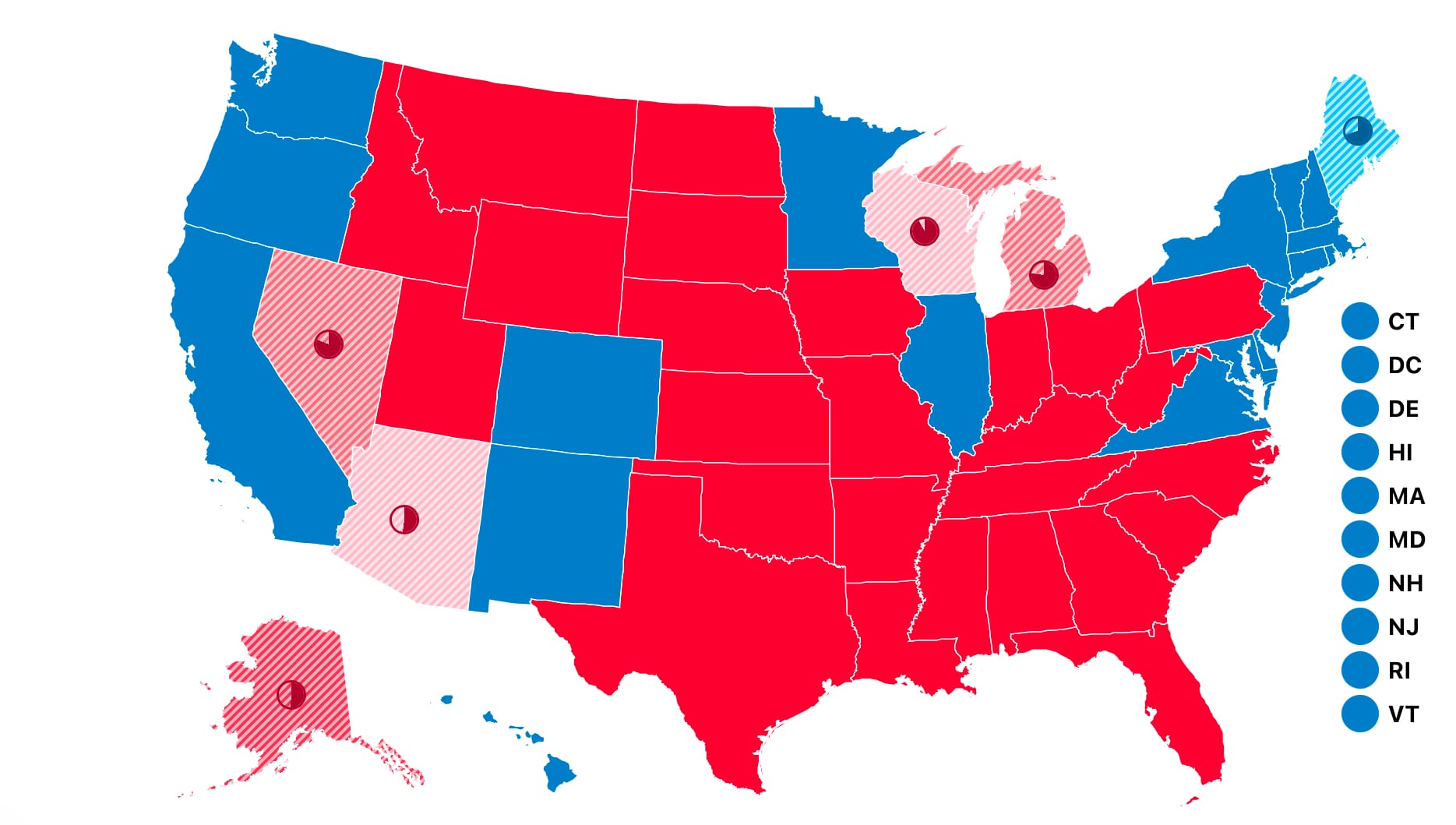
If, after reading my last entry, you remain unconvinced that we are already in dangerous territory, here’s Erin Reed’s Post-Election 2024 Anti-Trans Risk Assessment Map that shows the states where it is safe—or extremely dangerous—to be LGBTQ+.
Twenty-six states have anti-LGBTQ+ legislation. Florida and Texas, unsurprisingly, are the two worst, earning a “Do Not Travel” rating.
Whether you are yourself trans, have trans friends or family, or are simply a decent human being, it’s impossible to ignore the existential threat the new administration poses. Not just because of the awful laws they will certainly look to enact in the future, or because of the protective laws they simply won’t enforce. It’s because of the permission it will give—and already has given via its 2016 incarnation—to states, municipalities, and individuals to do their worst. All politics is local, and the incoming administration doesn’t need to enact a single damn law to make life for the LGBTQ+ community even more dangerous than it already is[1].
Sixteen states, incuding California, Hawaii, and Minnesota, recognize the threat and have enacted strong protections, including shield laws that ensure access to transgender healthcare. Many LGBTQ+ people are moving into those states to cloak themselves in a mantel of security. I’m grateful these states are willing to take a stand. I hope it’s sufficient.
This is also true for abortion rights, gender and racial equality, global warming, international incidents, financial markets, etc. “Doing nothing” is as much a path to destruction as any specific law that may get passed. ↩︎
My partner and I first broached the possibility that we might need to flee the country last summer. After election day, we began that preparation in earnest.
There’s a lot we don’t know. The incoming administration has threatened to do a lot of terrible things to transgender people; withholding medication; legislative erasure; forced detransition; mass incarceration; extermination. Many of these things, I’d want to stay and fight through. Others would make daily life impossible or unbearable.
She and her partner went through several scenarios that might push them to fight, or force them to flee, and she’s shared a template to help others think through their decision points.
She also shared a long list of existing anti-trans legislation and rhetoric from politicians. It’s terrifying to realize we’re already deep into dangerous territory; it’s not theoretical, or, as Haste titles that section, “These Things Are Already Happening. You are not overreacting.”
I’ve been wondering recently when the people who survived the Holocaust—because they fled Germany and elsewhere—decided it was time to leave. How bad did it get before they packed up their belongings and left their homes, family, friends, and country behind?
Right now, five weeks after the election, and five weeks before the next administration takes control, it feels both too soon and the absolutely right time to start thinking about an exit plan if you or a loved one are vulnerable.
At some point it may be too late. We might only recognize that moment in retrospect.
An all-too-brief origin story about one of my favorite drinks, sorrel, from culinary historian Ramin Ganeshram in Imbibe:
Our folklore tells us that the first sorrel maker was Anansi, the trickster spider, a character from the Akan storytelling tradition. Anansi traveled from Ghana to the Caribbean with enslaved people, and was adapted based on local traditions. Anansi, the story goes, steals a stalk of roselle hibiscus, flings it into a pot of boiling water with sugar and spices (including a native Caribbean addition, allspice), and tries to pass it off as wine. When villagers don’t believe him, Anansi cries, “It is so real!” What they hear is “It’s sorrel,” and so the drink and the name were born.
The truth of the name is a darker story. As violence stripped enslaved people of their cultural identities and languages, the drink called bissap in Senegal, zobo in Nigeria, and zobolo in Ghana became known as “sorrel,” a pidgin form of roselle.
Ganeshram also drops this nugget:
In the last 12 years, bartenders have come to know an elegant form of this heritage Caribbean drink in Sorel, the liqueur made by Jackie Summers (whose mother's parents emigrated from Barbados) and his company, Jack From Brooklyn. Made with roselle flowers from North Africa, Sorel is the most awarded liqueur in American history, with more than 200 accolades in the gold or better category. It's a smooth, complex brew that subtly and consistently marries the flavors of traditional sorrel without the home-brewed inconsistencies that can make it too sweet or sour, or too heavy on certain spices.
I’ve enjoyed Sorel for years and had no idea it was so well-appreciated by others.
Everyone’s hair is on fire because a president pardoned his son. Unprecedented? Sure.
Early this morning, I came across an Esquire article from Charles P. Pierce in Apple News+, headlined:
A President Shouldn’t Pardon His Son? Hello, Anybody Remember Neil Bush?
The deck was as straightforward:
Nobody defines Poppy Bush’s presidency by the fact that he pardoned his progeny. The moral: Shut the fck up about Hunter Biden, please.
The article included the following paragraph (emphasis added):
But the luckiest thing about this lucky American businessman is that his father and brother were both presidents of the United States, and that his father exercised his unlimited constitutional power of clemency to pardon The Lucky American Businessman for all that S&L business way back when. The president’s name was George H.W. Bush. The Lucky American Businessman was his son, Neil, whose brother, George, later became president of the United States himself.
I bookmarked it, prepared to post an update to my “unprecedented” comment, but in tracking down the direct web link, I instead got a “Sorry, this story isn’t available in Apple News” error.
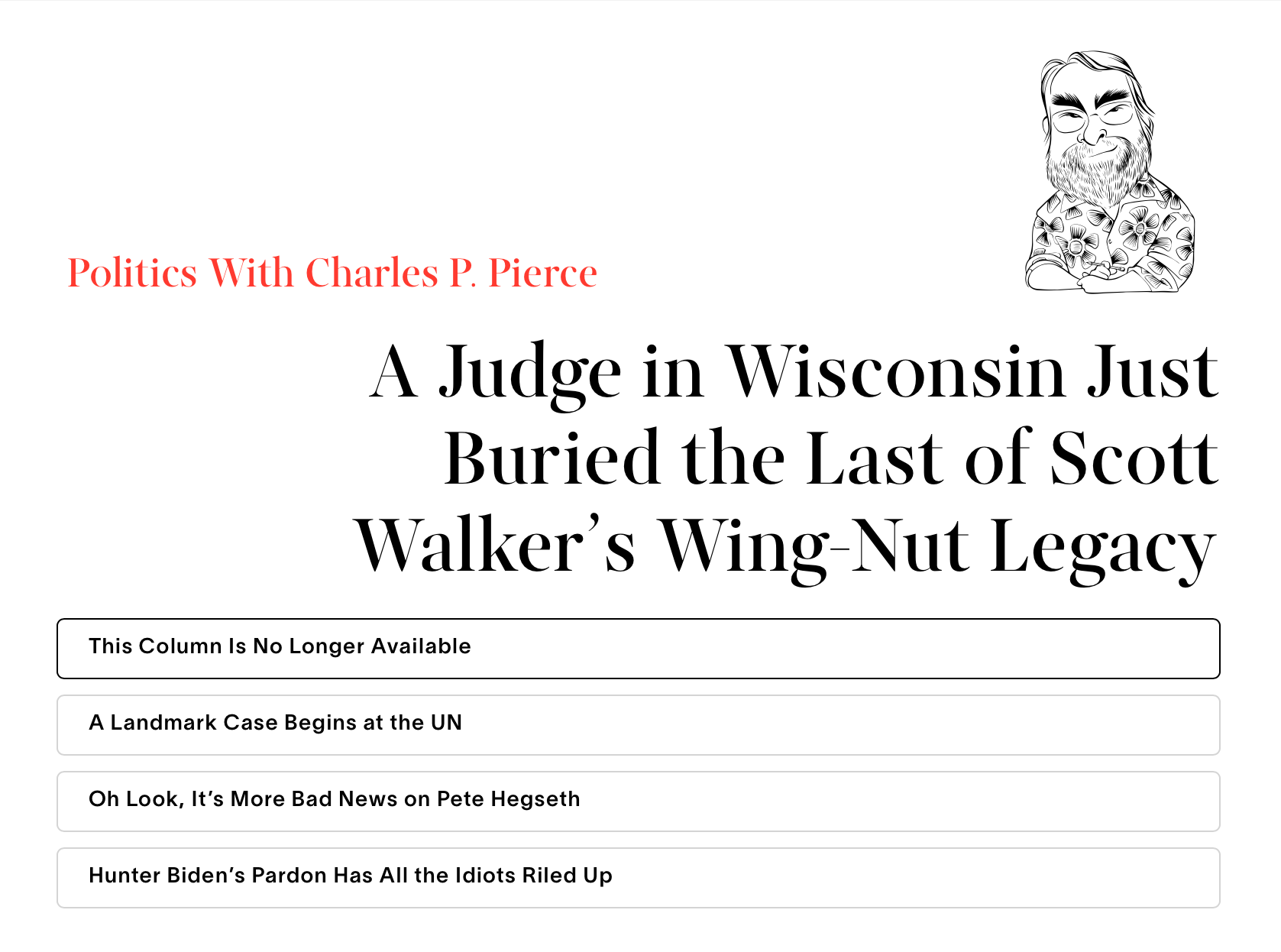
Hm. The article was still available in Apple News+ when visited it directly, but both the headline and the deck were now changed. It now read:
Hunter Biden Isn’t the First Presidential Son Caught Up in Controversy. Anybody Remember Neil Bush?
Nobody defines Poppy Bush’s presidency by his son’s struggles or the pardons he issued on his way out of the White House. The moral: Shut the fck up about Hunter Biden, please.
It includes an Editor’s Note:
Editor’s Note: This story has been updated. An earlier version stated incorrectly that George H. W. Bush gave a presidential pardon to his son, Neil Bush. Esquire regrets the error.
The paragraph I quoted also removed the reference to a pardon:
But the luckiest thing about this lucky American businessman is that his father and brother were both presidents of the United States. The president’s name was George H.W. Bush. The Lucky American Businessman was his son, Neil, whose brother, George, later became president of the United States himself.
On the Esquire Politics site simply pulled the article, giving it a title “This Column Is No Longer Available,” with the content of article itself also replaced by an Editor’s Note.
It appears Pierce, the article’s author, got caught spreading misinformation, possibly originating on Threads (archive). The Threads post itself now has a Community note linking to a fact-check.
I wanted to believe that H.W. Bush had pardoned his son—and no one has thought about it since—because I also believe Hunter Biden’s pardon would have absolutely zero impact on President Biden’s legacy.
I’m not sure if Pierce wrote the story based on the misinformation, or added the “pardon” bits to an existing story.
Either way, it’s a reminder of the importance of double-checking what you read, especially when it validates your own viewpoint.
President Joe Biden, in a direct and unapologetic statement:
Today, I signed a pardon for my son Hunter. From the day I took office, I said I would not interfere with the Justice Department’s decision-making, and I kept my word even as I have watched my son being selectively, and unfairly, prosecuted.
When the news broke Sunday evening that President Biden pardoned his son, Hunter, my first thought was good for him. I also knew I’d awake to a string of pearl clutching.
Sure enough, the deluge of denunciations came fast and furious. Almost every story led with the “reversal” of President Biden’s “previous pledges” to not pardon his son, with the “hypocrisy” of his decision “sparking backlash.” Republicans called him a “liar”, Democrats were “disappointed.”
I can’t get into President Biden’s head, but I think that once Trump won, a pardon was a fait accompli. I’m sure the prosecutors knew that, too, at least at some level. There was no way he’d let his son twist in the wind ahead of a vindictive incoming president who nominated Matt Gaetz/Pam Bondi as Attorney General and Kash Patel to lead the FBI. He may have “broken” his promise, but I believe that promise was made under very different circumstances, before the American public elected a criminal. At this point, I think there’s a bit of “fuck it” happening, and I’m OK with that.
I’m only surprised that he did it now, and not at 11:59 a.m. on January 20, 2025, as a massive, Dark Brandon middle finger to the incoming administration.
If Donald Trump’s children were facing jail time, is there any doubt in your mind that he would immediately use his one incontrovertible power as president and pardon them? Heck, I suspect he might do it preemptively as soon as he’s sworn in, just in case.
May I remind you that Donald Trump pardoned his daughter’s father-in-law four years ago, and then, last week, nominated him as ambassador to France?
Beyond that, Trump has a litany of self-serving pardons. I don’t recall the Right raising a ruckus about it four years ago.
Everyone’s hair is on fire because a president pardoned his son. Unprecedented? Sure. But only because the president’s son was prosecuted for a crime few other people would be charged with. As Biden notes in his statement:
Without aggravating factors like use in a crime, multiple purchases, or buying a weapon as a straw purchaser, people are almost never brought to trial on felony charges solely for how they filled out a gun form.
From that previously linked list of Trump pardons and commutations:
The rapper Kodak Black […] was granted a commutation. In 2019, he was sentenced to nearly four years in prison for lying on background paperwork while attempting to buy guns.
[Black] admitted to lying on background check forms while buying multiple firearms […].
Prosecutors said two of the guns were later found by the police at crime scenes, including one — with Black’s fingerprints and a live round in the chamber — that had been used to fire at a “rival rap artist.” […]
Another weapon was discovered in the trunk of a car as the rapper and his team attempted to cross the Canadian border into upstate New York in April. Black was charged with unlawful possession of marijuana and criminal possession of a firearm.
The underlying crimes are superficially similar. If Trump can commute a stranger’s sentence in this situation, why shouldn’t President Biden pardon his son for a less serious version of the same basic crime?
Unsurprisingly, the New York Times has the pearl-clutchiest of takes. Under the hed “Broad Pardon for Hunter Biden Troubles Experts,” writer Kenneth P. Vogel suggests the pardon
[…] is raising awkward historical comparisons and sharp questions about the use of presidential clemency.
Vogel then quotes one of those experts:
“It is extraordinarily hazardous to use the pardon power in a case where the person is an intimate of the president,” said Aziz Z. Huq, a professor at the University of Chicago Law School.
It’s unclear why the good professor believes this, providing no evidence to support his belief, only that:
[…] President Biden’s pardon of his son “really does strike at the rule of law.”
Except it doesn’t. The president has the absolute authority to issue pardons, which Vogel himself immediately notes:
Presidents have unchecked authority to issue pardons, which wipe out convictions, and commutations, which reduce prison sentences.
We may not like how some have used that authority, but it is very much within “the rule of law.”
I’m not big on bothsidesism, but in a world where the president-elect is a convicted felon and adjudicated rapist, who was granted “presidential immunity” by a stolen Supreme Court, and who successfully ran out the clock on his own prosecutions, I’m perfectly comfortable with President Biden exercising his power as a president, and as a father.
The hypocrisy of the Right and everyone else handwringing over this is staggeringly vomitous. Their side has—and will do—much, much worse.
Now, I’d like for President Biden to take it a million steps farther, and offer preemptive pardons and commutations to everyone incarcerated for minor drug offenses, sitting in jails pending bail, and all the people the president-elect has suggested will be targeted by his incoming “Justice” Department. To quote Keith Olbermann:
Literally offer a pardon to anybody Trump might go after for prosecuting him, criticizing him, covering him, or looking at him funny. I want a 1-800-PARDONME hotline. I want 10 million pardons.
After all, if the President’s decision to pardon his son will, says the reliably execrable Jonathan Turley,
be a decision that lives in infamy in presidential politics.
he might as well go all the way. He’s got nothing to lose.
I’m visiting my mom, sitting on my bed with my Vision Pro, legs stretched out in front of me while scrolling through immersive images, and marveling at how good 2D-converted-to-3D photos look. The room has a door to the left and a blank wall to the right.
I’m flipping through images, and suddenly I’m in the bedroom at my home, 2,500 miles away. There was the bedroom door to the left, slightly ajar. The bathroom door to my right, light shining through. Air purifier on the floor. For the briefest of moments, nothing felt odd. I was on my bed at home. I’ve seen this view through my Vision Pro dozens of times.
Then my brain flipped out as it realized I wasn’t looking at reality. The bathroom door wasn’t there. The glowing blue light of the air purifier wasn’t there.
The photo aligned perfectly with the room I’m in: a door where a door was; the bathroom door to the right filling in the blank wall, and the bed, stretched out before me.
I stared at the photo for several seconds trying to figure out what was actually real and what wasn’t. Even though I knew where I was and what I was looking at, I had to lift the Vision Pro to confirm my surroundings.
It was surreal.
The Vision Pro has several issues. It’s expensive. It’s heavy. It stresses my eyes. There aren’t enough compelling apps and content yet.
But goodness, it absolutely nails that tangible sense of being there.
It’s not without some mild reservation that I note the 18th anniversary of the release of the Nintendo Wii. One of my favorite gaming systems is now an adult.
The Wii hit the shelves on November 19, 2006, and quickly became the biggest holiday gift. Waiting lists—and the lines of people wanting to buy—stretched long. People who were lucky enough to reach the front of those lines would sometimes buy two or three and sell them at absurd markups.
In honor of Wii’s birthday, let me tell you the story of how my good friend Torrey Walker (aka THW) made my Christmas that year.
I first wrote about this as it happened in my now-defunct personal blog. Here are those entries (lightly edited for length and clarity).
It started just a few weeks after the release, just as the frenzy was reaching fever pitch.…
December 05, 2006: Don’t Buy A Wii
I must implore you: Don’t buy a Nintendo Wii.
As you’ve no doubt heard, both Sony and Nintendo have new gaming systems this gift-giving holiday season, Sony with its sequentially named Playstation 3, and Nintendo with its oddly named Wii.
When I younger, and more dexterous, I loved playing video games. I owned a Playstation and SuperNES; I now own a PS2 and Nintendo GameCube. But I don’t play anywhere near as much as I used to, so the thought of buying a new video gaming system didn’t catch my fancy. Especially one that costs $600 (PS3) or was a minor advance graphically (Wii).
My friend Torrey, though, is an avid gamer, to the point where he stood in line to buy a Wii. Me being the curious sort, and him being the generous type, he brought his Wii over to share with [my then-girlfriend] Ying and my friend Elliot.
We played with Wii for several hours, and it was an absolute blast; from the clean and minimalist Apple-like design, to the Wii-mote (the wireless Wii remote controller), to the surprising physicality of the Wii Sports games.
Ah, the games. Wii comes bundled with a sports pack: Bowling, Tennis, Boxing, Golf and Baseball. You use the Wii-motes as you would use the appropriate sports implement: with Bowling, you pull your arm back and roll it forward as if you were releasing a bowling ball; with Tennis, you swing as if you had a racquet; with Boxing, you hold them in your fists and punch; etc.
Of course, these are video games, and you would expect that you’d be sitting on your couch, waving these Wii-motes around and jamming buttons, but no: we found ourselves getting into the physical motions of playing the games. We’d swing the Wii-mote like we really had a tennis racquet in our hands, even though a sharp wrist flick would be enough. Or we’d deliver huge roundhouse punches in Boxing, even though fast jabs would get the job done.
Both Elliot and Ying were especially interesting to watch. Elliot really got into Tennis; he was leaping back and forth across the floor, reaching for the balls as they whizzed past him. Ying took Boxing to heart, punching and jabbing like her life depended on it, and working up a sweat.
In fact, that would be the hallmark of the Wii afternoon: by the end of the day, all four of us had gotten some amount of physical activity we would not have gotten if we were playing any other video game. That’s right, a workout. Elliot, Ying and I all “boxed” for 15 or 20 minutes, and by the end of it, not only had we started sweating, we actually felt pain in our shoulders and arms!
From a video game!
By the time Torrey was re-boxing the Wii, I was already considering buying a new video game system. I concluded my initial review:
So again, I must beg of you: don’t buy a Wii. If this post tempted you, resist. If you find yourself in a Toys ‘R’ Us or Wal-Mart, and you see that gleaming white rectangle sitting on the shelf, you don’t want it.
But do me a favor will you? Hold on to it and give me a call, OK?
Two weeks later, things escalated.
December 17, 2006: A Wii Bit of Madness
It’s 5:30 on a Sunday morning, and I’m about to go stand in line for a Nintendo Wii. What am I, crazy?
Indeed, I was clearly suffering from Wii-thdrawal after playing with the system but not having one of my own, so I figured I had to at least try to get a Wii. It didn’t go as I’d hoped.
[Ying and I] have returned from our Wii excursion, and other than memories of long lines and cold people, we are empty-handed. We visited ten locations (which includes repeat visits to one), and each store had a line longer than we could have imagined.
Waking up at 5:30 am was, it turns out, an amateur move.
We happened to be [at Westgate Mall Target] last night about 8pm, and three families had already lined up (one at 6pm) for an 8am store opening. When we returned this morning, about 7am, the line was over 100 people, for a store claiming 100 units.
Had we decided to stand in line at 8pm the night earlier, we would have come home with a Wii. Ah, Wii-grets.
Ying is a little disappointed by the lack of Wii; she’s second-guessing her decisions to wake up at 5:30, to go to certain stores in a certain order, etc. For me, it was more of an experiment. It was interesting to see which stores had longer lines, and how many people were willing to brave the cold (37 degrees, by my car’s gauge) for a game system.
I’m willing to wait until the excitement subsides a bit.
Yep, I’d pretty much Wii-signed myself to not owning a Wii for weeks, possibly months, and I was OK with that.
Then Torrey Did A Thing.
December 20, 2006: THW comes through, Wii is in the hizz-ouse!
In 1984, my mom woke me up early Christmas morning. Sitting next to my bed was the unopened box of an Apple //c computer and monitor. My uncle owned one of those, and I’d spent time at his house hacking with it. He’d once promised he’d bring it over to my house so I could have more time with it. Even in my sleepy state, when I saw the box, my initial shot of excitement was quickly replaced with cold logic: “What’s my uncle’s computer doing here?”
I was told nope, it’s not your uncle’s, it’s yours, and it’s your Christmas gift.
I believe the ceiling still has an imprint of my head, and the floor a dent from my jaw [from] the extremely unexpected present.
Today, THW sent me an email.In today? What time can I stop by to say hi? I’m leaving... tomorrow and won’t be back until just before New Years. /thw
Stop on by, I told him. I figured we’d BS for a few minutes, catch up on what’s been going on the last couple of days, chat about plans for the holiday break we’re about to start. You know, typical friend stuff before you don’t see each other for two weeks or so.
In he walks. We chat about two minutes before he steps back outside my office, and I hear some rustling of plastic. He steps back in and hands me a white box with “Wii” written on it in huge letters.
Let me go through my thought process here.
On seeing it: Fucker! You got a me a gift and put it in a Wii box? That’s cold.
On holding it: It’s heavy.... Oh! You’re loaning me your Wii for the week you’ll be away. That’s fucking sweet. What a good friend.
I thanked him for loaning it to me, and he says, nope, that’s yours. That’s your Christmas gift.
I couldn’t quite get my mind around it. You’re giving me your Wii?
“No”, he says (silently adding “you idiot”, I imagine), “it’s yours.”
Through a series of circumstances, he had an extra one. When he read my entry about waking up at 5:30 to stand in line, and coming back empty-handed, he made his decision: as his Christmas gift to me, he would sell me his extra Wii. I guess he decided that getting up that early to buy one was a worthy endeavor, and instead of making beaucoup bucks scalping it on eBay (as he rightly could), he decided to sell it to me.
Wow.
Last Saturday, when Ying and I had decided to wake up early the next day, I called Elliot, and offered him the chance to buy a Wii, should we find ourselves lucky enough to find two. He declined, but was touched that I would give up a potential financial benefit for him. I didn’t quite understand it at the time. He’s my friend, and of course if I’m buying a Wii I’ll pick up a second one for him.[…]
Now, I get it. What Torrey did was a selfless act. Not in the same realm of giving up a kidney or the last taco, but still remarkable. He passed up the chance to make money so his friend could have a Wii-filled vacation. I was actually tearing up a bit when he [handed] it to me.
Unsurprisingly, I still have that Wii, and it was a source of joy for many years. While I haven’t played it in a long while, it—and the hours and hours of fun it generated over the years—remains a treasured touchtone of my friendship with Torrey.
Thank you Torrey for that unforgettable act of friendship, and Happy Birthday Wii!
The satirical news outlet the Onion has purchased Infowars, the rightwing media platform run by conspiracy theorist Alex Jones, at a court-ordered auction.
“[T]he head of the Onion’s parent company” is one “Bryce P. Tetraeder”, Global Tetrahedron CEO, who explained his reasons for the purchase on The Onion:
All told, the decision to acquire InfoWars was an easy one for the Global Tetrahedron executive board.
Founded in 1999 on the heels of the Satanic “panic” and growing steadily ever since, InfoWars has distinguished itself as an invaluable tool for brainwashing and controlling the masses. With a shrewd mix of delusional paranoia and dubious anti-aging nutrition hacks, they strive to make life both scarier and longer for everyone, a commendable goal. They are a true unicorn, capable of simultaneously inspiring public support for billionaires and stoking outrage at an inept federal state that can assassinate JFK but can’t even put a man on the Moon.
Through it all, InfoWars has shown an unswerving commitment to manufacturing anger and radicalizing the most vulnerable members of society—values that resonate deeply with all of us at Global Tetrahedron.
This both is, and isn’t, “an Onion story.”
The (supposedly real) CEO of The Onion, Ben Collins, wrote on Bluesky[1]:
Hi everyone.
The Onion, with the help of the Sandy Hook families, has purchased InfoWars.
We are planning on making it a very funny, very stupid website.
We have retained the services of some Onion and Clickhole Hall of Famers to pull this off.
I can't wait to show you what we have cooked up.
InfoWars was already “very stupid” so they only need to make it “very funny.” I have faith they can do that.
(Collins also included a link to a New York Times story as—I suppose—confirmation this wasn’t “an Onion story.” He should have chosen a more reputable site.)
His Bluesky name, “Tim Onion,” is a swipe at Donald Trump, who once called Apple’s CEO, Tim Cook, “Tim Apple.” I would have expected “Ben Onion” though. Perhaps that’s why I don’t run a globally beloved satire site. ↩︎
News: the 4th edition of The F-Word is coming out in two weeks from Oxford UP! Everything you could want to know about the word fuck.
This is a major revision: 500 pages with 150 new entries, 150 antedatings, & 2,500 new quotations.[…]
I already own the second edition, purchased in 2001, and it was one of the most fun reads I’ve ever had. I laughed my fucking ass off thumbing through it, all the while learning about my most-used expletive. I pre-ordered the fourth edition immediately, and it arrived today. Alas, it’s 25-fucking-hundred miles away from me, so I’ve had fuck-all chance to read it. Fuck.
The F-Word is a historical dictionary devoted to the word fuck, including all parts of speech, compounds, phrases, and certain euphemisms. A “historical dictionary” means that, like the Oxford English Dictionary, it illustrates every sense of every entry with quotations, from the earliest that can be found to a (relatively) recent example, showing exactly how the word has been used throughout history.
And:
This new, fourth edition (2024) is not just a minor update but a comprehensive revision. The fourth edition includes over 2,500 new quotations; over 150 new entries; and over 150 antedatings—earlier examples of existing entries, improving our understanding of the word’s development. Major new discoveries push back the known history of fuck by almost 200 years.
Sheidlower was an editor for the OED, so he understands comprehensive dictionaries, including the importance of antedating entries:
Many antedatings represent significant improvements in our knowledge of the word's history. The expression for fuck's sake, previously first recorded in 1943, is now known from 1922; fucked 'crazy' has been improved from 1971 to 1951, fuckload from 1984 to 1970, headfuck 'something that causes confusion' from 1993 to 1976, ratfuck 'a frenetic social event' from 1979 to 1969. In particular, research into early erotica has resulted in a number of major antedatings. The noun ass-fuck, previously first found in 1940, is now recorded in 1874; dogfuck has been improved from 1980 to 1867, face-fuck from 1972 to 1899, fuckstick 'the penis' from 1973 to 1904, mouth fuck from 1954 to 1868, and tongue fuck from 1974 to 1902.
It’ll be fucking great. I hope it sells a fuckton.
Nitish Pahwa, in a Slate piece densely packed with receipts:
Now that Trump is headed back to the White House, with X’s Elon Musk in tow, there is not even a pretense of hope on that platform for anyone who voted against Trump. It’s better late than never, but it’s well and truly time to cut X loose.
Maybe it seemed, once, that a spirited internal resistance could effectively limit Musk's damage and preserve some of the prior spirit of the microblogging platform that writers, public agencies, and other creative types had come to depend upon. I honestly cannot tell you what exactly was my justification for maintaining a Twitter/X presence, even as I explored other social media outfits and publicly acknowledged that Musk's regime was repellingmasses of tweeters, boosting easily debunkable disinformation, shedding all of X's remaining utility for journalists, bullying transgender users, spreading straight-up white-supremacist rhetoric, and influencing CEOs in every other field to become as domineering and unapologetic as Musk is, whatever the backlash.
I refuse to fuel Musk’s algorithms with my content and attention. I started winding down my participation in October 2022 (after first trying to do so in 2018). I had several “professional obligations” on it at the time that made it impossible for me to fully disengage, but once those obligations no longer existed, I stopped posting on X/Twitter, and only read it when someone links to something over there.
(I then bleach my eyeballs, because yeeech.)
The only people still in the Nazi bar either are Nazis, like Nazis, or enjoy debating Nazis; or who—despite all the Nazi insignia, salutes, and propaganda surrounding them—still don’t believe they’re in a Nazi bar. Perhaps they’re busy nursing their carefully curated follow list in a back corner, and haven’t realized how many of their not-Nazi friends already left or are grabbing their coats. Or their friends are waiting on them to rise and head for the door so they can follow.
Or, perhaps, they don’t know better bars exist.
Today, the three meaningful alternatives to X/Twitter are Bluesky, Threads, and Mastodon. I chose Mastodon, because it’s because it’s not owned by any (billionaire) individual, and it’s where most of my (generally geeky) people are. It’s big advantage is it’s decentralized: there are multiple servers talking to each other rather than one single, central server. A benefit of this is you can join a server based on topic or affinity (e.g. technology, journalism, or activism). The biggest downside? It’s decentralized, which requires you to choose a server (in the way you choose an email provider) with no easy way of comparing them, and the getting started process can be arduous for many non-techie folks.
More and more people are moving from X/Twitter, some 700,000 in a week to Bluesky alone, according to Jay Peters at The Verge:
Bluesky gained more than 700,000 new users in the last week and now has more than 14.5 million users total, Bluesky COO Rose Wang confirmed to The Verge. The “majority” of the new users on the decentralized social network are from the US, Wang says. The app is currently the number two free social networking app in the US App Store, only trailing Meta’s Threads.
That’s the second large influx recently:
The independent platform has seen a lot of growth in recent weeks — on October 24th, Bluesky announced it had 13 million users. After X’s recent announcement that it would let blocked users still see posts from the person that blocked them, for example, Bluesky said it added 500,000 new users in one day.
Many friends are happy on BlueSky. Some prefer Meta/Facebook’s Threads (though I’m not a fan of Mark Zuckerberg any more than I am of Elon Musk). I have accounts on both, mainly as a hedge, in case someone I really care about is active on one of them.
The Verge offers more specific advice on how to leave X/Twitter, including taking your account private, downloading your content, and eventually deactivating your account completely.
Regardless of which new social network you choose, it’s important to start the process now. The best time to leave a Nazi bar is the day it becomes one. The next best time is today.
It’s an odd feeling to be—in even a small way—celebrating seven years as an American citizen, just days after American democracy gave us, for the second time, a Donald Trump presidency.
Yet it is also fitting, as the reason I became an American citizen seven years ago was because American democracy gave us, for the first time, a Donald Trump presidency.
In 2016, despite living in America for thirty-five years, I wasn’t ever motivated to pursue my citizenship. There was no real reason, merely inertia. Lack of citizenship never stopped me from doing anything: As a permanent resident I could work legally, had most of the protections of being a citizen, and while I wasn’t always thrilled with the people America elected (hello Reagan, Bush, and Bush), the impact on my daily life was minimal.
For my first decade or so in the U.S., I didn't care much for politics, and didn't really identify with a political party.
I only really started paying attention to politics during the Clinton administration. Because politics wasn’t huge in my life, neither was voting. I came close to applying for citizenship as I tracked Barack Obama’s rise—from a junior senator speaking at the DNC, through his historic nomination, election, and reelection—but the inertia was powerful. I deeply regret missing the opportunity to vote for him, or to be naturalized under his presidency.
After eight years of Barack Obama, I was excited by the possibility of following our first Black president with our first female president, but my first hint this wasn’t the timeline I thought it was came on February 16, 2016. I wrote in Day One:
Tonight, I fear for America.
Donald Trump won the Republican New Hampshire primary. […]
Trump would be an unmitigated disaster, and it’s going to ensure that I have my citizenship, so I can leave the country for more than six months at a time....
I wonder if there’s any chance of my getting it in time to vote?
It wouldn’t have been enough time, but it didn’t matter: I didn’t start the process.
Then this, on March 8:
It’s Time.
Trump has won Michigan and Mississippi. He won Michigan with over 37%; his nearest competitor is Kasich with 25% and Cruz with about 24%. He won Mississippi with 49%, with Cruz at 35%. This terrifies me. Trump has a legitimate shot at the nomination, and the presidency.
I’d finally started the process, but there was no real urgency. I had faith in the American democratic system, and, like many people then (and many people this year) I was certain beyond any doubt Trump could not possibly win. I could wait, and would get to be naturalized under America’s first female president.
Yeah.
January 19, 2017:
Awake in a Marriott in Annapolis.
The end of Barack Obama’s administration is near and I’m sad and scared.
I never completed my citizenship papers and a small part of me worries it won’t go through.
Also sad that I’d be sworn in under Trump.
Sad indeed, but not enough to allow that distasteful prospect to deter me. His inauguration was the motivation I needed to finally complete the process: I felt it necessary to cloak myself in the protections of American Citizenship.
February 2, 2017:
Just mailed my citizenship application. I’m slightly short of breath.
I had a biometrics appointment a month later, and on August 30 I went in for my in-person interview, where they assessed my English reading and writing ability, along with my knowledge of U.S. history, the Constitution, and current politics.
The interview was a little nerve-racking, mostly because I feared vapor-locking while answering the civics questions, but I got through them with no issues.
At the end, the interviewer handed me my result form, with a big “X” next to “Congratulations! Your application is recommended for approval.” I unexpectedly choked up when he wished me luck, and only barely kept my emotions in check as I rose to leave.
I went home and poured myself the most American of spirits, bourbon—Jefferson’s Reserve, a hat-tip to our founding fathers.
Then, on November 9, 2017:
American Citizen!
So here I am, seven years after Donald Trump’s first inauguration, celebrating my citizenship and my right to vote, just days after millions of other Americans exercised theirs to vote for Donald Trump. Again.
It’s just after 4 a.m. on the East Coast as I post this, and I haven’t been able to sleep because it’s now clear that Donald Trump will again be president of the United States.
While it hasn’t yet been officially called by the AP or others, Trump sits at 267 Electoral College votes, with AK and its three electoral votes the only thing standing between him and victory. I suspect by the time the sun breaks over the Atlantic Ocean, Trump will have been declared the winner, with as many as 312 electoral votes.
What has become of this country?
Tens of millions of my supposedly “fellow” Americans consciously chose a demagogue and the vile hatred he and his followers represent. They knew the nastiness he offered, and they wanted it.
I admit that in my heart of hearts I was hoping for a Harris landslide, a blowout victory that repudiated MAGA politics. Instead, Trump has solidified his grasp on this country (when you’re a star, they let you do it).
Don’t ever tell me again this country isn’t deeply racist and misogynistic.
This election was about power: Who has it, who wields it, and who benefits from it.
Americans voted for their own self-interest: To keep themselves at the top of the food chain.
They understand that being a white male makes you untouchable, and being a white female confers the privilege of white men upon you.
A significant number of Latino voters also aligned themselves with Trump, perhaps out of a misguided attempt at self preservation, but equally likely out of an anti-immigrant “fuck you, I got mine” mentality.
I’ve seen a lot of people on Mastodon (and I’m guessing across most social media) saying they’ll fight Trump for the next four years.
Cool cool cool.
What makes them think he’ll allow that fight? Where will they take it? The courts? The press? Congress? The streets?
They have a lot of faith in the strength of institutions he’s pledged to destroy—or which have already capitulated well before his election.
The Supreme Court has granted him immunity. The press already has demonstrated deference. Congress will be a feckless lapdog. And protesters in the streets are likely to be met with a military presence—whether it’s U.S. military or Trump’s “Proud Boys.”
After what we’ve observed over the last decade+, and especially what Trump and his MAGA party have done and said they’ll do, what reason is there to believe he won’t shut down any protesters, with intimidation if not violence? We’ve seen it already.
And here’s a truth: Those with the energy to fight are often the ones who can just walk away from that fight without consequence.
The rest of us who can’t “blend in” are tired of having our souls crushed by an America we thought had our backs.
I’ve also seen people trotting out “we are better than this” and “this is not who we are”.
Bullshit.
It’s time to retire both phrases. We’ve proven we’re not “better than this.” We’ve shown this is “who we are.”
It’s been true for a long while, but there was always some amount of plausible deniability. It’s pretty damn hard to deny it now after this electoral outcome.
On January 20, 2025, Donald Trump gets sworn in for the second time. On that day, I expect The Great American Experiment will come to an end.