The headline for this New York Times piece by David W. Chen (“Crime Festers in Republican States While Their Troops Patrol Washington”) was sharper than I’ve come to expect from the newspaper. I anticipated a piece deeply critical of the administration’s obvious pretense that “high crime rates” in D.C. and other “blue cities” were a legitimate justification for deploying (or threatening to deploy) armed National Guard troops to them, when many “red cities” had equally high (or higher) crime rates. I contemplated a condemnation of the conspicuous fiction, and a call for the deployments to end.
But it’s the New York Times, so instead we got the same mealy-mouthed, what’s-good-for-the-goose bothsiderism they’ve been publishing for years:
When Tennessee’s Republican governor, Bill Lee, dispatched his National Guard troops to Washington to support President Trump’s crackdown on crime, Democrats and other critics wondered why he didn’t keep them within state lines.
Memphis, after all, has long been one of the most dangerous cities in the country, with a murder rate about twice as high as the nation’s capital, according to F.B.I. statistics. Nashville has a higher rate of violent crime than Washington as well.
The same questions could be asked of other Republican governors like Greg Abbott in Texas, Mike DeWine in Ohio and Mike Kehoe in Missouri, since cities under their purview all have higher rates of violent crime than the nation’s capital. Yet no Republican governor has asked for federal intervention.
In pretending to question the “high crimes” rationale for deploying the National Guard to blue cities, and suggesting they should be equally welcome in high-crime red cities, the Times is normalizing the idea of armed military—which Chen dismissively calls “supplementary forces”—patrolling American streets.
This will have the far right salivating: Yes, you’re right, they’ll nod thoughtfully. We should deploy troops to other cities, in a totally nonpartisan way. Even the liberal New York Times thinks it’s a great idea.
I’m used to headlines inaccurately reflecting the stories they top, but usually it’s the headlines that are terrible. Here we get a strong headline and an awful article.
Instead of fighting creeping fascism, this framing from the Times enables it.
Steve Hayden, the advertising copywriter who helped redefine the relationship between tech and culture through Apple’s legendary “1984” commercial and later rose to become vice chairman of Ogilvy, has died. He was 78. […]
Hayden, then a 36-year-old writer at Chiat/Day, conceived “1984” with art director Lee Clow. Directed by Ridley Scott, the Orwellian allegory introduced Apple’s Macintosh computer as a liberating force against conformity. The most famous ad ever made, “1984” aired just once nationally but became a cultural milestone, heralding both the age of the personal computer and a new era in brand storytelling.[…]
Hayden crafted the dictator’s speech based on quotes from Mussolini, Mao and Hitler […]
Hayden’s impact on Apple and the ad world is undeniable. RIP to an advertising legend.
(Via long-time Apple employee Chris Espinosa, who called Hayden “the best of the best.” He also shared Hayden’s 2019 Commencement speech at Interlochen Arts Academy, which Espinosa says “captures him, in all his love, humor, wit, and genius.”)
This is a must-read visual essay (subtitle: “How the Camera Was Used to Justify Black Racial Inferiority”) in Sacred Footsteps (“an online publication dedicated to spiritual & alternative travel, history & culture from a Muslim perspective”); it was one of the readings from Week 6 of Karen Attiah’s Resistance Summer School:
The myth of the ‘dark continent’, already well established in Europe by this point, was further cemented through photography, allowing existing stereotypes to be represented visually. If we look at a broad spectrum of colonial photographs produced in Africa (and this also applies to the Middle East and elsewhere), a visual vocabulary emerges.
Photography was used to emphasise the contrast between ‘light’ (civilised) and ‘dark’ (uncivilised). This ‘light’ was shown by contrasting skin colour and by emphasising power dynamics through dress and pose. […]
Meanwhile, at a sewing class in the Mission of the Daughters of Charity in the Belgian Congo (1910), the position of the white women, again dressed in white, with their hands placed on shoulders of those seated, emphasises their dominant status over the young women. Their manner is parental, infantilising those seated; the ‘white saviour’ trope captured on camera.
(The photo essay also references “lynching postcards” from the United States during the early 20th century, which were printed “for distribution, collection or kept as souvenirs.” These images show smiling men, women, and children who showed up to witness the murder of Black people the way you and I might enjoy an outdoor concert.)
The images, and the context behind them, are deeply disturbing, yet immediately recognizable for what they are:
The purpose of these images was, quite simply, to dehumanise Black people and proclaim the superiority of the white race.
I was especially struck by Leibovitz’s 2022 photo of Justice Ketanji Brown Jackson at the Lincoln Memorial, which completely de-centers Jackson while emphasizing Lincoln—she’s literally in the shadows, looking up at him. This was for a story about Jackson’s Supreme Court ascension, yet Lincoln hovered in the background.
I learned the term L’appel du Vide—or Call of the Void—this week while having lunch with my friend and former colleague, Matt, after describing a recent drive along the north Maui coast, where I steadfastly fixed my eyes on the center line to my left to avoid reflexively veering over the edge of the steep cliff on my right. It never occurred to me this was a well-known psychological phenomenon. NeuroLaunch explains it:
Have you ever found yourself teetering on the edge of a cliff, heart racing, palms sweaty, when suddenly a tiny voice in your head suggests, “What if I just… jumped?” Don’t worry; you’re not alone in this peculiar experience. In fact, you’ve just encountered one of the most fascinating quirks of the human mind, one that has puzzled psychologists and philosophers for generations.
The “Call of the Void,” or “L’appel du Vide” in French, is a term that describes those fleeting, often disturbing thoughts that pop into our heads in potentially dangerous situations. It’s not just about heights, either. Maybe you’ve had the sudden urge to swerve your car into oncoming traffic or to stick your hand into a whirring blender. These thoughts can be jarring, but they’re a normal part of the human experience.
The term was new to me even if the phenomenon wasn’t: I’ve experienced the “call” innumerable times. I’ve often found myself at the edge of a mountaintop or skyscraper, and the sensation that I might slip and fall—or catapult myself—into the unknown was overwhelming. My rubbery, tingling legs and suddenly racing heart would impel me to move away with alacrity. It’s one reason I thoroughly dislike roller coasters, and will never go skydiving or bungee jumping. As I always tell people, I’m not afraid of heights, I’m afraid of falling from them.
The seemingly irrational, but common urge to leap—half of respondents felt it in one survey—can be so disturbing that ruminators from Jean-Paul Sartre (in Being and Nothingness) to anonymous contributors in lengthy Reddit sub-threads have agonized about it. While the French philosopher saw a moment of Existentialist truth about the human freedom to choose to live or die, ramp_tram called it “F***king stupid” when he had to plaster himself to the far wall of a 14th-floor hotel atrium away from the balcony railing because “I was deathly afraid of somehow jumping off by accident.”
“Accidentally jumping” is a remarkably apt—if contradictory—description of how it feels.
That urge to jump, to swerve off a cliff, or to stick our hand in a blender is basically our brain—the amygdala, or “fear center,” and the prefrontal cortex, or decision-making center—gaming out dangers, firing off warning signals, and conjuring these scenarios in an effort to keep us safe. If we envision sticking our hand in the blender, we also imagine the consequences of doing so, making it more likely we will take extra care to avoid liquefying our extremities.
NeuroLaunch, again:
From an evolutionary psychology perspective, this phenomenon might actually be a survival mechanism. By briefly considering the worst-case scenario, we become more aware of the danger and more likely to take precautions. It’s like our brain’s way of saying, “Hey, pay attention! This situation could be dangerous!”
Unsurprisingly, I may have succumbed to one form of L’appel du Vide. While in a New York subway station, I removed my backpack and in doing so, knocked my glasses off my face and onto the tracks. The train, I’d noticed moments earlier, was nine minutes away. I judged the distance to the tracks (four to five feet) and decided I could get back up easily enough, so without further thought—and in some small state of panic, as I am virtually blind without my glasses—I leapt down, grabbed my glasses, and… struggled to get back onto the platform. To complicate matters, transit police were on the platform and had to pull me up. I was certain I would be arrested, but managed to avoid that particular ignominy. Only after I was safely back on the platform did the utter stupidity of my actions hit me: What if the train had arrived early? What if there was no one to help me back onto the platform? What if I’d forgotten which was the third rail?
I still shudder when I recall it. Perhaps, though, this wasn’t L’appel du Vide but another relevant French phrase: J’suis un putain d’idiot.
But I am more than a critic: I am a hater. I am not here to make a careful comprehensive argument, because people have already done that. If you’re pushing slop or eating it, you wouldn’t read it anyway. You’d ask a bot for a summary and forget what it told you, then proceed with your day, unchanged by words you did not read and ideas you did not consider.
I am here to be rude, because this is a rude technology, and it deserves a rude response.
He concludes:
I became a hater by doing precisely those things AI cannot do: reading and understanding human language; thinking and reasoning about ideas; considering the meaning of my words and their context; loving people, making art, living in my body with its flaws and feelings and life. AI cannot be a hater, because AI does not feel, or know, or care. Only humans can be haters. I celebrate my humanity.
The Centers for Disease Control and Prevention leadership was in stunning disarray Wednesday evening after the Trump administration fired the agency’s director hours after she refused to resign under pressure.
The director, Susan Monarez, said she was resisting being ousted by the nation’s top health official, Robert F. Kennedy Jr., for political reasons after about a month in office.
In linking up the story last night on the FDA’s updated COVID vaccine eligibility rules, I completely missed that the administration was also in the midst of firing the head of the CDC. According to White House spokesperson Kush Desai, Monarez “is not aligned with the President’s agenda.”
At least four top officials at the Centers for Disease Control and Prevention (CDC) submitted their resignations Wednesday, saying the recent changes and leadership at their agency are preventing them from fulfilling their duties as public health authorities.
RFK Jr. is an absolute disaster, and should himself be fired. But that won’t happen, because this entire regime is an absolute shit-show.
The FDA approved updated COVID-19 shots on Wednesday, but limited their use for many Americans, recommending them only for people 65 and older or those younger with a health condition that puts them at higher risk.
The FDA also removed one of the two vaccines available for young children.
People seeking the shots will soon face another hurdle. An influential advisory committee to the Centers for Disease Control and Prevention must vote to recommend them.
U.S. Health Secretary Robert Kennedy Jr. named eight members to serve on a key panel of vaccine advisers on Wednesday, including several who have advocated against vaccines, after abruptly firing all 17 members of the independent committee of experts.
They will sit on the U.S. Centers for Disease Control and Prevention's Advisory Committee for Immunization Practices, which advises the agency on who should get the shots after they are approved by the U.S. Food and Drug Administration.
The New York Times, again:
A decision by the C.D.C.’s panel is expected within a month, and it could greatly influence access to the shots at drugstore sites, which have become the most convenient places to get them. Laws in a number of states, including California, Pennsylvania, Florida and Massachusetts, require that pharmacy staff are only permitted to administer vaccines recommended by the C.D.C., said Richard Hughes IV, a lawyer who represents vaccine makers.
Tom Latchem at The Daily Beast on Monday (via Ken “PopeHat” White, who deadpanned “Government by drunk Thanksgiving uncle”):
The Trump administration will move to pull the COVID vaccine off the U.S. market “within months,” one of Robert F. Kennedy Jr.’s closest associates has told the Daily Beast.
Dr. Aseem Malhotra, a British cardiologist who has repeatedly claimed in the face of scientific consensus that the vaccines are more dangerous than the virus, told the Daily Beast that Kennedy’s stance is shared by “influential” members of President Donald Trump’s family. Like Kennedy himself, no Trumps hold any scientific qualifications.
One way to “pull the COVID vaccine” would be to make it virtually impossible for the average American to get it.
Again from the Times:
This would mark the first fall/winter season that Covid shots were not widely recommended to most people and children, pitting federal health officials in the Trump administration against several national medical groups that oppose the restrictions.
How many people will see their lives destroyed—or will die—because they weren’t “eligible” for a COVID vaccine? Kennedy and Trump will have blood on their hands.
The Supreme Court has repeatedly held that the First Amendment protects flag burning from prosecutions aimed at its offensiveness or its tendency to profane a national symbol. That’s a generation old.
Now the FedSoc mids in the Administration have a Bright Idea: what if we prosecuted flag burning not as flag burning but on theory that it falls under the “fighting words” or incitement exceptions?
Except this is not, in fact, a particularly good idea.The “fighting words” exception is defunct. It hasn’t been used by the Supreme Court to justify a speech restriction in living memory and it was specifically rejected as a basis to uphold flag burning laws.[…]
“Incitement” is dumb too. Incitement means speech INTENDED and LIKELY TO cause IMMINENT lawless action. That means “go beat up this guy.” It does NOT mean “hey I have an unpopular opinion.” Courts have not upheld “incitement” as a “heckler’s veto” […]
It’s easy to say why. Saying “you can prosecute flag burning as incitement because it makes people really mad” allows you to say “you can’t criticize Israel/denounce Trump/preach Islam/say reality TV suck because it makes people so mad.” It limits speech to what thug trash will tolerate.
He calls it a “performative decision, which is calculated to appeal to vapid totalitarian twats” and I couldn’t possibly improve on that description.
Cracker Barrel, in a statement on X/Twitter (via Josh Marcus at The Independent):
We thank our guests for sharing your voices and love for Cracker Barrel. We said we would listen, and we have. Our new logo is going away and our “Old Timer” will remain.
At Cracker Barrel, it’s always been – and always will be – about serving up delicious food, warm welcomes, and the kind of country hospitality that feels like family. As a proud American institution, our 70,000 hardworking employees look forward to welcoming you to our table soon.
I’m not surprised Cracker Barrel retreated from its rebrand in the face of a right-wing MAGA backlash. Down-home Southern hospitality is their brand, and the “anti-woke” activists who executed this contrived “controversy” really hate losing their white-coded imagery that buttresses their sense of superiority, from Uncle Ben to Aunt Jemima, and now, Uncle Herschel. They have excitedly embraced cracker—a derogatory term for poor, rural, white Southerners—because they are desperate for a return to a world where whiteness was an explicit advantage (rather than the implicit one we’ve lived with for the past 60 years), even when poor.
This manufactured furor brought to mind the first time I can recall hearing “cracker” used to describe a person. It was from my boss at my first IT job in New York, in the early ’90s. He was probably in his late 30s or early 40s, white, and proudly declared to me one day that he was a cracker. I don’t recall how it came up, but it sounded vaguely racist, and immediately brought to mind visions of slave foremen on horseback whipping the backs of Black men in a field. That it turned out to be a self-deprecating slur somehow didn’t make it better.
That’s the image I’ve always associated with Cracker Barrel, and I’ve never felt comfortable visiting their restaurants. Imagine expressing nostalgia for a “Peckerwood” restaurant or “Golliwog” café.
I commend Cracker Barrel for even attempting to rewrite its past, doomed though it was.
Apple announced the event on its website, on X/Twitter, and via invitations to the press—surprisingly, I didn’t get one: September 9 at 10 a.m. Pacific. Expect the iPhone 17 family, at least—including a rumored “thin” iPhone, which many have dubbed iPhone 17 Air—and likely the Apple Watch Series 11 and Ultra 3, Apple TV, and AirPods Pro 3.
A neat Easter egg: the glowing Apple logo on the site is interactive, with lava-like blobs trailing your cursor. The logo is described in the accessibility text thusly:
The Apple logo radiates with a blue gradient and is cast in thermal colors that merge from cool blue to yellow to hot red and from the top of the Apple stem all the way to the bottom of the Apple logo
This executive order, like most Trump pronouncements, is meant to rouse his MAGA base while providing cover for harassment. The order doesn’t actually criminalize flag burning. Instead it directs the prosecution of anyone who is deemed to be “causing harm” by burning (or, more broadly, “desecrating”) the flag. The order specifically calls out “crimes against property and the peace” as well as those who are “aiding and abetting others to violate” the law. It also directs government agencies to “deny, prohibit, terminate, or revoke visas, residence permits, naturalization proceedings, and other immigration benefits, or seek removal from the United States.”
I expect “the flag” to be extended to mean any representations of the flag—on uniforms, plus pictures, lapel pins, hats, and T-shirts—and “desecration” to mean “was in any way sullied or dirtied.” A photo of a burning flag on your social media account will be considered a desecration.
Therefore, I expect this order to be used against protesters cheering on a flag burner, future sandwich slingers who splatter anyone wearing a flag pin, and demonstrators carrying the American flag who are careless enough to get tear gas sprayed on it.
In other words, it’s one more excuse for the Trump regime to go after their perceived enemies—especially anyone not born here or with Not Okay skin tones.
I anticipate the “Prosecuting Mean Words Said About Donald Trump” executive order to land any day now.
Another Strong Songs recommendation from this season: A couple of friends recently introduced their eight- and ten-year-old kids to the “Mah na mah na” song from Sesame Street and The Muppet Show (which the kids insisted I sing along to with them all afternoon—twist my arm, why don’tcha?), so I shared this episode of Strong Songs with them, which dissects “Mah na mah na” (along with “Rainbow Connection,” the Sesame Street theme, and “Pinball Number Count”). I had no idea “Mah na mah na” was a real and established song and not just a bunch of nonsense syllables sung by an orange-haired beatnik Muppet.
The Martini emoji was the first of its kind for a reason: It’s the most recognizable cocktail in history. When a bartender pours someone else’s order of a chilled, clear liquid into a conical glass and bestows it with an olive or citrus twist, there’s no question about what that drink is.
The Martini was my first cocktail infatuation. I made, I dunno, hundreds? of them since 2007. I experimented with everything: the gin, the amount of vermouth, the length of the stir. I even tried shaking it, if you can imagine. (One thing I rarely did—except under duress—was use vodka. I have standards.)
Now, there’s a dedicated cocktail convention:
The Martini Expo will be held in New York City at Industry City in Brooklyn on September 12th and 13th. Starting with a Martini dinner, the event continues with a day and evening of activities (pace yourselves)—including seminars, lunch, book signings, more food, and a Martini mixer. Attendees will have the chance to drink in the Martini’s full arc of history while legendary personalities in the drinks space and bartenders from some of New York City’s top bars (and beyond) stir and shake things up.
I’m disappointed I won’t be able to make this. I’ll drown my sorrows in a Martini.
A poignant five-minute video showing people living with Parkinson’s disease—and the hand tremors that accompany it—using their iPhone to record beautiful, stable memories using Action mode. Action mode isn’t an “accessibility feature”; it wasn’t designed specifically to help Parkinson’s patients. It’s marketed as helping to “capture smooth hand-held videos even when you’re moving around a lot—when jogging or hiking, for example”. But it demonstrates how thoughtful design benefits everyone. This is Apple at its finest. If you’re not even a little emotional at the end, you’re not wired right. I found the video especially affecting: only yesterday my mom underwent a skin biopsy to check for Parkinson’s (and Bradykinesia). We’ll know the results in a month.
Kirk Hamilton wraps up another terrific season of one of my favorite podcasts with an in-depth musical analysis of the Bill Withers classic, “Lean on Me” (Overcast, Apple Podcasts). Hamilton also uses it as an opportunity to deconstruct several more Withers classics, reminding me just how much of his music is a part of my musical firmament (“Ain’t No Sunshine”, “Lovely Day”, “Just the Two of Us”, and “Use Me”, for starters).
But along the way, Mr. Blahnik created a toxic work environment, said nine current and former employees who worked with or for Mr. Blahnik and spoke about personnel issues on the condition of anonymity. They said Mr. Blahnik, 57, who leads a roughly 100-person division as vice president for fitness technologies, could be verbally abusive, manipulative and inappropriate. His behavior contributed to decisions by more than 10 workers to seek extended mental health or medical leaves of absence since 2022, about 10 percent of the team, these people said.
Blahnik hasn’t commented, and Apple says it never happened:
In a legal filing, Apple denied that there had been “harassment, discrimination, retaliation or any other harm.”
The accusations against Blahnik include sexually inappropriate behavior—toward both male and female employees—including this peculiar account:
On another occasion, Mr. Blahnik said in front of several employees that the wife of a Fitness+ manager must have had an affair with another man because the manager’s son had a different hair color, Ms. Mofidi and three other former employees said. Mr. Blahnik used a vulgar word in making the remark, they said.
Some people think they’re being chummy when they’re actually being indecorous. Assuming he used the reported language, I’d wager Blahnik thinks it was locker-room talk. At the very least, he appears to have a seriously misplaced sense of propriety.
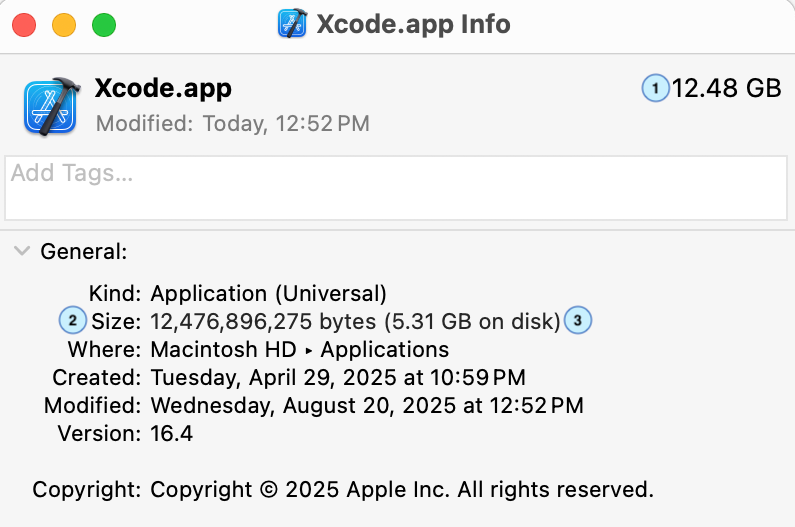
A Friend Who Would Know™ got in touch with me with a fact check of my size assertion, noting that Xcode was between 4.06GB and 5.31GB on disk (a recent Apple silicon-only beta version being the smallest and the current Mac App Store Universal version the largest).
He was absolutely right: The Mac App Store install for which I reported “12.5GB” shows only “5.31 GB on disk” in Finder’s Get Info window.
This is a long-standing quirk of how Finder displays file sizes, and the benefits of several features of APFS (🛎️) working together to reduce on-disk file sizes.
Finder reports three numbers for a file’s size:
A human-readable size (“12.48GB” here).
The number of bytes for the file (“12,476,896,275 bytes” in this case).
The amount of actual space that file consumes on disk (“5.31 GB on disk”).
I reported the human-readable size (rounded), because that’s what I suspect most people will consider the “file size”: it’s also what’s displayed in the Size column in Finder.
However, if you’re concerned about “disk space,” it’s perfectly reasonable to consider just the “on disk” size, as that’s the actual free space you would theoretically need for Xcode.
(I’m ignoring here the space needed to download, decompress, and install the app.)
However, I ran a couple of tests to see if my assumption that the “on disk” size is the amount of free space I’d need was valid. I created four APFS-formatted disk images using Disk Utility: 6GB (5.77GB free), 7GB (6.77GB free), 13GB (12.75GB free), and 15GB (14.75GB free). I then tried copying the “5.31 GB on disk” Xcode.app to each one. The results were both exactly and not at all what I expected:
6GB, 7GB images: Copying failed with an error: The item “Xcode.app” can’t be copied because there isn’t enough free space.
13GB, 15GB images: Copying completed, after which the 13GB disk image showed 7.1GB free, while the 15GB image showed 9.08GB free.
The math ain’t mathing!
I expected the 6GB and 7GB results, despite the “on disk” size, because I suspected that number is the result of some APFS behind-the-scenes magic: It would still need the number of bytes to be free to complete the copy.
The successful copy to the 13GB and 15GB images was also not a surprise. What did shock me was the amount of free space reported after the copy. How does a 13GB disk image, with 12.75GB free to start, end up with 7.1GB free after copying a 12.48GB file?!
(To further amuse myself, I then duplicated the copied app on the images several times. Each copy took up almost no additional space—an extra 0.15GB in total for three copies.)
What kind of APFS witchcraft is this?
The (short) answer is likely some combination of clones, sparse files, hard links, and maybe transparent compression—all APFS features. I won’t pretend to be capable of explaining them here, but if you’re interested in learning a bit about APFS, About Apple File System has an introduction (and Apple File System Reference has exhaustive details that no mere mortal should be reading).
I’ve been tweaking this site since it launched a bit over a year ago: generally small fixes to address odd spacing of various elements, font sizes, and such. Most of those changes are not worth mentioning here. A couple of recent changes I think are worth noting, though, and I’d love your feedback.
Search
Most useful, I think, is the addition of a Search option to the navigation bar. Ghost (the engine that powers this site) has built-in search, but I never exposed it. JAG’s Workshop is rapidly approaching 500 posts, so this should make it easier for you to find a specific post I wrote, or search for a topic (for example, “Apple” or “Politics”). There’s even a keyboard shortcut to bring it up: ⌘K (or Ctrl-K for non-Mac folks). Please try it out.
Fonts
I love fonts. For a while during my days working in desktop publishing in the late ’80s to mid-’90s, I had a massive collection of (mostly legal) fonts. That collection has been lost to the ravages of time, but I can sort of replicate the pleasure of perusing a font book with Google Fonts, Adobe Fonts, or FontSpace.
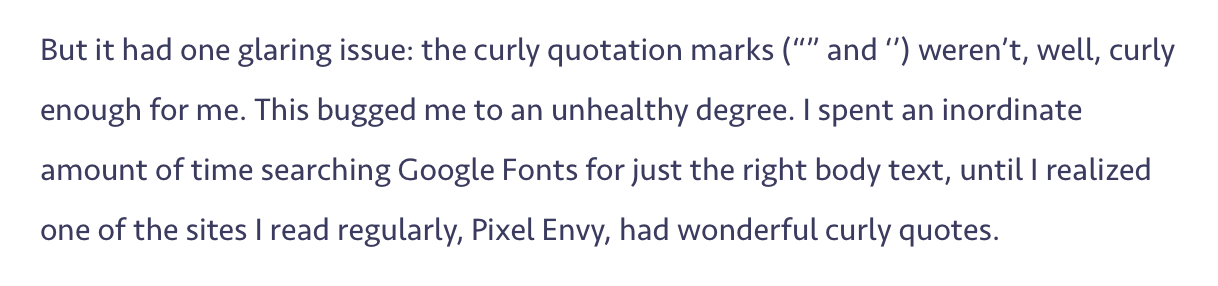
I started with Roboto, but the weights never felt right. I flirted with Inconsolata briefly, but the programmer-friendly monospaced font didn’t fit this text-heavy site. I settled on Seravek as the primary font, partly because it’s a macOS system font and would therefore have no external dependencies for most of my readers.
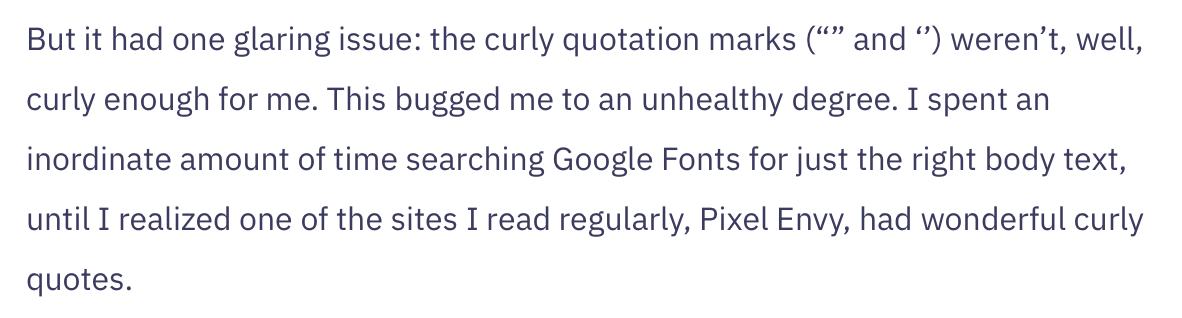
But it had one glaring issue: the curly quotation marks (“” and ‘’) weren’t, well, curly enough for me. This bugged me to an unhealthy degree. I spent an inordinate amount of time searching Google Fonts for just the right body text, until I noticed that one of the sites I read regularly, Pixel Envy, had “real” curly quotes and the text was very readable.
That hurt a bit—IBM, really?—but damn, I like how it looks (in addition to the curly curly quotes, I dig the double-story “a” and “g”), so it’s now the primary body and headline font in my font stack (IBM Plex Sans, Seravek, Roboto, system-ui). Beyond the specific letter forms, I find it’s also more readable on small screens. I’m not a huge fan of its italics (more like slanted or oblique than true italics), and I still need to tweak some spacing issues, but overall I’m pleased with the change.
Call to Action box
A few weeks back I added a call-to-action form to the bottom of each post to drive email signups. The results were… uninspiring. It also felt heavyweight and a bit needy. But, I do want to remind folks they can sign up to receive these posts in email for free (or an optional monthly or annual payment), so I rethought things and landed on a simple text block (which you can see at the end of this piece). I hope this one does better!
In addition to the usual email, RSS, and social media links, there’s also the next addition to the site, tips.
Tips
Ghost has had the option for recurring paid subscriptions for several years now (and I’ve had it enabled since launching this site), but they were, you know, recurring. That can be a turn-off for folks who want to support their favorite creators, but don’t want to worry about being charged every month or year. They may just want to show their support with a one-time contribution, or drop a small thank you for a specific article that was especially valuable to them. Sites like Buy Me a Coffee, Ko-fi, and even Patreon filled the void, but Ghost got its own integrated option a few months back, and I’ve finally enabled it.
Now, if you enjoy an article, or simply want to say “good job!” you can show your appreciation for as little as $1.
Regular, recurring subscriptions remain available to anyone wanting the “perks”: A free subscription gets you a (very) occasional member-only email, and paid subscribers don’t have sponsor/affiliate ads in the navigation bar. All forms of support, paid or not, get my heartfelt gratitude.
Experiments
I’m also exploring various other “member perks.” I haven’t settled yet on what those might be (I’m open to suggestions!) but as an experiment, I’ve updated the Archives page to now include both “Featured” posts and “Linked” posts. Members (including on the free tier) can see and click on any post, and can hide the Linked posts (so it only shows Featured posts—how it was until now). Non-members can see the Linked post titles but can’t click through to them.
This doesn’t actually block anyone from reading those Linked posts, of course: you can use the Search link in the navigation bar to find any article in the list. This is merely a test of the membership system. (I’m also curious whether anyone will become a member just to make it easier to read earlier linked posts.)
What’s next?
I’ll continue to tweak the site often (I’m investigating eliminating the sidebar in favor of a top navigation bar in all orientations so I can have a wider site, for example), but the next significant update will be to Ghost 6. I’m excited about the social network integration feature, especially. The transition will take some planning and downtime, so I’m proceeding very carefully.
Stay tuned for that, and thanks as always for reading.
Mike Brock, in his Notes on a Circus, speaks for so many of us who’ve been told we’re “overreacting” to Donald Trump’s rapid decent into fascism:
Remember who told you this was hysteria.
They told you that those of us warning about fascism were being hysterical. Now the President has seized control of the capital’s police force, deployed military units against citizens, and announced forced relocations of undesirables—and these same voices are explaining why it’s not really that bad, why it’s technically legal, why we should wait and see how it plays out.
The “hysteria” was prophecy. The “alarmism” was accuracy. The “derangement” was simply seeing clearly what was coming while others chose comfortable blindness.
Cassandra’s life was miserable as she foretold truths that would not be believed. Those likewise cursed with seeing the future with seeming certainty get no pleasure from being right. It’s emotionally draining to be constantly running around, axe and burning torch in hand, in defense of our democracy, only to be stopped by Americans unaware that their country is rapidly disintegrating right before their eyes. No amount of “I told you so” will make being right about the downfall of our democracy satisfying.
“Celebrating 50 years of The Rocky Horror Picture Show” from Jennifer Ouellette at Ars Technica is just a terrific retrospective of one of my favorite musicals.
I first saw The Rocky Horror Picture Show at the Waverly sometime in the early ’90s, long after it had established itself as a cult classic. I’d been a high school and college theatre nerd, and I remember the friend who took me—she’d been going for years—insisting it would be right up my alley. Hot patootie, was she right. I fell in love with this show from the moment those giant red lips filled the screen. The music, the characters, the sci-fi setting, the absolute campiness of it all, and, of course, the audience interaction and talkback—all of it delighted me. It felt like a new world had opened up, that I’d found my people. That it was OK to be weird and goofy and obsessed. It stuck with me like few other movie experiences.
I’ve listened to the soundtrack (conservatively) four or five hundred times, and it’s impossible for me to listen (or watch the movie) without singing along and interjecting talkbacks. For example, in the opening credits, when The Lips sing:
… see androids fighting …
I am physically incapable of not exclaiming:
… and fucking and sucking on …
…Brad and Janet…
Or:
… to the late night, double feature, picture show, by RKO.
RK-who?
And of course:
… to the late night, double feature, picture show. In the back row.
Fuck the back row!
I never had a chance to be part of a shadowcast, though I’d gladly give it a shot even today. I’d be thrilled to play Riff Raff—or Brad. Unhinged lunatic or milquetoast dork? Both would be tremendous fun… though I may have aged out of both. Perhaps Dr. Scott is now more my speed.
In addition to the movie soundtrack, I also own The Rocky Horror Show original stage soundtrack, and the 25th Anniversary Edition DVD (which includes an audience participation version), and bless my soul, as sure as there’s a light over at the Frankenstein place, you can bet I’ll be buying the 50th Anniversary 4K edition when it’s released in October. Until then, yes, you do see me shiver with antici… pation.
A 2023 analysis from TechSpot suggested that game size had increased at an average rate of roughly 6.3GB per year between 2012 and 2023—games that come in over 100GB aren't the norm, but they aren't hard to find. Some of that increase comes from improved graphics and the higher-resolution textures needed to make games look good on 4K monitors and TVs. But TechSpot also noted that the storage requirements for narrative-heavy, cinematic-heavy games like The Last of Us Part 1 were being driven just as much by audio files and support for multiple languages.
He follows up with a Mac example:
For another prominent recent example, consider the install sizes for the Mac version of Cyberpunk 2077. The version of the game on Steam, the Epic Games Store, and GOG runs about 92GB. However, the version available for download from Apple's App Store is a whopping 159GB, solely because it includes all of the game's voiceovers in all of the languages it supports. (This is because of App Store rules that require apps to have all possible files included when they're submitted for review.)
This difference in install size really seems to bother Cunningham. The link in the above paragraph is to Cunningham’s July piece on the release of the game for Mac, where he wrote:
The game will also require 92GB of storage when downloaded from Steam, GOG, or the Epic Games Store and 159GB of storage when downloaded from the Mac App Store. The difference in size is because the App Store version “has all voiceovers included” and because Apple’s App Review guidelines (see section 2.4.5, item iv) prohibit apps from downloading additional files after the initial download is done.
Alas, both parentheticals and his reasoning are wrong—stemming, I presume, from a misreading of the App Review Guidelines and an unawareness of available APIs for reducing app download sizes.
The guideline Cunningham references says:
2.4.5 Apps distributed via the Mac App Store have some additional requirements to keep in mind: […]
(iv) They may not download or install standalone apps, kexts, additional code, or resources to add functionality or significantly change the app from what we see during the review process.
What it’s not saying is that apps must “have all possible files included” in the downloaded app package. Downloading additional content is definitely allowed. Two examples from Apple itself:
Logic Pro: a 6GB initial install, with optional instruments, effects, and samples taking up to 72GB.
Xcode: a 12.5GB initial install, with optional SDKs, simulators, and tools taking up to 41GB.
Apple does require “all possible files” to be available during the review process, but that doesn’t mean those files must be included in a single app upload.
At WWDC22, Apple introduced Background Assets, with the express purpose of enabling smaller initial app and game downloads, allowing developers to carve out assets—say, voiceovers in various languages—so they can be downloaded (or not) as needed. If a player only wants English or Mandarin voiceovers, the app doesn’t need to include French, German, or Jamaican Patois in the download. This provides a smaller initial download (and on-disk footprint)—no bloat, no wasted storage space for never-to-be-used files. Of course, should the player want Jamaican Patois, it’s just a download away.
By implementing Background Assets, developers allow all their downloadable assets to be seen by App Review. Those assets are downloaded by the app during review as needed, just as they would be when in the hands of customers. Developers do not have to upload a single binary containing all the assets for Apple to review their app.
(If those assets aren’t available during review, the app gets rejected. This catches many developers who, for example, expected to enable their production servers only after approval, not realizing that those servers are used during the app review process.)
While it may be true that the complete Mac install of Cyberpunk 2077, with all the voiceovers, requires 159GB of storage, it absolutely does not require all 159GB to be part of one download package. That the game has such a large footprint is the developer’s doing, not the result of an Apple requirement.
In case you never had the pleasure of running this program, allow me to describe the experience. A window appears, titled “Bob Land.” Then, a ball, randomly colored and labeled “Bob,” is drawn. And another, and another, filling the window with chaotic abandon.
Bob Johnson, the author of the original SillyBalls, left Apple in 2001, the year I joined.
The sequel to SillyBalls, Son of Silly Balls, is one of the earliest sample projects I recall reviewing (the ReadMe and related metadata, not the code!).
That we know SillyBalls was written by Johnson (and who updated it over time) is a clear indication the project was created before Steve Jobs returned to Apple. One of his early commandments after his return was that the names of engineers would be scrubbed from public content; partly to dissuade employee poaching, but also to instill a sense of “One Apple”—the idea that the collective “we” created products at Apple, not the individual. By the time I joined DTS in 2001, this mindset was firmly ingrained, especially in Developer Relations, and no names (or even initials) would ever again appear in sample projects.
(Sometimes, though you can still see hints of the author shine through. In Son of Silly Balls, the use of “localisation” and “Share and Enjoy” points clearly to my illustrious erstwhile DTS colleague, Quinn.)
Not many people were pro-Ali following his anti-war protests, but here's Carlin supporting him unreservedly—while delivering pointed jabs at America’s nation-building woes. This was from the Ed Sullivan Show in 1971. Carlin was always on the right side of history then, and remains so today. That his routines remain relevant now—with minor updates to countries and people—is both a testament to his abilities as an astute political observer, and a stinging critique of our shameful lack of progress as a country. Pick any number of Carlin’s clips, and it’s a good bet you’ll find relevancy to today’s politics. One of our great misfortunes as a society is that we aren’t able to hear Carlin mercilessly skewer this particular political moment and regime. I imagine he’d have a field day with Trump, Musk, and the rest of them.
It is only in the past few years, after I read a post by someone on how they decide names for their devices, that the thought even occurred to me that those names for my devices don’t have to be so dry and meaningless. That I can treat naming my devices with some thought put into it, and name them based on some theme or the purpose that they will be serving.
Since then, the theme I have started with my devices is “celestial bodies/objects”. I try to name my devices based on some constellation.
I’ve been naming my devices for over 20 years. While celestial bodies, sci-fi, Greekmythology, and movie references are all excellent, evergreen options, I went a different route. Most of my devices are named after cities and beaches in the country I was born: Trinidad and Tobago.
When selecting names, I try to have some logical (or at least defensible) reason behind my choice. Broadly speaking, computers are named after cities, and iPads are named after beaches, with some exceptions:
Port of Spain: The country’s capital. Everything revolves around it. This is my main computer, historically a desktop Mac (currently an older 5K Intel iMac). However, as I’ve moved to a “desktop laptop” lifestyle, this name will shortly shift to my M4 MacBook Pro 14".
Scarborough: Previously the capital of Tobago, prior to the island’s unification with Trinidad. This is my secondary/travel computer, currently an M1 MacBook Air 13" (on which I’m writing this right now).
Diego Martin: My extended family lived here; it was practically my second home. This was my main computer at work. The name, like me, is now retired.
Curepe: This is my iPhone. I cannot for the life of me recall my reasoning behind this name, beyond it being another city where some of my family lived. It could just be because it’s short.
Maracas: My favorite beach, home of big waves and bake and shark. It’s the name of my iPad Pro, my companion while lounging.
Petit Valley: A small town adjacent to Diego Martin, I gave this name to my very petite Raspberry Pi.
Piarco: A small town, but more relevant here, the name of the international airport, thus the name of my WiFi network—first christened when connectivity was provided by an Apple Airport base station.
Names remain stable even when replacing a device, so, for example, my current iPhone is Curepe16, and my current iPad is Maracas7. Other names I’ve used over the years include Arima, Belmont, Mayaro, and St. James.
My naming scheme inspired my wife to follow suit: Her MacBook Air is named “Harbin,” after her city of birth.
Not all my devices are named after Trinidad and Tobago cities and beaches, though. A handful of old devices are named much more prosaically, to more easily identify them; “iPad 1st gen 16GB” or “iPhone 6 Silver 16GB,” for example.
I rarely name my accessories. One exception: on a recent trip to Hawaii, I managed to forget my precious AirPods at home, a potentially devastating error while on vacation. Luckily, Costco had a sale on AirPods, so I picked up a pair on the trip. They ended up being a backup to my pair at home. I did not give them a city or beach name.
Tom Gjelten, writing for NPR in 2015 on the occasion of the 50th anniversary of the Immigration and Nationality Act (the 60th anniversary of which is just two months away):
During the debate over the bill, however, conservatives said it was entirely appropriate to select immigrants on the basis of their national origin. The United States, they argued, was fundamentally an Anglo-Saxon European nation and should stay that way.
Sen. Sam Ervin (D-N.C.) said he objected to the idea of giving people from Ethiopia the same right to immigrate to the United States as people from England, France, Germany, or Holland. “With all due respect to Ethiopia,” Ervin said, “I don’t know of any contributions that Ethiopia has made to the making of America.”
Ohio Representative Michael Feighan, another Democrat, also objected to the Act, and offered a remedy:
Rather than giving preference to those immigrants whose skills were “especially advantageous” to the United States, Feighan insisted on prioritizing those immigrants who already had relatives in the United States, with a new preference category for adult brothers and sisters of naturalized U.S. citizens.
In justifying the change, Feighan told his conservative allies that a family unification preference would favor those nationalities already represented in the U.S. population, meaning Europeans. Among the conservative groups persuaded by Feighan’s argument was the American Legion, which came out in support of the immigration reform after originally opposing it.
In an article praising Feighan’s legislative prowess, two Legion representatives said he had “devised a naturally operating national-origin system.” A family unification preference, they argued, would preserve America’s European character.
“Nobody is quite so apt to be of the same national origins of our present citizens as are members of their immediate families,” they wrote. […]
Built on a racist premise, the “unintended consequences” of the Immigration and Nationality Act brought to America an unprecedented number of brown-skinned immigrants—including my mom, and by extension, me. Republicans (and “conservative” Democrats) have been striving to reverse this legislative “mistake” ever since.
I have little doubt the passage of this bill, and the resulting surge of non-white Americans, is a central facet of the far right’s Great Replacement Theory, this president’s hateful anti-immigration rhetoric, and Monday’s unprecedented takeover of the D.C. police and National Guard deployment.
America’s been fighting its base anti-immigration sentiment since its inception, and we now have a president enthusiastic to magnify, not minimize, our country’s worst tendencies.
This is a list of African Americans reportedly killed while unarmed by non-military law enforcement officers in the United States. Events are listed whether they took place in the line of duty or not, and regardless of reason or method. The listing documents the occurrence of a death, making no implications regarding wrongdoing or justification on the part of the person killed or officer involved.
This long form article from Johannes Böhme in Die Zeit was not what I expected, yet I remained captivated to the very end. You’ll want to set aside some time to read and sit with this one:
On August 7, 2023, a 176-page indictment arrived at the courthouse. It accused Gregor Formanek of being an accessory to murder in 3,322 cases. As a member of the SS, he had served as a guard in the Sachsenhausen concentration camp from July 1943 to February 1945.
He was 19 years old when he became a guard in Sachsenhausen. Which is why prosecutors were seeking to try the elderly man in the chamber for juvenile delinquents.
In all likelihood, this would be the last opportunity to bring a perpetrator of the Holocaust to justice. Formanek’s case will probably mark the end of the almost eight-decades-long process of coming to terms with the Holocaust in German courtrooms, a journey that began with the Nuremberg war crimes trials.
Formanek was indicted for his war crimes at the age of 99.
Donald Trump, Kristi Noem, and the rest of this administration should pay close attention.
Jen Pawol will make history this weekend as the first woman to be an umpire in a regular-season MLB game
Pawol will ump three games during this weekend’s Marlins-Braves series in Atlanta, including both ends of Saturday’s doubleheader (she’ll be at first base in the opener and third base in the nightcap) as well as the series finale on Sunday, when she will be behind home plate.
Congratulations to Pawol for her achievement—and about damn time, MLB.
Earlier this week, Apple announced “a new $100 billion commitment to America,” which included an “ambitious new American Manufacturing Program.” The additional investment is on top of their previously announced $500 billion commitment.
“Today, we’re proud to increase our investments across the United States to $600 billion over four years and launch our new American Manufacturing Program,” said Tim Cook, Apple’s CEO. “This includes new and expanded work with 10 companies across America. They produce components that are used in Apple products sold all over the world, and we’re grateful to the President for his support.”
The entirety of the nearly 1,500-word press release is about those last eight words: we’re grateful to the President for his support.
What “support” has the President provided, exactly? None that I’m aware of—we’ve seen only threats of tariffs and acts of retaliation. The press release is a sop to this notoriously transactional—and flattery-craving—president, a way of appeasing him and giving him what he most wants: attention for himself and his “deal making skills.”
Cook continued his relationship building (if you’re being charitable, ass-kissing if you’re not) by gifting Trump a shiny bauble: a disc of Kentucky-made glass, atop a 24-karat gold base from Utah, designed by a former U.S. Marine corporal who now works at Apple. The glass has the Apple logo cut out of it, and is inscribed with both Trump’s name and Cook’s signature.
“We’re going to be putting a very large tariff on chips and semiconductors. But the good news for companies like Apple is if you’re building in the United States, or have committed to build, without question, committed to build in the United States, there will be no charge. Even though you’re building, and you’re not producing yet in terms of the big numbers of jobs and all of the things that you’re building, if you’re building, there will be no charge.
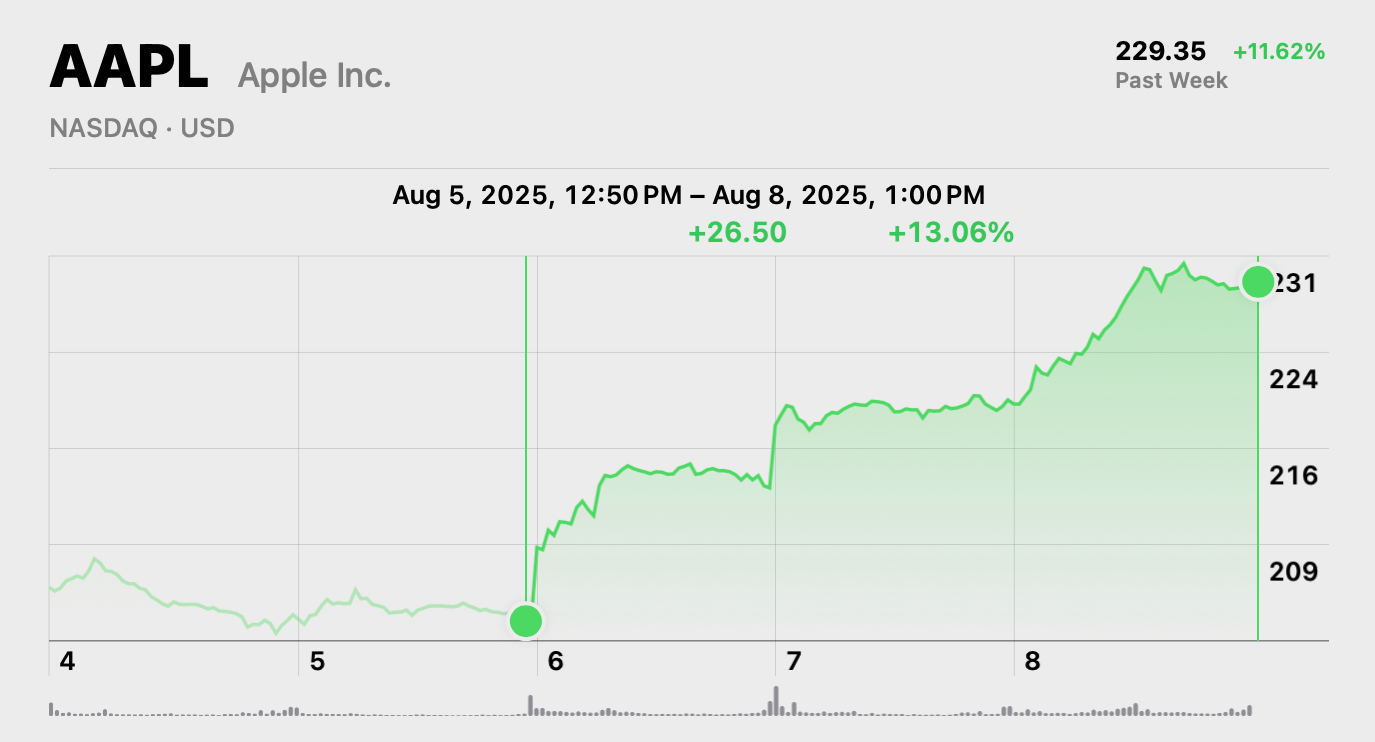
That in turn pleased the stock market, which pumped up Apple’s stock more than 13% since Wednesday.
I don’t know Cook. I’ve only met him a handful of times when I worked at Apple. Once was in 2016, when I and a small cohort of Black Apple employees sat with him in the wake of the Alton Sterling and Philando Castile police shootings to express the community’s anxieties, and to ask him to be more vocal in his support for the company’s Black employees. I have two memories of that meeting. One, Cook clearly cared deeply about Civil Rights and social justice—his admiration for Martin Luther King, Jr. and John Lewis was not just lip service. Two, he was taken aback at the suggestion that he wasn’t showing sufficient support. He’d tweeted after those shootings and believed that everyone, inside and outside Apple, would see it—and understand its meaning. He didn’t grasp that not everyone read his tweets, nor that oblique calls for justice aren’t the same as directly standing against racism. That meeting led, indirectly, to Speaking up on racism, in the wake of yet more police violence four years later.
I share that to say that nearly a decade after that meeting, I believe Tim Cook is more of a social progressive than not. I don’t believe he supports Donald Trump and his policies. I suspect most of those policies are anathema to Cook—and that people I respect would not be working for him if they weren’t.
I also recognize exactly how naïve that sounds.
Cook is a shrewd businessman. His primary objective is to ensure the continued success of Apple. He understands that a president who is easily mollified by overt acts of ring-kissing and knee-bending is also one who is easily manipulable. I choose to believe that Cook’s actions are those of a CEO protecting his company, its employees, and its customers, and—ultimately, yes—its profitability.
Cook is an operations guy. Crediting the President for a hundred-billion-dollar investment Apple was already going to make and bestowing a glass-and-gold trinket as thanks—while weathering some backlash and a temporary loss of personal dignity—is likely seen as simply one more operating cost of goods sold.
When that happens, all these “ego appeasements” (as one friend put it) will not matter—and Apple will have alienated anyone who might care enough to defend them.
GPT‑5 is smarter across the board, providing more useful responses across math, science, finance, law, and more. It’s like having a team of experts on call for whatever you want to know.
The accompanying 75-minute introduction video includes several impressive demos, including several where GPT-5 wrote hundreds of lines of (apparently working!) code in just a few minutes.
(Sam Altman introduces the video, then—mercifully—steps off stage and leaves the presentation to his team. He continues to appear awkward and uncomfortable in front of an audience.)
This new model, they say, has “Expert intelligence for everyone.” It’s described as “safer and more accurate” and “less prone to hallucinations and pretending to know things.” This is especially important given their focus on health:
Our best model yet for health-related questions, providing more precise and reliable responses while acting as more of a proactive thought partner.
Health is apparently one of their most asked about topics. The video introduction included a segment where Altman interviewed a cancer survivor about her use of ChatGPT to help her understand her diagnosis. This is not an area for confabulations—that is, making shit up.
GPT-5 is already available to most customers. Curious what it had to say for itself, I prompted it, Tell me about GPT-5:
Alright, let’s cut the fluff—here’s the real deal on GPT‑5, dropped fresh on August 7, 2025.
The Rundown: What’s So Hot About GPT-5?
Unified, smart-as-hell system: No more awkward model selection. GPT‑5 auto-routes queries—whether you need quick answers or deep thinking, it decides. Say “think hard about this” and it kicks into high-reasoning mode.
Big gains everywhere:
Writing, math, coding, health, visual perception—all of it cranks up performance across the board.
Benchmarks: AIME 2025 math score hits 94.6%, SWE‑bench Verified coding at 74.9%, Aider Polyglot at 88%, multimodal understanding at 84.2%, and HealthBench Hard at 46.2%.
Coding wizardry: Smarter front‑end generation, debugging, and “vibe coding” that feels like magic from a design-infused AI.
Safer and sharper: Way fewer hallucinations, better at saying “I don’t know,” less goody‑two‑shoes yes‑man behavior, and real improvements in health advice.
Context monster: Huge token window—270k input, 128k output (visible + invisible reasoning) for the API, and around 256–400k in other variants. Multimodal: text + image in, text only out.
Pricing & variants:
ChatGPT access: Free users get limited play; Plus gives more; Pro (~$200/month) brings unlimited and extended reasoning.
API tiers: gpt‑5 (full), gpt‑5‑mini, and gpt‑5‑nano—pick your speed/cost combo.
Enterprise upgrades: Smarter Microsoft Copilot, better reasoning, deeper conversation tracking.
Bottom Line (Told Straight)
GPT-5 is basically a PhD-level AI roommate—sharp across the board, fast, and way more reliable than its predecessors. OpenAI clearly focused on being useful, not just flashy. It’s less “AI showing off” and more “AI that works for you.”
If you’re into writing clearer, reasoning deeper, coding smoother, or just want a smarter base-layer assistant—GPT-5 probably rules.
We are observing stealth crawling behavior from Perplexity, an AI-powered answer engine. Although Perplexity initially crawls from their declared user agent, when they are presented with a network block, they appear to obscure their crawling identity in an attempt to circumvent the website’s preferences. We see continued evidence that Perplexity is repeatedly modifying their user agent and changing their source ASNs to hide their crawling activity, as well as ignoring — or sometimes failing to even fetch — *robots.txt* files. […]
There are clear preferences that crawlers should be transparent, serve a clear purpose, perform a specific activity, and, most importantly, follow website directives and preferences. Based on Perplexity’s observed behavior, which is incompatible with those preferences, we have de-listed them as a verified bot and added heuristics to our managed rules that block this stealth crawling.
That’s a pretty damning accusation, and a harsh penalty. Perplexity, for its part, is crying foul:
Because Cloudflare has conveniently obfuscated their methodology and declined to answer questions helping our teams understand, we can only narrow this down to two possible explanations.Cloudflare needed a clever publicity moment and we–their own customer–happened to be a useful name to get them one.Cloudflare fundamentally misattributed 3–6M daily requests from BrowserBase’s automated browser service to Perplexity, a basic traffic analysis failure that’s particularly embarrassing for a company whose core business is understanding and categorizing web traffic. Whichever explanation is the truth, the technical errors in Cloudflare’s analysis aren’t just embarrassing—they’re disqualifying. When you misattribute millions of requests, publish completely inaccurate technical diagrams, and demonstrate a fundamental misunderstanding of how modern AI assistants work, you’ve forfeited any claim to expertise in this space.
This controversy reveals that Cloudflare’s systems are fundamentally inadequate for distinguishing between legitimate AI assistants and actual threats. If you can’t tell a helpful digital assistant from a malicious scraper, then you probably shouldn’t be making decisions about what constitutes legitimate web traffic.
I don’t know which multi-billion dollar behemoth is right. On the one hand, I don’t like how much control Cloudflare has over the internet. I’ve often been stymied by one of their “Checking if the site connection is secure” loops, and their “Content Independence Day” is an obvious—if unstated—cash grab. On the other hand, Perplexity has a multitude of issues—and they just signed up to power searches for Donald Trump’s “Truth” Social.
Every time someone floats the idea that Apple should acquire Perplexity to “supercharge” its AI efforts, I get whiplash, not just from the sheer strategic laziness of the suggestion, but from the deeper cultural misalignment it completely ignores. The very idea is a perplexing thought.
Perplexity isn’t some misunderstood innovator quietly building the future. It’s a company fundamentally unsure of what it is, what it stands for, or how to exist without parasitizing the open web. It’s been posing as a search engine, an AI-powered Q&A tool, a research assistant, and lately, some vague hybrid of all three, depending on who’s asking and what narrative sounds hottest that week. The only throughline is this: a constant need to justify its own existence, retrofitting its product pitch to whatever the industry is currently foaming at the mouth about.
Masna makes a compelling case not just against Perplexity itself, but argues Apple doesn’t need Perplexity:
Not for the tech — which is just a UX layer on top of open models and scraped data. Not for the team — which seems more interested in testing the boundaries of IP law than building products people trust. And definitely not for the culture — which is allergic to accountability and powered by vibes over values.
I found myself nodding in agreement throughout. The more I learn about (and use) Perplexity, the less I think they’re a good fit for Apple.
I was unaware of Blaugust until my friend and former colleague Scott jokingly mentioned it on Mastodon. In case you’re likewise unaware, Blaugust is a decade-old annual writing challenge, similar to NaNoWriMo, but instead of writing 50,000-word novels in November, you publish 31 blog posts in August:
The goal is to stoke the fires of creativity and allow bloggers and other content creators to mingle in a shared community while pushing each other to post more regularly. […]
Blaugust at its heart has always been about celebrating the creation of content on a regular schedule. The original challenge was to post 31 times during the month of August which is 31 days long. This can be posting every day or doubling up on some days to make the schedule a bit easier.
You may have caught the “shared community” in that first paragraph. Blaugust isn’t just about creating and publishing content on a regular basis. It’s also about being part of a community of bloggers:
Our hope is to create a nurturing environment where Veteran bloggers can help those just getting started and the cross-pollination of ideas can create something truly spectacular.
Since Blaugust is a “challenge,” there are, of course, “awards” for achieving milestones:
Bronze Award – For writing at least 5 posts during August.
Silver Award – At least 15 posts.
Gold Award – At least 25 posts.
Rainbow Diamond Award – Posted 31 times or more during August (“the original challenge”).
I can now claim the Newbie Blogger award, having officially signed up for the challenge, and the Bronze award, having already posted six times this month (this post makes seven)—meaning I’m almost halfway to Silver.
Gold and the coveted Rainbow Diamond awards are a stretch, but I have reason for hope: I’ve published 314 times since the start of the year, averaging more than one post a day, and I’m currently on a 203-day publishing streak—though some poorly timed travel will likely interrupt that. But I’m committed to publishing 24 more posts in 26 days.
Subscribe to follow my progress. Get each post by email, via RSS, or follow @jagsworkshop on Mastodon for notifications.
Interested in giving the challenge a shot? With three-ish weeks remaining in August, Bronze (at least) is eminently achievable, even if you’ve never blogged before. You can start blogging with WordPress, Medium, Tumblr, or Micro.blog. Not sure what to write? Try Blog Prompts for hundreds of ideas. Don’t forget to use the hashtag #blaugust2025!
You can share your progress with me: I’m on Mastodon and Bluesky. Let’s write!
David Pogue has a massive, 600-page tome forthcoming:
Deeply researched and lavishly illustrated in color, Apple: The First 50 Years includes new interviews with 150 key people who made the journey, including Steve Wozniak, John Sculley, Jony Ive, and many current designers, engineers, and executives. The book busts long-held myths; goes backstage for both the titanic successes (450 million iPods, 700 million iPads, 2.2 billion iPhones) and the instructive failures (Lisa, Apple III, MobileMe); and assesses the forces that challenge Apple’s dominance as it enters its second half century.
Coming March 2026. I’ve already placed my preorder (order yours through Bookshop or Amazon and I get a tiny kickback that supports the site).
Assuming it’s final, I find it a weird choice to use iPod controls on the cover. Is that the most iconic Apple image? Why not the original mouse? Or the arrow cursor? Or an iPhone silhouette? Personally, I’d have selected the original Macintosh icon, but I’m OG.
Less commented upon but just as bad is the branding trap. Substack is a damn good name. It looks good, it sounds good. It’s short and crisp and unique. But now they’ve gotten people to call publications on Substack not “blogs” or “newsletters” but “substacks”.
A friend, trying to be complimentary, once said to me, “Your Substack is neat and interesting, too.” I very nearly died inside. Don’t call it a Substack.
Gruber was back on Sunday with links on leaving Substack and Substack’s $100 million VC raise (provocatively titled “Substack Raised Another $100 Million, Which, I Bet, Is Already Being Flushed Down the Same Toilet as Their First $100 Million”), where he astutely notes:
If their business model were actually as simple as described, they’d already be profitable and wouldn’t have needed to raise another $100 million. They’ve already got a lot of subscribers. They’ve already got a stable of high-profile writers. They already keep 10 percent of what subscribers pay.[…]
What would validate Substack’s strategy is showing proof of actual profits and profitable growth. And if they had actual profits and profitable growth they wouldn’t have needed to raise another $100 million. […]
I firmly believe one could build a very nice business taking 10 percent of subscription revenue for a blogging/newsletter platform, if you could get as nice a roster of popular writers to build on the platform as Substack has. I do not think that’s a $1 billion business, though. And if it were, they should, at this point, be able to get there on their own, without additional funding. They should have achieved profitability lift-off long ago.
One might get the impression that Gruber isn’t a fan of Substack.
From Ghost Changelog (Ghost’s “product announcements & new features” site):
The next major version of Ghost has arrived, and our 6.0 release is packed full of more upgrades and improvements than you can shake a stick at.
The signature feature is integration with social networks (“discover, follow, like and reply to your posts across Bluesky, Flipboard, Threads, Mastodon, WordPress, Ghost”), plus a “native analytics suite” (just a couple of months after I ditched Google Analytics for Plausible), and—for those of us who self-host Ghost (hello!)—“a new official Docker Compose” environment (which should make it easier to deploy and manage).
I’ll be upgrading jagsworkshop.com to Ghost 6 once I’m able to fully test its features. Stay tuned for that.
Beyond the great new feature set though, what really caught my attention was their revenue:
When we announced Ghost 5.0 a few years ago, we were proud to share that Ghost’s revenue had hit $4M – while publisher earnings had surpassed $10M. It felt great to have such a clear sign that our goal to create a sustainable business model for independent creators was succeeding.
Today, Ghost’s annual revenue is over $8.5M while total publisher earnings on Ghost have now surpassed $100M.
Ghost is a not-for-profit organization. They have no venture capital investors to satisfy. They make money the way all good businesses should: by building a good product and charging a fair price for it. They do not, from what I can tell, promote Nazis.
Contrast this with its most well-known competitor, Substack, which is VC funded—it recently closed a $100 million round, valuing them at $1.1 billion—with an expected $45 million in annual revenue. And they definitely promote Nazis.
Substack pulls in 5.3x more revenue than Ghost ($45 million vs. $8.5 million) and is valued at $1.1 billion. So… congratulations to Ghost on their $200 million valuation!
A recent conversation with a friend reminded me that I’ve been meaning to link to this story from Oliver Milman at The Guardian:
Blood-sucking ticks that trigger a bizarre allergy to meat in the people they bite are exploding in number and spreading across the US, to the extent that they could cover the entire eastern half of the country and infect millions of people, experts have warned. […]
The ticks are known to be unusually aggressive and can provoke an allergy in bitten people whereby they cannot eat red meat without enduring a severe reaction, such as breaking out in hives and even the risk of heart attacks. The condition, known as alpha-gal syndrome, has proliferated from just a few dozen known cases in 2009 to as many as 450,000 now.
I first learned of alpha-gal syndrome in 2017 from a Wired article (archive), lamenting piteously to a few friends: Fuuuuuuuck mmmmeeeee…
An allergy to red meat would eliminate a significant portion of my (admittedly unhealthy) diet, from the obvious (burgers, steaks, sausage, ribs) to the less apparent (pork fried rice, lamb samosas, kao ga prow, dumplings). Even tacos become verboten. Tacos!
It’s a culinary death sentence!
So how far can alpha-gal spread? Cases have been found in Europe and Australia, although in low numbers, while in the US it’s assumed lone star ticks won’t be able to shift west of the Rocky mountains.
Whew. One more reason to live in California.
But other tick species might also be able to spread alpha-gal syndrome – a recent scientific paper found the western black legged tick and the black legged tick, also called the deer tick, could also cause the condition.
Shit.
Obviously I’m being flip here—alpha-gal syndrome is a serious allergic reaction which can lead to Anaphylaxis, a potentially fatal reaction that restricts breathing. Alpha-gal isn’t just found in “red meat,” but also in other mammal-derived food and non-food products: milk, lard, and bouillon, sure; but also in personal care and household products, and even in some medications and vaccines.
Beyond anaphylaxis, other symptoms include itchy skin, swelling, hives, wheezing, abdominal pain, diarrhea, nausea, heart palpitations, and low blood pressure.
Kamala Harris somehow manages to reflect both deep resignation and unbridled hope in her first significant post-election interview, on The Late Show with Stephen Colbert. Harris’ disappointment and disillusionment with the election—and the electorate—is palpable. Ostensibly on the show to pitch her new book, 107 Days, the interview felt akin to the first tentative steps of (very public) therapy, with moments of catharsis—brief, measured, but evident. I got the sense Harris is still emotionally raw from her experience—and understandably so. I think she has a lot to get off her chest, and this was her initial foray.
The moment that captured my attention came early in the interview. After Colbert asked if foregoing a run for governor of California is to “save herself for a different office,” she made it clear that “it’s more basic than that,” flatly stating:
I don’t want to go back in the system. I think it’s broken.
I—and the audience—gasped. It’s a stinging indictment. Even Colbert appeared taken aback, calling it “harrowing”—to which Harris quietly responds:
Well, but it’s also evident, isn’t it?
It’s quite evident to anyone paying even trivial attention—and not completely consumed by the MAGA cult.
Harris makes it clear her decision is not about giving up, that she’s “always gonna be part of the fight,” her goal being to “remind everyone who needs reminding right now of their power.”
The entire interview is terrific, including a moment toward the end when Harris acknowledges that, while she predicted much of what a Trump regime would bring, she could not predict “the capitulation” of “the guardians of our systems and our democracy.” Harris is unable to disguise her disgust for those supposed “guardians,” some of whom she calls “feckless.” Her anger is unmistakable.
Our civic discourse desperately needs more of Harris’ clear-eyed, righteous anger—and less apathetic acquiescence. I’m hopeful that her “listening tour” will spark other leaders to speak out. America needs a reckoning—and it can’t come quickly enough.
Figma’s stock more than tripled in its New York Stock Exchange debut on Thursday, a day after the design software company sold shares at $33 in its initial public offering.
Figma’s first trade at $85 valued the company at about $50 billion. The stock, trading under ticker symbol FIG, was halted after it soared past $112, before closing at $115.50 for a 250% gain. The company ended the day with a market cap of almost $68 billion.
I don’t often lust after company IPOs, but Figma is one I would have loved to get in on—not because I use Figma (I don’t), but because so many designers I know and respect love it.
Adobe’s plan to acquire Figma in 2022 for $20 billion fell through in the face of tough regulatory scrutiny. Figma got a $1 billion breakup fee that I’m sure softened the blow at the time, but today’s massive IPO no doubt makes up for any hard feelings.
Back to Novet at CNBC:
Figma boasts more than 13 million monthly users, two-thirds of whom are not designers. As of March 31, more than 1,000 clients were paying Figma upward of $100,000 annually, according to the prospectus. Google, Microsoft, Netflix and Uber are all customers.
Count Apple as a customer, too. Just a couple of weeks ago, they released an iOS 26 and iPadOS 26 design kit (or “UI Kit” in Apple parlance)—one of several design kits and icon templates created for Figma since iOS 17.
Oh… I didn’t get in on the IPO, of course—that’s reserved for the rich-and-well-connected crowd. And I have no plans to buy Figma at its post-pop price—way too rich for my blood. I’ll chill on the sidelines until the froth subsides.
Apple today announced financial results for its fiscal 2025 third quarter ended June 28, 2025. The Company posted quarterly revenue of $94.0 billion, up 10 percent year over year, and quarterly diluted earnings per share of $1.57, up 12 percent year over year.
Apple also reported “double-digit growth in iPhone, Mac and Services,” 12% EPS growth year over year, and “a new all-time high” installed base.
All in all, a strong quarter despite a significant impact from tariffs. During the earnings call, Tim Cook reported a small “pull forward of demand”—that is, purchases made sooner because of tariff concerns—but said it was only about one percentage point of the ten-point growth they saw. A bigger impact was the tariffs themselves. Cook said of this (as transcribed by 9to5Mac):
For the June quarter, we incurred approximately $800 million of tariff-related costs. For the September quarter, assuming the current global tariff rates, policies, and applications the balance of the quarter, and no new tariffs are added, we estimate the impact to add about $1.1 billion to our costs.
In addition to tariff uncertainty, Apple is also looking at a potential dent to its services revenue next quarter. Daniel Howley at Yahoo Finance:
The company could also have to deal with the impact of Google's antitrust lawsuit on the company's $20 billion per year agreement to use Google Search as the default option in the Safari browser and Siri.
Apple stock rose nearly 3% after hours before settling back under 2% as I publish.
See also: Jason Snell at Six Colors has his colorful charts up.
In our hunt for the best, we tasted 40 canned cocktails. Many just couldn’t hold up to the quality of a freshly made drink. But a few were balanced, complex, and convenient enough that we wouldn’t mind sipping on them in a variety of settings, from sunny beach days to, yes, swanky dinner parties. Here are the cans we couldn’t get enough of.
I’ve never tasted a canned cocktail worth trying again, but I haven’t tried any of these. “Best canned cocktails” is like “best frozen pizza”: a convenience option—acceptable in a pinch, probably better than nothing, and always a pale imitation of the real deal.
“I’m particularly concerned about where we are now, because we’re well into that five-year period in terms of we’re already doing sweeps, right?” Pitzer said. “We’ve already got masked guys. We’re already disappearing hundreds of people to … foreign countries, or to the Everglades, or now to Fort Bliss” — the El Paso, Texas, military base, which the Trump regime just awarded a $1.2 billion contract for a large new camp.
Bunch:
The most famous case study, in Nazi Germany, is also the source of many current misconceptions, since the “final solution” death camps, such as Auschwitz in Poland, where some of the six million Jews murdered in the Holocaust died in gas chambers, have often been what people think of. But the first well-known German concentration camp, Dachau, opened less than two months after Hitler took power in early 1933, and was used to detain — not slaughter — the Nazis’ political opponents.
“It was used in a kind of social engineering way,” Pitzer said of Hitler’s early camps. “There were a lot of homeless people, there were a lot of career criminals that they put in the camps to kind of dilute the percentage of political prisoners. So it would be more of a PR thing. People would support it more. You saw detention, particularly, of gay men.”
Immediately after seeing this article, a second crossed my social feeds—yet another executive order, written to sound benign, yet is anything but. Robert Davis at Raw Storyexplains it:
The order, titled “Ending Crime and Disorder on America’s Streets,” directs multiple federal agencies to discontinue funding services such as Housing First, Safe Consumption Sites, and other harm reduction practices. It also directs states to detain people with serious mental illnesses regardless of “forensic bed capacity at appropriate local, State, and Federal jails or hospitals.”
The executive order asserts:
Shifting homeless individuals into long-term institutional settings for humane treatment through the appropriate use of civil commitment will restore public order.
It also calls for the government to:
enforce, and where necessary, adopt, standards that address individuals who are a danger to themselves or others and suffer from serious mental illness or substance use disorder, or who are living on the streets and cannot care for themselves, through assisted outpatient treatment or by moving them into treatment centers or other appropriate facilities via civil commitment or other available means, to the maximum extent permitted by law[…]
And it seeks to encourage:
civil commitment of individuals with mental illness who pose risks to themselves or the public[…]
As usual it’s too early to tell what this will look like in practice, but at a minimum they’re clearing the way for involuntary commitment for any homeless people authorities decide to target as well as at least some non-homeless people with mental illness.
At maximum this seems to open the door for authorities declaring people mentally ill and institutionalizing them on that basis.
It could lead to attempts to use this against protesters who haven’t done anything arrest-worthy, and perhaps eventually activists/dissidents/ideological opponents.
We’re constantly being told that America’s present is nothing like Germany’s past—so why does it look so damn familiar? It’s increasingly disingenuous, verging on intentional ignorance. These articles and commentary testify that “authoritarian America” is no longer an historical allusion or a speculative future: it’s our present.
A lovely reminiscence from former Cubs outfielder Doug Glanville on how Ryne Sandberg’s “quiet confidence” during a minor league rehab stint subtly shaped his big league career:
But for me, I focused on something more personal. He was calm, intentional. He looked casual on the outside, but he cared. He was competitive, and he led by example, without having to say anything. No speeches, just a line or two of advice in private that carried more weight than a locker room address.
It gave me the freedom to challenge the labels I had been given, realizing that maybe those who assign labels are actually the lazy ones. Too impatient to take the time to really understand and get to know a player. Sure, it is important to listen and accept feedback, but I have always found it a stretch to accuse someone of not caring. Especially if the accusation is based solely on volume.
The following year, I made the 40-man MLB roster for spring training in Arizona. Fortunately, the Cubs put my locker next to Sandberg’s. I had a front-row seat to his routine. And long before I fully understood his work ethic, I took comfort in knowing you can be true to yourself and still add value to your team, and to your own performance.
Published a month ago, but made painfully poignant following Ryno’s passing.
Ryne Sandberg, an iconic player for generations of Chicago Cubs fans and a distinguished member of the National Baseball Hall of Fame, died Monday at the age of 65 from metastatic prostate cancer, the team announced. Sandberg passed away at his home, surrounded by his family, the Cubs shared.
Sandberg announced in January 2024 that he had been diagnosed with metastatic prostate cancer. He had chemotherapy and radiation treatments, and then said in August 2024 that he was cancer-free.
But he posted on Instagram on Dec. 10 that his cancer had returned and spread to other organs. He announced this month that he was still fighting, while “looking forward to making the most of every day with my loving family and friends.”
In all, Sandberg played 15 seasons on the North Side and finished his career as a Cub in 1997. By the time he hung up his cleats, he had become a ten-time all-star, nine-time Gold Glove winner (all consecutively), a seven-time Silver Slugger, and the 1990 home run derby champion (the same season he led the NL in home runs).
Growing up in New York in the mid-’80s and early ’90s, I watched “Ryno” play a lot against my beloved Mets. He was one of the best-hitting, best-fielding second basemen of my youth—much to our great frustration.
He played the game hard, he played it right, and he played it with “respect,” as he called it in his wonderful Hall of Fame induction speech:
Everything I am today, everything I have today, everything I will ever be is because of the game of baseball. Not the game you see on TV or in movies—Baseball. The one we all know. The one we played with whiffle ball bats, pretending to be Yaz or Fisk or Rose, in dirt fields and in alleys. We all know that game. The game fit me because it was right, it was all about doing things right. If you played the game the right way, played the game for the team, good things would happen. That’s what I loved most about the game, how a ground out to second with a man on second and nobody out was a great thing. Respect.
[…]
I was taught you never, ever disrespect your opponent or your teammates or your organization or your manager and never, ever your uniform. Make a great play? Act like you’ve done it before. Get a big hit? Look for the third base coach and get ready to run the bases. Hit a home run? Put your head down, drop the bat, run around the bases, because the name on the front is a lot more important than the name on the back. That’s respect.
Today’s players could learn a lot about “respect” from Ryno.
I’ve been listening to ATP—Accidental Tech Podcast—for its entire decade-plus run. Self-described as “Three nerds discussing tech, Apple, programming, and loosely related matters,” the hosts (Marco Arment, Casey Liss, and John Siracusa) bring a thoughtful yet playful approach to their Apple and tech conversations. Every episode is a joy to listen to (even though they sometimes rile me up), and it’s one of a small handful of podcasts I (gladly) pay to support.
On episode 647: You Get One Exclamation Point, The Boys™ discuss various ways Apple might achieve cost savings on a rumored low-cost Apple laptop. Their ideas, presented draft-pick style, were mostly serious, focusing on components Apple might remove to reduce the price of this hypothetical new hardware.
One option not suggested by The Boys™ on the latest @atpfm for cost savings on the rumored “low-cost Apple laptop”:
Ads on the boot, login, and wake screens—and, for good measure—the screensaver 🤑
Coming Soon: “Apple MacBook (Fall 2025, with ads)”… with a $150 option to remove them 🤪
One enjoyable ATP bit is that each episode starts with Follow-up (copyright John Siracusa), where they expand, correct, or simply comment on previous topics. That often includes commentary from their listeners.
Alright, with regards to the low-cost Apple laptops, Jason Anthony Guy writes…
Nerd achievement unlocked! 🔓🎉 Imagine my shock in hearing this last week (the episode came out today, but I listened to the “bootleg,” released immediately after recording ends—it’s one of the perks of membership). I was utterly delighted. It’s the nerd equivalent of having your Letter to the Editor printed in the newspaper or your timestamp opening NPR Politics.
(Ask your parents, kids.)
One thing you may have noticed in my Mastodon post: I wrote “Apple MacBook (Fall 2025, with ads)”. Casey dutifully explains the joke (it’s an Amazon Kindle reference), but John and Marco humorously correct him that Kindle has “special offers,” not “ads”.
I apologized to Casey for botching the joke and forcing him to bear the brunt of Marco’s and John’s joshing for my humor fail.
But wait! Turns Out™, the Kindle purchase options are “Ad-supported” and “Without Lockscreen Ads.” No mention of “special offers”!
Kindle purchase options. Take that, John and Marco!
Vindication!
OK, well, partial vindication: the Kindle device management page (where you can remove lock screen ads), does call them “Special Offers”.
#CaseyWasRight to call them “ads” and deserves both partial credit and a tearful (and no doubt begrudging) apology from his doubting cohosts in the next follow-up.
What is it about [glass] that makes tech giants return to it again and again? […]
Glass is not a part of our evolutionary environment.
Werner answers:
We are drawn to glass because it masterfully combines a primal, sensory lure with a sophisticated cognitive tool, all wrapped in the perfect metaphor for our digital age.
A short, thought-provoking perspective on the seemingly cyclical nature of glass (and glassy) user interfaces—from Aqua to Windows Aero to iOS 7 (a surprising but valid inclusion), and now, Apple’s Liquid Glass.
The International Bartenders Association, or IBA, maintains a list of official cocktails, ones they deem to be “the most requested recipes” at bars all around the world. It’s the closest thing the bartending industry has to a canonical list of cocktails […]
The journey has taken me to some interesting places, and now that it’s done, I have a little story to tell for each cocktail. I’m not gonna tell you all 102 stories, but I do want to debrief the experience. Drinking all 102 cocktails turned out to be unexpectedly tricky, and for reasons you’ll soon understand, I might be one of the first people in the world to do it.
This is my kind of project, and I’m disappointed that I didn’t think to do it myself.
I’ve tossed back a mere 43 of the current 102 IBA cocktails, a disappointing showing for a self-described cocktail enthusiast. This, of course, must and will be corrected. Many of the cocktails I’m missing are variations on a theme, with ingredients I have or can easily procure. The rest will require dedication—though I’m unsure if I’ll be able to achieve a 100% completion any time soon, considering the challenges Aaronson describes for his “final boss” cocktail: the IBA Tiki, which requires a pair of Cuban rums unavailable—legally, anyway—in the U.S.
Aaronson catalogs each cocktail by name recognition (well-known, medium, obscure) and by ingredient availability (easy, medium, hard) to identify which ones you’re likely to find at any halfway decent cocktail bar, and which ones you’ll have to hunt for—a very handy cheat-sheet!
One takeaway from Aaronson’s exercise: I need to start keeping lists.
Trump’s MAGA movement now faces a profound cognitive crisis. Their leader has violated the central promise of their political identity—the promise to reveal hidden truths and expose child sex abusers. But the conspiratorial frame he taught them makes it impossible to simply accept this as ordinary political disappointment.
Instead, they must choose between two equally destabilizing options: abandon the conspiratorial thinking that has become central to their identity, or turn that conspiratorial thinking against Trump himself.
[…]
This is why fighting conspiracy theories with facts doesn’t work. Facts are interpreted through frames, and frames shape how facts are understood. When someone is thinking conspiratorially, contradictory evidence just becomes proof of how deep the conspiracy goes.
Another take on the slow implosion of the MAGA world view. It’s delightful watching MAGAts contort themselves in their support for—or opposition to—releasing the Epstein files.
U.S. citizen Wilmer Chavarria, traveling on a U.S. passport, was detained at a U.S. port of entry for… no apparent reason. From Lola Duffort at Vermont Public:
What followed, according to Chavarria, who has been a U.S. citizen since 2018, was “nothing short of surreal and the definition of psychological terror.” The educator said he was separated from his husband, Cyrus Dudgeon, and interrogated by multiple agents over the course of four to five hours.
Chavarria said he was asked whether his marriage was real, whether he was really a school superintendent, and questioned about everything he had done while out of the country. And again and again, he said agents demanded that he hand over the passwords to his phone and district-issued laptop.
There’s no explanation of why Chavarria was stopped at the border, nor why they demanded access to his devices. Coincidentally, I’m sure, he’s a gay man from a Central American country.
Chavarria said he’s had students of color ask him in the past whether they should be worried when they cross the border into the United States. In the case of U.S. citizens, he’s always assured them they had “nothing to worry about.”
“Clearly, this is a change for me in my understanding, and now I’m no longer giving that advice,” he said. “From my own experience, I know that they should be worried.”
The article includes this important reminder:
A U.S. citizen cannot be denied entry into the United States because they refuse to give customs officials the passwords to their devices. But that can prolong an individual’s interrogation, and officials can then seize those devices and hold on to them long after someone has left the airport.
Border agents can keep your phone and try intimidating you, but they can’t force you to unlock it—and they can’t prevent you from entering the country. Again, if you’re an American citizen, you do not need to unlock your device just because you were asked to. You can just say no (Nancy would be proud).
Grandpa, tell me again about the “sanctity of citizenship”?
The Customs and Border Patrol offered Chavarria one final insult:
For years, Chavarria has been a member of CBP’s Global Entry program, which allows frequent travelers that undergo a special background check expedited clearance at ports of entry. As he was boarding a flight back to Vermont, he received an email notifying him that his permission to be in Global Entry had been revoked.
The reason? He did “not meet program eligibility requirements.”
Pettiness as policy. Slow. Fucking. Clap.
If you enjoy this curated collection of eclectic ephemera,
subscribe by email or follow in RSS to get new posts automatically.