

Jordan Rubin, reporting for MS Now:
The Supreme Court sided with Texas on Monday in emergency litigation over a law that its opponents said marked the first time a state has ever required its citizens “to prove their age before reading a newspaper, entering a bookstore, or even accessing the internet.”
Student and trade groups brought emergency applications to the high court against the law, called the App Store Accountability Act. The law is intended to help parents direct and supervise children’s downloads of apps and in-app purchases by requiring age verification, parental consent and age rating and content display. […]
A federal judge halted the law, finding that it was likely unconstitutional due to its restrictions on speech. Then a federal appellate panel granted the state’s request to lift the judge’s order, leading the groups to seek urgent relief from the high court.
The federal judge who initially blocked the law was Judge Robert Pitman in the Western District of Texas. Ann E. Marimow, reporting for The New York Times:
He compared it to a proposal that bookstores be required to verify the age of customers and obtain parental consent before minors enter or buy a book.
“It restricts access to a vast universe of speech by requiring Texans to prove their age before downloading a mobile app or accessing paid content within those apps and requires minors to obtain parental consent,” he wrote.
A three-judge panel of the U.S. Court of Appeals for the Fifth Circuit then paused that ruling and said it would allow the law to take effect, writing that the “need to protect children is intensified in the digital world.”
I continue to contend that age verification laws are mass surveillance under the guise of child safety—an attack on privacy that does little to protect children. No one needs to prove their age to read the print edition of The New York Times, but would need to do so to download and use the app (and eventually, the website, you can be sure).
Apple and Google already comply with the Texas law (and with similar requirements in Utah, Louisiana, Brazil, Australia, and Singapore) via their Declared Age and Play Age Signals APIs, respectively.
Apple’s lengthy Trust and Safety segment at WWDC26 that introduced new “child safety features” was no doubt a preemptive attempt to dissuade further demands to collect and share its customers’ personal data.
Developers have also started to comply. I saw my first age range request dialog a few days ago, from Anthropic’s Claude (separate from the more-intrusive identity verification they’re rolling out).
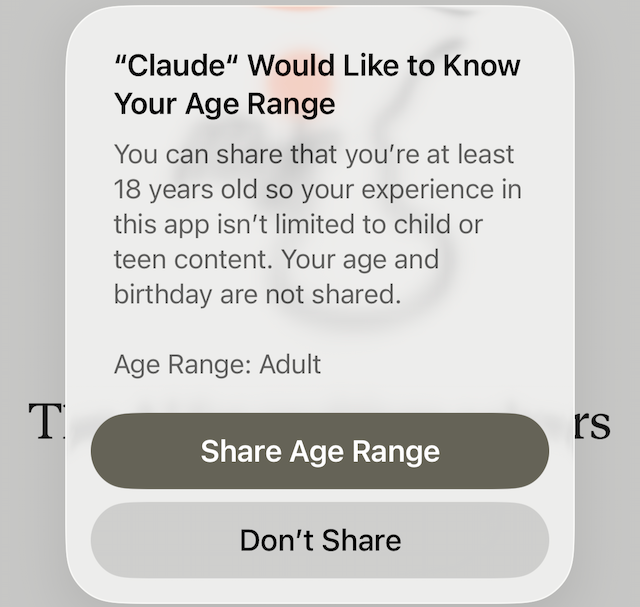
With laws requiring app stores and developers to verify and confirm your age to download apps, we’re not terribly far from laws that require your identity to do the same. I would wager a hotel-priced beverage that Texas, Utah, and elsewhere are salivating at the prospect of knowing who is downloading which apps and visiting which sites.