

Fast, private email hosting for you or your business. Try Fastmail free for up to 30 days.
Kamala Harris Interview on ‘The Late Show with Stephen Colbert’ ⚙︎
Kamala Harris somehow manages to reflect both deep resignation and unbridled hope in her first significant post-election interview, on The Late Show with Stephen Colbert. Harris’ disappointment and disillusionment with the election—and the electorate—is palpable. Ostensibly on the show to pitch her new book, 107 Days, the interview felt akin to the first tentative steps of (very public) therapy, with moments of catharsis—brief, measured, but evident. I got the sense Harris is still emotionally raw from her experience—and understandably so. I think she has a lot to get off her chest, and this was her initial foray.
The moment that captured my attention came early in the interview. After Colbert asked if foregoing a run for governor of California is to “save herself for a different office,” she made it clear that “it’s more basic than that,” flatly stating:
I don’t want to go back in the system. I think it’s broken.
I—and the audience—gasped. It’s a stinging indictment. Even Colbert appeared taken aback, calling it “harrowing”—to which Harris quietly responds:
Well, but it’s also evident, isn’t it?
It’s quite evident to anyone paying even trivial attention—and not completely consumed by the MAGA cult.
Harris makes it clear her decision is not about giving up, that she’s “always gonna be part of the fight,” her goal being to “remind everyone who needs reminding right now of their power.”
The entire interview is terrific, including a moment toward the end when Harris acknowledges that, while she predicted much of what a Trump regime would bring, she could not predict “the capitulation” of “the guardians of our systems and our democracy.” Harris is unable to disguise her disgust for those supposed “guardians,” some of whom she calls “feckless.” Her anger is unmistakable.
Our civic discourse desperately needs more of Harris’ clear-eyed, righteous anger—and less apathetic acquiescence. I’m hopeful that her “listening tour” will spark other leaders to speak out. America needs a reckoning—and it can’t come quickly enough.
Figma Pops 250% in Market Debut—Adobe, Who? ⚙︎
Jordan Novet, CNBC:
Figma’s stock more than tripled in its New York Stock Exchange debut on Thursday, a day after the design software company sold shares at $33 in its initial public offering.
Figma’s first trade at $85 valued the company at about $50 billion. The stock, trading under ticker symbol FIG, was halted after it soared past $112, before closing at $115.50 for a 250% gain. The company ended the day with a market cap of almost $68 billion.
I don’t often lust after company IPOs, but Figma is one I would have loved to get in on—not because I use Figma (I don’t), but because so many designers I know and respect love it.
Adobe’s plan to acquire Figma in 2022 for $20 billion fell through in the face of tough regulatory scrutiny. Figma got a $1 billion breakup fee that I’m sure softened the blow at the time, but today’s massive IPO no doubt makes up for any hard feelings.
Back to Novet at CNBC:
Figma boasts more than 13 million monthly users, two-thirds of whom are not designers. As of March 31, more than 1,000 clients were paying Figma upward of $100,000 annually, according to the prospectus. Google, Microsoft, Netflix and Uber are all customers.
Count Apple as a customer, too. Just a couple of weeks ago, they released an iOS 26 and iPadOS 26 design kit (or “UI Kit” in Apple parlance)—one of several design kits and icon templates created for Figma since iOS 17.
Oh… I didn’t get in on the IPO, of course—that’s reserved for the rich-and-well-connected crowd. And I have no plans to buy Figma at its post-pop price—way too rich for my blood. I’ll chill on the sidelines until the froth subsides.
(I’m Waiting for Go-down.)
Apple Reports Strong Q3 Despite Tariff Headwinds ⚙︎
Apple today announced financial results for its fiscal 2025 third quarter ended June 28, 2025. The Company posted quarterly revenue of $94.0 billion, up 10 percent year over year, and quarterly diluted earnings per share of $1.57, up 12 percent year over year.
Apple also reported “double-digit growth in iPhone, Mac and Services,” 12% EPS growth year over year, and “a new all-time high” installed base.
All in all, a strong quarter despite a significant impact from tariffs. During the earnings call, Tim Cook reported a small “pull forward of demand”—that is, purchases made sooner because of tariff concerns—but said it was only about one percentage point of the ten-point growth they saw. A bigger impact was the tariffs themselves. Cook said of this (as transcribed by 9to5Mac):
For the June quarter, we incurred approximately $800 million of tariff-related costs. For the September quarter, assuming the current global tariff rates, policies, and applications the balance of the quarter, and no new tariffs are added, we estimate the impact to add about $1.1 billion to our costs.
In addition to tariff uncertainty, Apple is also looking at a potential dent to its services revenue next quarter. Daniel Howley at Yahoo Finance:
The company could also have to deal with the impact of Google's antitrust lawsuit on the company's $20 billion per year agreement to use Google Search as the default option in the Safari browser and Siri.
Apple stock rose nearly 3% after hours before settling back under 2% as I publish.
See also: Jason Snell at Six Colors has his colorful charts up.
Wirecutter’s ‘Best Canned Cocktails’ ⚙︎
Antara Sinha, with a tough assignment at Wirecutter:
In our hunt for the best, we tasted 40 canned cocktails. Many just couldn’t hold up to the quality of a freshly made drink. But a few were balanced, complex, and convenient enough that we wouldn’t mind sipping on them in a variety of settings, from sunny beach days to, yes, swanky dinner parties. Here are the cans we couldn’t get enough of.
I’ve never tasted a canned cocktail worth trying again, but I haven’t tried any of these. “Best canned cocktails” is like “best frozen pizza”: a convenience option—acceptable in a pinch, probably better than nothing, and always a pale imitation of the real deal.
It’s Getting Harder to Pretend This Isn’t 1930s Germany
I recently saw two stories back-to-back that chillingly underscored where we are as a country—and where we’re headed.
The first was via Heidi Li Feldman, who shared this Will Bunch article from The Philadelphia Inquirer with the comment:
Important Will Bunch column on American concentration camps.
I don’t know about you, but “American concentration camps” lands like a jackhammer to the chest.
Bunch interviews Andrea Pitzer, author of One Long Night: A Global History of Concentration Camps:
“I’m particularly concerned about where we are now, because we’re well into that five-year period in terms of we’re already doing sweeps, right?” Pitzer said. “We’ve already got masked guys. We’re already disappearing hundreds of people to … foreign countries, or to the Everglades, or now to Fort Bliss” — the El Paso, Texas, military base, which the Trump regime just awarded a $1.2 billion contract for a large new camp.
Bunch:
The most famous case study, in Nazi Germany, is also the source of many current misconceptions, since the “final solution” death camps, such as Auschwitz in Poland, where some of the six million Jews murdered in the Holocaust died in gas chambers, have often been what people think of. But the first well-known German concentration camp, Dachau, opened less than two months after Hitler took power in early 1933, and was used to detain — not slaughter — the Nazis’ political opponents.
“It was used in a kind of social engineering way,” Pitzer said of Hitler’s early camps. “There were a lot of homeless people, there were a lot of career criminals that they put in the camps to kind of dilute the percentage of political prisoners. So it would be more of a PR thing. People would support it more. You saw detention, particularly, of gay men.”
Immediately after seeing this article, a second crossed my social feeds—yet another executive order, written to sound benign, yet is anything but. Robert Davis at Raw Story explains it:
The order, titled “Ending Crime and Disorder on America’s Streets,” directs multiple federal agencies to discontinue funding services such as Housing First, Safe Consumption Sites, and other harm reduction practices. It also directs states to detain people with serious mental illnesses regardless of “forensic bed capacity at appropriate local, State, and Federal jails or hospitals.”
The executive order asserts:
Shifting homeless individuals into long-term institutional settings for humane treatment through the appropriate use of civil commitment will restore public order.
It also calls for the government to:
enforce, and where necessary, adopt, standards that address individuals who are a danger to themselves or others and suffer from serious mental illness or substance use disorder, or who are living on the streets and cannot care for themselves, through assisted outpatient treatment or by moving them into treatment centers or other appropriate facilities via civil commitment or other available means, to the maximum extent permitted by law[…]
And it seeks to encourage:
civil commitment of individuals with mental illness who pose risks to themselves or the public[…]
This was via Denise Wheeler, who, in linking to the article, noted:
Hitler targeted people with mental or physical disabilities for murder in what the Nazis called the T-4, or “euthanasia” program.
Evan Urquhart of Assigned Media pulls it together:
As usual it’s too early to tell what this will look like in practice, but at a minimum they’re clearing the way for involuntary commitment for any homeless people authorities decide to target as well as at least some non-homeless people with mental illness.
At maximum this seems to open the door for authorities declaring people mentally ill and institutionalizing them on that basis.
It could lead to attempts to use this against protesters who haven’t done anything arrest-worthy, and perhaps eventually activists/dissidents/ideological opponents.
We’re constantly being told that America’s present is nothing like Germany’s past—so why does it look so damn familiar? It’s increasingly disingenuous, verging on intentional ignorance. These articles and commentary testify that “authoritarian America” is no longer an historical allusion or a speculative future: it’s our present.
Doug Glanville on ‘The Quiet Greatness of Ryne Sandberg’ ⚙︎
A lovely reminiscence from former Cubs outfielder Doug Glanville on how Ryne Sandberg’s “quiet confidence” during a minor league rehab stint subtly shaped his big league career:
But for me, I focused on something more personal. He was calm, intentional. He looked casual on the outside, but he cared. He was competitive, and he led by example, without having to say anything. No speeches, just a line or two of advice in private that carried more weight than a locker room address.
It gave me the freedom to challenge the labels I had been given, realizing that maybe those who assign labels are actually the lazy ones. Too impatient to take the time to really understand and get to know a player. Sure, it is important to listen and accept feedback, but I have always found it a stretch to accuse someone of not caring. Especially if the accusation is based solely on volume.
The following year, I made the 40-man MLB roster for spring training in Arizona. Fortunately, the Cubs put my locker next to Sandberg’s. I had a front-row seat to his routine. And long before I fully understood his work ethic, I took comfort in knowing you can be true to yourself and still add value to your team, and to your own performance.
Published a month ago, but made painfully poignant following Ryno’s passing.
Ryne Sandberg, Cubs’ Stellar Hall of Fame Second Baseman, Dies at 65 ⚙︎
Patrick Mooney, writing for The Athletic on Monday:
Ryne Sandberg, an iconic player for generations of Chicago Cubs fans and a distinguished member of the National Baseball Hall of Fame, died Monday at the age of 65 from metastatic prostate cancer, the team announced. Sandberg passed away at his home, surrounded by his family, the Cubs shared.
Jay Cohen, AP:
Sandberg announced in January 2024 that he had been diagnosed with metastatic prostate cancer. He had chemotherapy and radiation treatments, and then said in August 2024 that he was cancer-free.
But he posted on Instagram on Dec. 10 that his cancer had returned and spread to other organs. He announced this month that he was still fighting, while “looking forward to making the most of every day with my loving family and friends.”
Absolutely Fuck Cancer.
Eli Ong, WGN, Chicago’s Very Own broadcast home of the Cubs:
In all, Sandberg played 15 seasons on the North Side and finished his career as a Cub in 1997. By the time he hung up his cleats, he had become a ten-time all-star, nine-time Gold Glove winner (all consecutively), a seven-time Silver Slugger, and the 1990 home run derby champion (the same season he led the NL in home runs).
Growing up in New York in the mid-’80s and early ’90s, I watched “Ryno” play a lot against my beloved Mets. He was one of the best-hitting, best-fielding second basemen of my youth—much to our great frustration.
He played the game hard, he played it right, and he played it with “respect,” as he called it in his wonderful Hall of Fame induction speech:
Everything I am today, everything I have today, everything I will ever be is because of the game of baseball. Not the game you see on TV or in movies—Baseball. The one we all know. The one we played with whiffle ball bats, pretending to be Yaz or Fisk or Rose, in dirt fields and in alleys. We all know that game. The game fit me because it was right, it was all about doing things right. If you played the game the right way, played the game for the team, good things would happen. That’s what I loved most about the game, how a ground out to second with a man on second and nobody out was a great thing. Respect.
[…]
I was taught you never, ever disrespect your opponent or your teammates or your organization or your manager and never, ever your uniform. Make a great play? Act like you’ve done it before. Get a big hit? Look for the third base coach and get ready to run the bases. Hit a home run? Put your head down, drop the bat, run around the bases, because the name on the front is a lot more important than the name on the back. That’s respect.
Today’s players could learn a lot about “respect” from Ryno.
My condolences to his family, friends, and fans.
Nerd Achievement Unlocked: My Name and Snarky Comment Read on ATP
I’ve been listening to ATP—Accidental Tech Podcast—for its entire decade-plus run. Self-described as “Three nerds discussing tech, Apple, programming, and loosely related matters,” the hosts (Marco Arment, Casey Liss, and John Siracusa) bring a thoughtful yet playful approach to their Apple and tech conversations. Every episode is a joy to listen to (even though they sometimes rile me up), and it’s one of a small handful of podcasts I (gladly) pay to support.
On episode 647: You Get One Exclamation Point, The Boys™ discuss various ways Apple might achieve cost savings on a rumored low-cost Apple laptop. Their ideas, presented draft-pick style, were mostly serious, focusing on components Apple might remove to reduce the price of this hypothetical new hardware.
After the show aired, I quipped on Mastodon:
One option not suggested by The Boys™ on the latest @atpfm for cost savings on the rumored “low-cost Apple laptop”:
Ads on the boot, login, and wake screens—and, for good measure—the screensaver 🤑
Coming Soon: “Apple MacBook (Fall 2025, with ads)”… with a $150 option to remove them 🤪
One enjoyable ATP bit is that each episode starts with Follow-up (copyright John Siracusa), where they expand, correct, or simply comment on previous topics. That often includes commentary from their listeners.
On episode 650: Whatever It Takes to Get the Laundry Folded, came this follow-up:
Alright, with regards to the low-cost Apple laptops, Jason Anthony Guy writes…
Nerd achievement unlocked! 🔓🎉 Imagine my shock in hearing this last week (the episode came out today, but I listened to the “bootleg,” released immediately after recording ends—it’s one of the perks of membership). I was utterly delighted. It’s the nerd equivalent of having your Letter to the Editor printed in the newspaper or your timestamp opening NPR Politics.
(Ask your parents, kids.)
One thing you may have noticed in my Mastodon post: I wrote “Apple MacBook (Fall 2025, with ads)”. Casey dutifully explains the joke (it’s an Amazon Kindle reference), but John and Marco humorously correct him that Kindle has “special offers,” not “ads”.
I apologized to Casey for botching the joke and forcing him to bear the brunt of Marco’s and John’s joshing for my humor fail.
But wait! Turns Out™, the Kindle purchase options are “Ad-supported” and “Without Lockscreen Ads.” No mention of “special offers”!
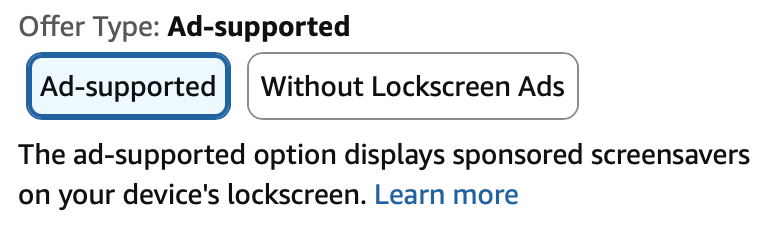
Vindication!
OK, well, partial vindication: the Kindle device management page (where you can remove lock screen ads), does call them “Special Offers”.

#CaseyWasRight to call them “ads” and deserves both partial credit and a tearful (and no doubt begrudging) apology from his doubting cohosts in the next follow-up.
‘Glass Is Not a Part of Our Evolutionary Environment’ ⚙︎
Ilia Werner (Design Lovers on YouTube) wonders:
What is it about [glass] that makes tech giants return to it again and again? […]
Glass is not a part of our evolutionary environment.
Werner answers:
We are drawn to glass because it masterfully combines a primal, sensory lure with a sophisticated cognitive tool, all wrapped in the perfect metaphor for our digital age.
A short, thought-provoking perspective on the seemingly cyclical nature of glass (and glassy) user interfaces—from Aqua to Windows Aero to iOS 7 (a surprising but valid inclusion), and now, Apple’s Liquid Glass.
Adam Aaronson Drank all 102 IBA Cocktails ⚙︎
The International Bartenders Association, or IBA, maintains a list of official cocktails, ones they deem to be “the most requested recipes” at bars all around the world. It’s the closest thing the bartending industry has to a canonical list of cocktails […]
As of 2025, there are 102 IBA official cocktails, and as of July 12, 2025, I’ve had every one of them.
The journey has taken me to some interesting places, and now that it’s done, I have a little story to tell for each cocktail. I’m not gonna tell you all 102 stories, but I do want to debrief the experience. Drinking all 102 cocktails turned out to be unexpectedly tricky, and for reasons you’ll soon understand, I might be one of the first people in the world to do it.
This is my kind of project, and I’m disappointed that I didn’t think to do it myself.
I’ve tossed back a mere 43 of the current 102 IBA cocktails, a disappointing showing for a self-described cocktail enthusiast. This, of course, must and will be corrected. Many of the cocktails I’m missing are variations on a theme, with ingredients I have or can easily procure. The rest will require dedication—though I’m unsure if I’ll be able to achieve a 100% completion any time soon, considering the challenges Aaronson describes for his “final boss” cocktail: the IBA Tiki, which requires a pair of Cuban rums unavailable—legally, anyway—in the U.S.
Aaronson catalogs each cocktail by name recognition (well-known, medium, obscure) and by ingredient availability (easy, medium, hard) to identify which ones you’re likely to find at any halfway decent cocktail bar, and which ones you’ll have to hunt for—a very handy cheat-sheet!
One takeaway from Aaronson’s exercise: I need to start keeping lists.
(Via Nick Heer at Pixel Envy.)
MAGA’s ‘Hero Frame Collapse’ ⚙︎
Trump’s MAGA movement now faces a profound cognitive crisis. Their leader has violated the central promise of their political identity—the promise to reveal hidden truths and expose child sex abusers. But the conspiratorial frame he taught them makes it impossible to simply accept this as ordinary political disappointment.
Instead, they must choose between two equally destabilizing options: abandon the conspiratorial thinking that has become central to their identity, or turn that conspiratorial thinking against Trump himself.
[…]
This is why fighting conspiracy theories with facts doesn’t work. Facts are interpreted through frames, and frames shape how facts are understood. When someone is thinking conspiratorially, contradictory evidence just becomes proof of how deep the conspiracy goes.
Another take on the slow implosion of the MAGA world view. It’s delightful watching MAGAts contort themselves in their support for—or opposition to—releasing the Epstein files.
Border Agents Detain U.S. Citizen at George Bush Intercontinental Airport ⚙︎
U.S. citizen Wilmer Chavarria, traveling on a U.S. passport, was detained at a U.S. port of entry for… no apparent reason. From Lola Duffort at Vermont Public:
What followed, according to Chavarria, who has been a U.S. citizen since 2018, was “nothing short of surreal and the definition of psychological terror.” The educator said he was separated from his husband, Cyrus Dudgeon, and interrogated by multiple agents over the course of four to five hours.
Chavarria said he was asked whether his marriage was real, whether he was really a school superintendent, and questioned about everything he had done while out of the country. And again and again, he said agents demanded that he hand over the passwords to his phone and district-issued laptop.
There’s no explanation of why Chavarria was stopped at the border, nor why they demanded access to his devices. Coincidentally, I’m sure, he’s a gay man from a Central American country.
Chavarria said he’s had students of color ask him in the past whether they should be worried when they cross the border into the United States. In the case of U.S. citizens, he’s always assured them they had “nothing to worry about.”
“Clearly, this is a change for me in my understanding, and now I’m no longer giving that advice,” he said. “From my own experience, I know that they should be worried.”
The article includes this important reminder:
A U.S. citizen cannot be denied entry into the United States because they refuse to give customs officials the passwords to their devices. But that can prolong an individual’s interrogation, and officials can then seize those devices and hold on to them long after someone has left the airport.
Border agents can keep your phone and try intimidating you, but they can’t force you to unlock it—and they can’t prevent you from entering the country. Again, if you’re an American citizen, you do not need to unlock your device just because you were asked to. You can just say no (Nancy would be proud).
Back in April, the AARP wrote 6 Things You Can Do to Secure Your Phone as You Reenter the Country After Traveling. What world are we living in that the AARP is warning its audience of the dangers of traveling to the U.S.?
Grandpa, tell me again about the “sanctity of citizenship”?
The Customs and Border Patrol offered Chavarria one final insult:
For years, Chavarria has been a member of CBP’s Global Entry program, which allows frequent travelers that undergo a special background check expedited clearance at ports of entry. As he was boarding a flight back to Vermont, he received an email notifying him that his permission to be in Global Entry had been revoked.
The reason? He did “not meet program eligibility requirements.”
Pettiness as policy. Slow. Fucking. Clap.
’Death Rattle of a Cult’ ⚙︎
Thom Hartmann, at The Hartmann Report:
To begin: if you want everything around the Epstein furor to make sense, all you have to understand is that Donald Trump has been leading a cult.
Like Jim Jones did. Like Charles Manson did. Like Rajneesh did here in Oregon. Unlike Manson, but more like Rajneesh and Jim Jones, however, Trump’s cult is fairly large and preexisted his appearance on the scene. And that’s part of his problem.
It’s large enough to have in it three kinds of people.
The three being “true believers,” “facilitators,” and “the true believers who have suddenly seen a crack in reality.” Of these “former true believers” Hartmann writes:
Once they saw the light through that crack — saw the real world — they realized that they were being lied to.
When a cult is on the verge of collapse, these kinds of people become more and more numerous as more and more people begin to wake up from the cult leader’s trance.
At that point, they turn on the cult leader the way a spurned lover turns on the previous object of their affection. They become angry and vengeful. They demand answers. They want to know how they got sucked in and why: “Who did this to me? And to whose benefit?”
This is how Donald Trump’s world is disintegrating right now, and the danger is that, like Jim Jones, Charles Manson, and Rajaneesh, he may destroy a lot of lives when he goes down.
With Trump’s grip on his cult (and his reality) slipping away, the people who puppeted him into power—Rupert Murdoch’s Fox “News” especially—may be looking to cut him loose before he takes them down with him. Given Trump’s incredibly ill-advised $10 billion lawsuit against the Murdoch-owned Wall Street Journal, that moment may be sooner than we think.
Jon Stewart to CBS and Others ‘Bending the Knee’: Go Fuck Yourself ⚙︎
From Monday’s The Daily Show: Trump’s Epstein doodle defense, Stephen Colbert’s cancellation, and a rousing, gospel-inspired, f-bomb-laden musical number.
Do not watch if there are sensitive ears nearby.
Apple Makes Continuing Play for Subscription Revenue with Introduction of AppleCare One ⚙︎
Apple today unveiled AppleCare One, a new way for customers to cover multiple Apple products with one simple plan. For just $19.99 per month, customers can protect up to three products in one plan, with the option to add more at any time for $5.99 per month for each device. With AppleCare One, customers receive one-stop service and support from Apple experts across all of the Apple products in their plan for simple, affordable peace of mind. Starting tomorrow, customers in the U.S. can sign up for AppleCare One directly on their iPhone, iPad, or Mac, or by visiting their nearest Apple Store.
Launching Thursday. At $20–$32 a month ($240–$384 annualized, but there’s no annual pricing), this is a solid deal for the set of Apple customers who both buy AppleCare and have multiple high-priced devices.
(The AppleCare page is already updated with AppleCare One details for each product. I love that the AppleCare One tile updates to show the selected product in combination with two other devices. I appreciate these little details.)
Not all customers benefit from AppleCare One. The cost of AppleCare+ for an iPhone 16e, iPad mini, and Mac mini (all minimally specced) is $17 a month ($10, $3.50, $3.50) or $170 a year ($100, $35, $35).
However, if you own a pair of Apple headphones—from the least expensive AirPods 4 ($15 a month) up—AppleCare One becomes a great deal.
But the absolute screaming deal is for Apple Vision Pro owners: AppleCare+ for this $3,500 device starts at $25 a month ($250 a year). If you have a pair of AirPods or an Apple Vision Pro (or both!) AppleCare One becomes a no-brainer decision.
I use my iPhone caseless. When I’m asked why, my answer is “AppleCare is my case.”
I don’t get AppleCare+ on all my devices, just the ones most likely to be damaged or which cost a fortune to repair. I’m currently paying for five devices—iPhone, MacBook Pro, iPad Pro, AirPods Pro, and Apple Vision Pro—making AppleCare One a clear win.
Apple has consistently looked to Services to boost its bottom line (to the tune of $100 billion annually). Services revenue set all-time highs in both the first and second quarters this year, with double-digit growth in that second quarter, and the upcoming earnings report is likely to tell a similar story. AppleCare One will no doubt drive further growth.
I suspect both customers and Wall Street will cheer this new offering.
Apple Opens Online Store in Saudi Arabia, Plans ‘Iconic’ Retail Location ⚙︎
Apple today announced the expansion of Apple Retail into the Kingdom of Saudi Arabia with the launch of the Apple Store online and Apple Store app, introducing support directly from Apple in Arabic for the very first time. The arrival of the online store marks a new era for customers in Saudi Arabia, who will be able to shop Apple’s full range of products with exceptional service delivered by Apple’s talented, dedicated team members.
And:
Apple announced its plans to begin opening the first of several flagship Apple Store locations in Saudi Arabia starting in 2026. As part of this expansion, Apple is in the initial stages of planning an iconic retail store coming to Diriyah, a UNESCO World Heritage site.
This is the fruition of Apple’s Saudi Arabia retail expansion plans announced in December. Before today, Saudi Arabian customers relied on Apple Authorized Resellers and Service Providers—no direct Apple sales or support. Quite remarkable for a country of nearly thirty-five million people.
Apple also announced support for “Buy Now Pay Later” service Tamara, Saudi Arabia’s first fintech unicorn.
Apple customers have apparently been missing out on quite a lot until now: Apple Store Online brings Personal Setup and shopping support, the Apple Trade In program, AppleCare+, the Apple Education Store, Mac configure-to-order options, personalized Apple Watch case and band combinations, and engraving in Arabic and English on products that support engraving. I think this warrants a well-earned أخيراً! (finally!).
‘Drowning Doesn’t Look Like Drowning’ ⚙︎
This Slate piece from 2013 is especially relevant in light of the tragic drowning death of Malcolm-Jamal Warner.
If you spend time on or near the water (hint: that’s all of us) then you should make sure that you and your crew know what to look for whenever people enter the water. […]
Drowning is almost always a deceptively quiet event. The waving, splashing, and yelling that dramatic conditioning (television) prepares us to look for is rarely seen in real life.
The Instinctive Drowning Response—so named by Francesco A. Pia, Ph.D., is what people do to avoid actual or perceived suffocation in the water. And it does not look like most people expect. There is very little splashing, no waving, and no yelling or calls for help of any kind.
There are several signs of the Instinctive Drowning Response—that someone is drowning—including:
- An inability to call out for help. (“Breathing must be fulfilled before speech occurs.”)
- Their mouths alternately sink below and reappear above the surface of the water. (They “are not above the surface of the water long enough for them to exhale, inhale, and call out for help.”)
- An inability to wave for help. (“Nature instinctively forces them to extend their arms laterally and press down on the water’s surface… so they can lift their mouths out of the water to breathe.”)
- An inability to control their arms (that is, voluntary movements like “waving for help, moving toward a rescuer, or reaching out for a piece of rescue equipment”).
- “Their bodies remain upright in the water, with no evidence of a supporting kick.” (They “can only struggle on the surface of the water from 20 to 60 seconds before submersion occurs.”)
There are several other details to watch for—details that could save a loved one. I urge you to take a few minutes to read the Slate article and educate yourself. As it notes:
Sometimes the most common indication that someone is drowning is that they don’t look like they’re drowning. They may just look like they are treading water and looking up at the deck. One way to be sure? Ask them, “Are you all right?” If they can answer at all—they probably are. If they return a blank stare, you may have less than 30 seconds to get to them. And parents—children playing in the water make noise. When they get quiet, you get to them and find out why.
Be safe.
Malcolm-Jamal Warner Dies at 54 ⚙︎
Associated Press reports this terrible news:
Malcolm-Jamal Warner, who as teenage son Theo Huxtable on “The Cosby Show,” was central to a cultural phenomenon that helped define the 1980s, died at age 54 in an accidental drowning in Costa Rica, authorities there said Monday.
I’m gutted. And such a harrowing way to go.
Malcolm-Jamal Warner as Theo Huxtable was like the brother I never got a chance to meet but always knew what he was up to. Almost exactly one year younger than me, Warner’s Theo and I grew up together, two Black male Brooklynites navigating our teenage and young adult years. I often saw myself reflected in Theo—our overconfidence undercut by our awkwardness, intelligence tempered by academic anxiety, even our mutual slovenliness—everything about Warner’s Theo felt familiar, relatable, and real—albeit a more heightened, absurd, and infinitely funnier reality.
Kevin Fallon at The Daily Beast:
Theo was a conduit for the modern teenager in the ’80s and ’90s: a sense of entitlement and arrogance permeating the usual haplessness that accompany coming of age. That it rang so true—hilarious, endearing, and often profound—is because of the performance of Malcolm-Jamal Warner.
Watching scenes of Warner from The Cosby Show—as difficult as it was given what we know of its namesake—reminded me of just how incredibly talented he was, with boundless energy, impeccable timing, and irresistible charm.
A truly tragic loss.
See also: The New York Times obituary and The Rolling Stone tribute to Warner’s most memorable moment on the show.
John Gruber on His Process of Writing at Daring Fireball ⚙︎
From Myke Hurley’s “State of the Workflow” series on the Cortex podcast (Overcast, Apple Podcasts):
Myke interviews John Gruber of Daring Fireball. They take a deep-dive into how John’s writing takes shape – from capturing ideas and drafting articles to the meticulous editing behind his influential work.
This was a fantastic interview. Gruber started writing at Daring Fireball in 2002, about a year after I started at Apple, and I’ve been reading him since day 1. He’s very prolific and very influential within the Apple community. I’ve always been curious about his writing process, which allows him to churn out piece after interesting piece—but especially so now, early in my second year of public writing as I find my voice, a rhythm, and an audience.
It was revelatory to hear that several of my challenges, from procrastination to word obsession, mirror his own. I was especially chuffed to learn that our writing processes are similar. Asked “Do you agonize over word choice?”, Gruber answers:
I have always, I mean, literally since childhood, always tried to write my final draft right off the bat. Especially the longer the article, the more editing I do for myself. But I can’t bring myself to write other than thinking that I’m just going to start typing with the first word and get to the final word and just hit publish.
Like, the canonical ideal for me would be to not even proofread and just write what I think it’s going to be and hit return. So I, at every step, every single word of the way, am trying to pick the right word. And so yes, I obsess over word choice.
This is almost exactly how I write—and have for as long as I can recall. My goal (rarely achieved): Write straight through, as perfectly as possible, and publish. Start with a thesis—often just an emotional reaction—and write until I’ve exhausted the idea I’m pursuing, agonizing over each word, sentence, and paragraph as I go. Allow the act of writing to determine what needs to be written—How can I know what I think until I see what I say? I’ve rarely had success using outlines or bullet points to write, because the words I want to write I can only find by writing them. Bits and bobs become full sentences, which turn into complete paragraphs, and suddenly I’m not outlining, I’m writing. As Gruber says:
Don’t prepare to do the thing, just do it. I just need to sit down and start writing. And anything that feels like I’m working on the article, if I’m working on the article at all, I might as well just start writing it.
Keith Olbermann: My Experience With Stephen Colbert Is 100% Negative ⚙︎
Olbermann (again) shares his distaste for Colbert, this time in response to Paramount’s cancellation of Colbert’s The Late Show. Consider it a counterpoint of sorts. His critique starts at about the 15:53 mark. (Also available on Overcast and Apple Podcasts.)
Stephen Colbert is not an honest broker. He is not a sincere guy. He is not worthy of your trust, and the more I reflect on it, the more I think there was something to the old conservative theory about the Comedy Central show, that he was not some liberal pretending to be a stupid conservative, a really dumb Bill O’Reilly, who kept stepping on rakes, that he was a conservative, pretending to be a stupid conservative, so he could surreptitiously counter liberal narratives in a liberal space, and counter, more importantly, things like reality, and facts, and Democrats.
He details his early experiences with Colbert and rails against Colbert’s treatment of David Letterman’s staff after taking over the late-night slot.
It’s clearly personal. I wonder what Colbert thinks of Olbermann?
John Gruber on CBS’s Cancellation of ‘The Late Show With Stephen Colbert’ ⚙︎
John Gruber, at Daring Fireball (under the biblical title “Curse Not the King”):
In the way that fish take water for granted, Americans take true freedom of speech and freedom of the press for granted. It’s the culture we were born into, the air we breathe. And to my mind, the fiercest and most effective form of criticism — especially political — is mockery. Mark Twain, America’s first great (and perhaps still greatest) humorist, said, “Against the assault of laughter, nothing can stand.”
No one in Russian media mocks Vladimir Putin, lest they find themselves falling out one of Russia’s easily-fallen-out-of windows. No one in Chinese media mocks Xi Jinping. Back in 2017 the CCP went as far as to censor images of Winnie the Pooh, because Xi resembles Pooh so clearly, and people naturally find that amusing. Trump, clearly, has authoritarian instincts and desires, but US media — print, web, podcasts, YouTube, social, and TV — has been replete with unrelenting mockery aimed at him. There’s no better example of that than late night talk shows: Colbert on CBS, Jimmy Kimmel on ABC, Seth Meyers on NBC, Jon Stewart and his fellow hosts on The Daily Show at Comedy Central, John Oliver and Bill Maher on HBO. Vociferous, unrelenting critics of Trump, all of them. (And it works both ways: Greg Gutfield’s Gutfield! is a ratings success at 10:00pm for Fox News.)
That’s been one of the canaries I’ve been monitoring in the Trump 2.0 drift-into-authoritarianism coal mine. So long as Trump is getting skewered by comedians on major TV channels nightly, in some sense, we’re doing OK.
But while our Constitution and cultural fabric protect our media from government interference, there’s no such protection from ownership interference.
Solid piece—well researched, with terrific framing. Gruber really captures much of my shock, anger, and frustration when I learned of Colbert’s cancellation.
While I stopped watching late-night shows years ago, Colbert’s was the one show whose clips I’d catch semi-regularly. He was funny, nerdy, and we were (seemingly) politically aligned.
I could (if I squint really hard) understand Paramount firing Colbert if they were unhappy with his performance—or his politics—but to also end The Late Show is astonishingly short-sighted, and screams of pretext, a desire from Paramount to punish (silence) Colbert, while providing (in-)sufficient cover for doing so: “We’re not getting rid of Colbert; we’re exiting the late-night business!” It reeks of political animus disguised as an economic choice.
Thirty years of history, evaporated, just like that.
More on ChatGPT agent ⚙︎
ChatGPT can now do work for you using its own computer, handling complex tasks from start to finish.
You can now ask ChatGPT to handle requests like “look at my calendar and brief me on upcoming client meetings based on recent news,” “plan and buy ingredients to make Japanese breakfast for four,” and “analyze three competitors and create a slide deck.” ChatGPT will intelligently navigate websites, filter results, prompt you to log in securely when needed, run code, conduct analysis, and even deliver editable slideshows and spreadsheets that summarize its findings.
At the core of this new capability is a unified agentic system. It brings together three strengths of earlier breakthroughs: Operator’s ability to interact with websites, deep research’s skill in synthesizing information, and ChatGPT’s intelligence and conversational fluency.
ChatGPT carries out these tasks using its own virtual computer, fluidly shifting between reasoning and action to handle complex workflows from start to finish, all based on your instructions.
The site showcases several compelling video demos (but not, alas, the all-MLB-ballparks example from the intro video).
ChatGPT agent is available to Pro, Plus, and Team users (though it hasn’t shown up on my Plus account yet due to high Pro demand).
TechRadar’s Review of Donkey Kong Bananza ⚙︎
Dashiell Wood reviews Donkey Kong Bananza for TechRadar (“Donkey Kong Bananza is a must-have Nintendo Switch 2 game and worthy Super Mario Odyssey successor”):
Donkey Kong Bananza is a brilliant showcase of the power of the Nintendo Switch 2, thanks to its crisp visuals and showstopping destruction, and the hundreds of collectibles will provide tens of hours of entertainment even after the credits roll for those willing to put the time in.
It’s a worthy Super Mario Odyssey successor in almost every regard, and if Nintendo can keep this level of quality up with future Nintendo Switch 2 releases, it’s clear that the console will have a long and successful run just like its predecessor.
The “verdict”:
Donkey Kong Bananza is the greatest Nintendo Switch 2 title to date, delivering an incredible destruction system that showcases the power of the new system. It’s visually impressive and, while the story isn’t anything to write home about, benefits from charming and expressive voice acting and animations. Throw in a seemingly endless stream of collectibles and secrets, and you have a meaty adventure that’s a delight to explore.
See also Scott Stein’s review for CNet, which describes the game as “Mario and Zelda Smashed Together,” calling it “the best reason to buy a Switch 2 yet.”
I’m doubly excited.
Nintendo Switch 2
I’m surprised to find I’ve only mentioned the Nintendo Switch 2 in relation to the Trump Tariffs that delayed preorders and threatened to raise its price.
I tried, rather half-heartedly, to buy a Switch 2 at launch. It would have been nice to have, but I wasn’t about to wake up early to get one: we have the original Switch and don’t play it very often (anymore). I’d just wait until supply caught up with demand, and buy then, whether that was a month or a year later.
While browsing Amazon this week, I noticed the Switch 2 was “available by invitation.”
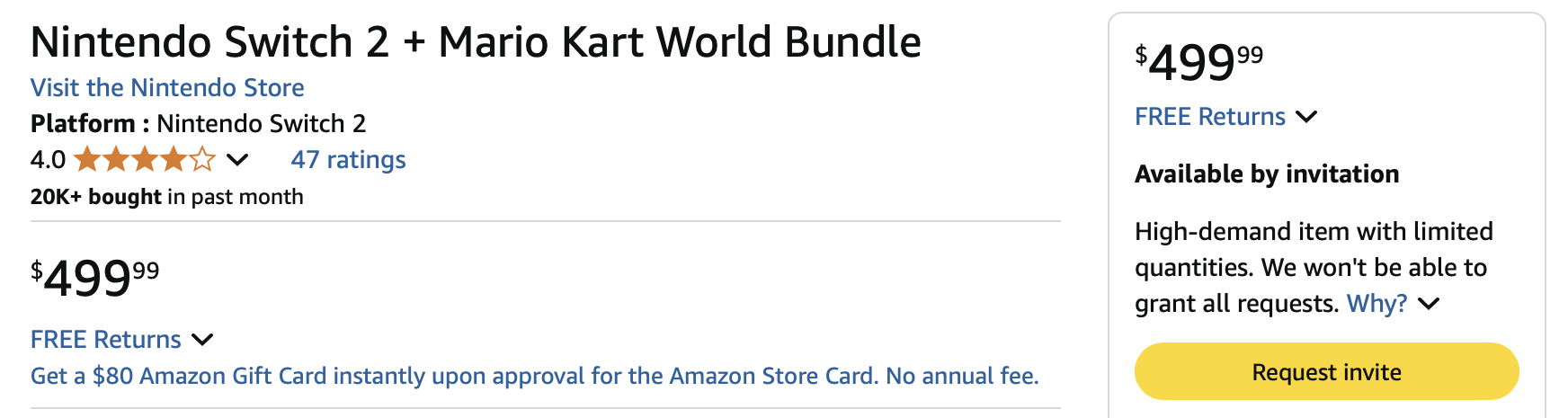
I had no idea what that meant, but I clicked on Request invite anyway. I figured it would be a few months before I got a chance to order. An email confirmed my chances of being selected were slim:
We process requests and send invites to qualified customers regularly, while supplies last. If invited to purchase, you’ll receive an email with a link that’s valid for 22 hours.
If you aren’t selected during this round of invites, your request is still eligible to be selected in future rounds so you don’t need to submit another request for the next 3 months. Since supplies are limited, we won’t be able to grant all requests.
What, I wondered, is a “qualified customer”? Regardless, I promptly forgot about it.
Five days later:
Congrats, you’re invited!
You can now buy the Nintendo Switch 2 + Mario Kart World Bundle. You have 22 hours from the time this email was sent to complete this purchase.
Apparently I’m a “qualified customer.”
So, an hour and a half later:
Ordered: “Nintendo Switch 2 + Mario…” and 2 more items
(While I was at it, I also ordered a Pro Controller and Donkey Kong Bananza.)
Supply, meet demand.
The console should arrive in the next couple of weeks. No doubt we’ll play it intensely for a few months, then it’ll sit unused until the Nintendo Switch 3 comes out.
I’m excited!
OpenAI Introduces ChatGPT Agent, Demonstrates it Planning Visits to All 30 MLB Ballparks
I don’t usually watch ChatGPT feature release videos because I find the just-sitting-around-a-table-chatting vibe a bit cringe, but I ended up watching Introduction to ChatGPT agent out of curiosity more than anything else.
As an agent, it does what you’d expect: accomplishing a task by running a virtual computer that controls multiple tools (text and web browsers, a terminal for running code). It looks capable enough (the primary example was planning a wedding trip; at one point, the agent realized it needed to understand “what does ‘black tie optional’ mean?” to figure out what type of suits to suggest), but what sparked this mention was the mini-demo at the end.
This demo starts at 22:44, where the presenters ask ChatGPT to build a plan to visit all 30 Major League Baseball parks in one summer. The agent pulls schedules, prioritizes day games, identifies the optimal routes between parks, and even highlights the best food in each park. It compiles a spreadsheet with all the information and generates a map.
I was gobsmacked. For the results, sure, but mainly for the topic itself. I’ve long aspired to visit all 30 MLB parks in a summer. I even bought and parked a domain name forever ago—BigLeagueRoadTrip.com—to document my progress.
That was 2016. The realities of work kept the idea for such an excursion firmly in the realm of pure imagination, but I recently started again considering what such a trip might look like—and again balked at the logistical nightmare it would be.
Now, a huge chunk of the work could be delegated to agentic software—accomplishing tasks that would take hours or days if done manually, but that can now be completed in seconds or minutes by software.
I felt like this demo existed specifically to convince me to use ChatGPT agent. If it was a micro-targeted drop-in, I wouldn’t be surprised.
Which might mean a legitimate shot at a Big League Road Trip in 2026.
Nvidia Now Worth $4 Trillion, Just One Year After Hitting $3 Trillion ⚙︎
It’s been a week since Nvidia topped, then closed above the $4 trillion market cap mark, and I’m still having a hard time wrapping my mind around “a graphics card company” becoming the first to achieve this milestone. Some analysts are already anticipating a $5 trillion market cap.
When Nvidia hit $3 trillion—just a year ago!—I linked to a story detailing their near-collapse in 1995. I remain awed by their resilience, but also skeptical of the AI frothiness that’s driving their valuation.
Tripp Mickle, in his New York Times coverage, notes:
Nvidia’s rise is reminiscent of dot-com era titans like Cisco and Juniper Networks, which built the equipment that ran communications networks for the internet. Cisco’s shares increased more than a thousandfold between its initial public offering in 1990 and 2000, when it briefly became the world’s most valuable company.
What Mickle doesn’t say is that Cisco, valued at more than $550 billion at the height of the dotcom era, is worth only $270 billion today.
Nor does he mention that Juniper Networks was at the time valued at over $40 billion, with a share price over $244. It was acquired earlier this month by Hewlett Packard for $14 billion, or $39.95 a share.
I’m not predicting a similar trajectory for Nvidia—that would be foolhardy—but this unprecedented rise from $1 trillion to $4 trillion in two years gives me pause.
Of course, I also didn’t buy Nvidia at $45 like I was told to, so perhaps don’t come to me for stock advice.
No doubt I’ll be writing a “$5 trillion valuation” piece within the year.
The Apple Style Guide Game Show
I thoroughly enjoyed this fun, silly Snazzy Labs video:
Apple is famous for its pedantic product naming and lingo, but did you know it’s all kept in a lesser-known 243-page rulebook? In this ultimate tech collaboration, @LinusTechTips, @mkbhd, @ScottTheWoz, and Quinn from @snazzy compete to test their knowledge of Apple’s hidden terminology and naming conventions. @upgraderelay host, Myke Hurley, challenges us with real questions and scenarios based on Apple’s internal style guide to see who really knows the company’s most bizarre rules. Do you know Apple’s lingo better than some of YouTube’s biggest tech creators? Play along and find out if you can beat us at our own game!
I went into this game expecting a perfect score. After all, I worked in Apple’s Product Marketing organization (in Developer Relations), where adherence to the Apple Style Guide was practically a requirement.
I’m also building a JAG’s Workshop Style Guide, modeled after the Apple Style Guide, to ensure editorial consistency on this site—and especially to resolve conflicts that arise with the Chicago Manual of Style, AP Stylebook, and Oxford Style Manual.
So I was crushed by my actual showing: a mere 150 points out of a possible 210—enough to top the eventual winning score of 130 points, but still quite embarrassing.
My former colleagues must be appalled.
I got three questions wrong, and missed a couple in the final “two errors” round.
I distinctly recall Apple preferring portable computer and notebook computer, over concerns that “laptops” got very hot and could burn you. The October 2022 edition of the Apple Style Guide (available as late as January 2024) had these three entries:
notebook computer The preferred generic term for Apple portable computers. It’s OK to use notebook alone occasionally if the meaning is clear. You can also use portable computer, but when you refer to a specific model (such as MacBook Air or MacBook Pro), itʼs best to use the model name.
portable computer An alternative to notebook computer. Avoid using portable as a noun, except in informal contexts. The terms notebook computer and notebook are generally preferred for Apple portable computers.
laptop computer Avoid in favor of notebook computer, which is preferred, or portable computer.
This was the case until a March 2024 update, when notebook, notebook computer, and portable computer were all deprecated in favor of laptop.
The question about accessing Apple Pay on iPhone threw me, because Apple unexpectedly distinguishes between pressing a button once or more than once:
Use press to mean pressing the side button once; use double-click or triple-click to mean pressing it more than once.
This was true for devices with a Home button, but was expanded in March 2024 to include all buttons you can press more than once.
Lastly, I was confident the display on the front of Apple Vision Pro was called EyeSight, but that’s just the name of the technology. The physical part of the device is just called the front display.
Round 3’s “two errors in the sentence” was especially challenging because I usually wanted to make more than just two fixes.
I was disappointed I missed tap instead of tap on, and turn instead of rotate, but it was the final question I found especially problematic. The incorrect sentence:
The Mac Studios are powerful, with M2 Ultras chips inside.
Clearly pluralizing Mac Studios and M2 Ultras is wrong: it should be Mac Studio (singular) or Mac Studio computers (or devices as the “official” answer suggested); and M2 Ultra (singular) or M2 Ultra chips(plural):
The Mac Studio computers are powerful, with M2 Ultra chips inside.
But I’d also drop the definite article, stick with the singular, and reference the chip differently:
Mac Studio is powerful, with the M2 Ultra chip inside.
And I’d go even further:
Mac Studio with the M2 Ultra chip is powerful.
If this is causing your mind to warp, imagine what it’s done to those of us who wrote (or write!) this way for a living.
San Diego Performing Arts Groups Combine Improv and Activism for ‘Know Your Rights’ Workshops ⚙︎
KPBS Midday Edition in San Diego featured two local theatre groups—Uprise Theatre and Voces Unidas/Voices United—using improv to educate their community about their rights in the face of ICE raids. (Listen in Overcast or Apple Podcasts.)
Annie Rios, Uprise Theatre:
Uprise Theatre is a nonprofit organization here. It is rooted and run out of southeast San Diego in particular. We use art and activist lawyering to disrupt systems of oppression and reclaim power with the people. And that’s a really fancy way of saying that we use a lot of different creative and artistic techniques to educate and empower folks about their constitutional legal rights, especially as it pertains to law enforcement.
Guillermo Mendez, Voces Unidas/Voices United:
What we do is people’s theatre in action. […] Our job in theater is to put it on stage. The tears, the sweat, the blood, the death, the laughter, all the things that go on in the working class community, all our struggles—put it on the stage. But in this also, how we can figure out how to use theater, improvisation and teaching and working with the community, how to address this particular moment, how to address this fascism that’s in our community.
The conversation was deeply inspiring and it got me thinking of different ways I could use my theatre and improv background to get involved with a similar effort. A wonderful use of the performing arts to empower communities.
(Via Ronzilla.)
In Yet Another Government Handout, Musk’s xAI Lands $200 Million Government Contract for Anti-Semitic Grok AI ⚙︎
Lauren Feiner, The Verge:
A week after Elon Musk’s Grok dubbed itself “MechaHitler” and spewed antisemitic stereotypes, the US government has announced a new contract granting the chatbot’s creator, xAI, up to $200 million to modernize the Defense Department.
I guess Elon and Donald made up.
The contract announcement from the Chief Digital and Artificial Intelligence Office (CDAO) is light on details, but says the deals will help the DoD “develop agentic AI workflows across a variety of mission areas.” Alongside the contract award, xAI announced “Grok for Government,” which it says will supply “frontier AI products” to the US. In addition to the DoD contract, xAI says other federal agencies will now be able to purchase its tools via the General Services Administration (GSA) schedule. The company plans to work on new products for government customers, like custom models focused on national security, applications for healthcare and science use cases, and models accessible in classified environments.
Me, using ChatGPT earlier today:
ChatGPT 🤖: In AP style, dammit (with an “e”) is considered the standard spelling when used in print.
🤦🏽♂️: I’m sorry?
🤖: Yes—you read that right. In AP style, the standard spelling is “dammit” (with an e), not “damnit.”
🤦🏽♂️: Where is there an “e” in “dammit”?
🤖: There is no actual “e” in dammit. I wasn’t saying there’s an “e” in the word itself—I was contrasting the two spellings (dammit vs. damnit)… The word is spelled dammit. No “e” beyond the one in dam.
Yeah, the government’s gonna be just fine under AI control.
Trump Supporters Are Making It Very Difficult for Me to Enjoy Delicious Schadenfreude
It’s abhorrent that the current regime is making Americans fearful that they may be snatched from their homes or detained at the border—and possibly dispatched to a concentration camp in another country, or worse, Florida.
I understand I must be consistent in my denunciation of ICE and their arbitrary, usually racist raids and detentions—no one should be worried they won’t be able to return home to their family and friends, be they citizen, legal resident, or undocumented.
But damn it, every time a member of the Leopards Eating People’s Faces Party has their face eaten by a leopard, I savor—however briefly and against my better angels—that bittersweet schadenfreude:
Chris Landry is a legal U.S. resident and has lived in the Granite State since he was 3 years old. He has a partner, five children and a job in manufacturing.
He was stopped Sunday at the border in Houlton, Maine, while returning from a family vacation. […]
Three hours later, the 46-year-old was told he couldn’t come home, despite having a green card and being a legal U.S. resident. […]
As a Canadian citizen, he couldn’t vote for president, but he supported Donald Trump. […]
“I was definitely all for ‘Make America Great Again,’ and having a strong, unified country, and a bright future for my five American children, but now I feel a little differently,” he said. “I’ve been torn from my family. My life has been disregarded completely.”
If Arpineh Masihi could vote, she would have cast her ballot for Donald Trump. She’s a devout supporter of the US president – even now that she’s locked up as an illegal immigrant.
“He’s doing the right thing because lots of these people don’t deserve to be here,” Arpineh told the BBC over the phone from the Adelanto immigrant detention centre in California’s Mojave Desert.
“I will support him until the day I die. He’s making America great again.”
I’m not about to let this regime turn me into someone who delights in the suffering of others just because they voted against their own best interests.
But please do allow a momentary smirk.
‘Trump’s Failing Ability to Command Attention’ ⚙︎
Marcy Wheeler at Empty Wheel offers a terrific teardown of Trump’s “Truth” Social attack on Rosie O’Donnell, the media’s inability (or unwillingness) to identify the reason for it, and what his later Epstein follow-up says about Trump’s slipping “super power”:
Rosie O’Donnell made a powerful moral critique of Trump, and as that critique was bearing out, he responded to it by asserting to have power over her, power he doesn’t have. And rather than focusing on or even mentioning that moral critique — or even continuing to focus on the many ways the Trump Administration did exacerbate the flood — those who disseminated his tweet gaped in horror at his spectacular display of power, without identifying it as an attempt to avoid being held accountable.
[…]
Trump’s ability to command and direct attention — his ability to rupture context and redirect attention to his own claims of authority — is his super power. It is how he has attained and remained in government; it is how he has beat back scandals that would have doomed others.
And that super power has been failing him as his DOJ and FBI reversed course on past fevered promises to disclose everything about the Epstein scandal.
That’s what, I have tried to argue, has always been missing from reporting on this exchange: how badly Trump flubbed a role, suppressing coverage by bullying a journalist, that is second nature to him.
The illogic of Trump’s long post about the Epstein Files—they don’t exist, are a hoax created by Democrats to hurt him, which they haven’t released, and he doesn’t want to be seen—has turned the MAGA world on its head.
I want to say, this will be fun to watch, but Trump’s approach to bad news is to take drastic, destabilizing actions as a means to distract. That he’s losing some of his ability to do that in this instance is great, but I’m worried about what bomb he’ll drop next—literally or figuratively.
Google’s New ‘Manage Subscriptions’ Rolls Out Early (To Me, at Least) ⚙︎
Andrew Liszewski at The Verge, earlier this week:
Google is introducing a new Gmail feature for those feeling overwhelmed by an onslaught of subscription emails in their inboxes. The Manage subscriptions view shows a list of emails delivered through active subscriptions, automatically sorted with the most frequent senders at the top, next to individual one-click links that will unsubscribe you from their mailing lists.
You can find the new feature by clicking the navigation bar in the top left corner of your Gmail inbox and selecting Manage subscriptions from the menu that appears. If you don’t see it yet, it’s being introduced on the web version of Gmail starting today, the Android mobile app starting on July 14th, and the iOS app starting on July 21st, but it could take a couple of weeks for it to show up for all users. It will be available for all personal Google accounts, Google Workspace customers, and Workspace Individual Subscribers in “select countries.”
Color me surprised to find this feature already available to me on iOS a week and a half earlier than expected (Gmail version 6.0.250622). This is a regular Gmail account, nothing special about it as far as I know (except maybe it’s been around a while).
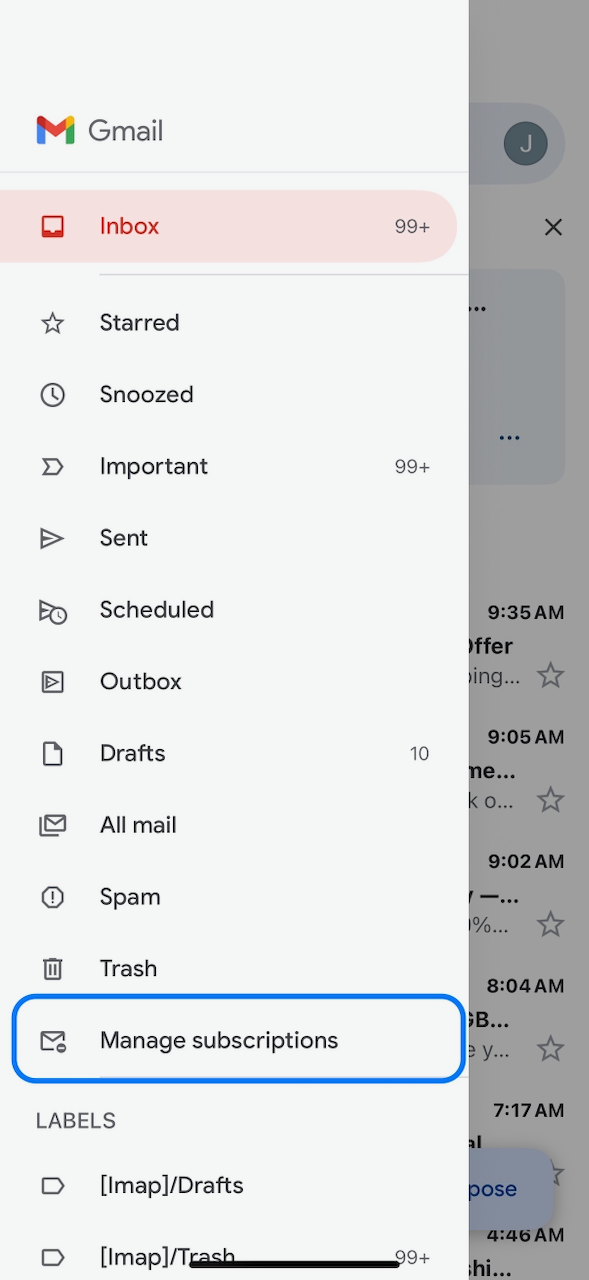
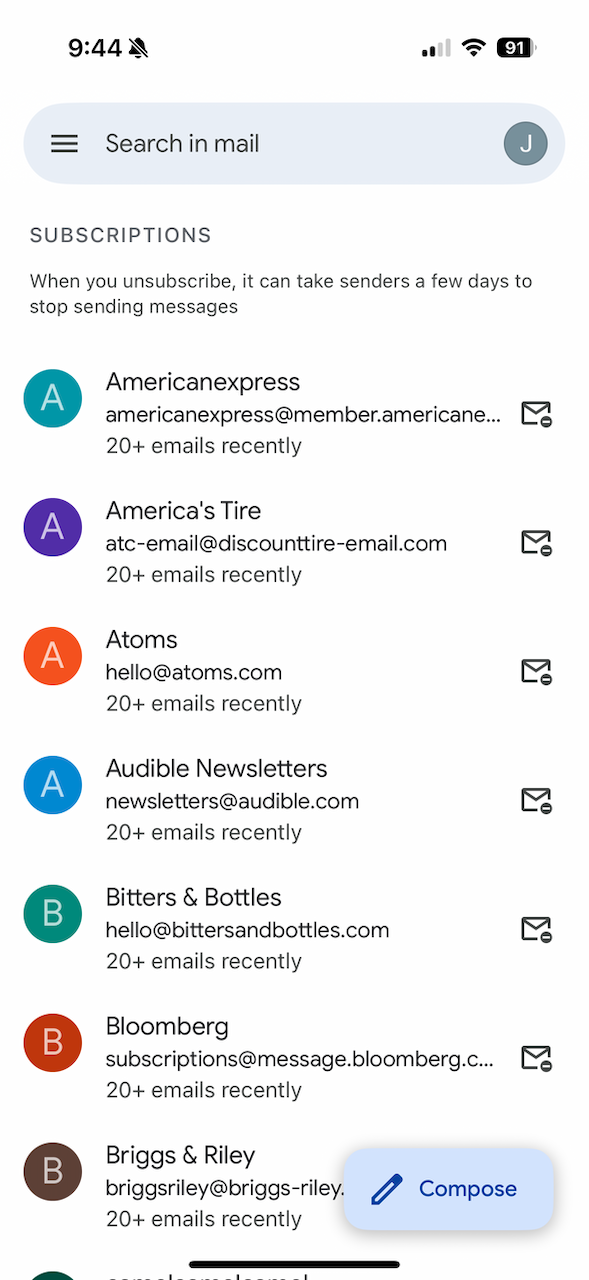

Tap on “Manage subscriptions” to see a list of your subscriptions, then tap one to unsubscribe.
This is especially welcome on this particular Gmail account, as it’s my “bulk email” account, so it has a lot of subscriptions.
The feature works exactly as described, but more useful than the unsubscribing itself is seeing just how many marketing emails I get from businesses I no longer use. (Sorry Atoms.)
Rosie O’Donnell Torches Donald Trump After His Unhinged Threat to Revoke Her Citizenship ⚙︎
Alexandra Marquez and Lindsey Pipia, reporting on the crazy for NBC News:
President Donald Trump on Saturday threatened to take away comedian Rosie O’Donnell’s U.S. citizenship, something that he cannot legally do, reigniting a decadeslong feud between the pair.
“Cannot legally do” is doing a lot of heavy lifting here.
Trump’s insane threat was announced where he issues all of his official proclamations: “Truth” Social:
Because of the fact that Rosie O’Donnell is not in the best interests of our Great Country, I am giving serious consideration to taking away her Citizenship. She is a Threat to Humanity, and should remain in the wonderful Country of Ireland, if they want her. GOD BLESS AMERICA!
- The President of the United States doesn’t have the power to strip anyone of their citizenship.
- Shouldn’t such a threat be impeachable?
- Rosie O’Donnell gave a masterclass in how to respond to Trump. Just chef’s kiss perfection.
The media is treating Trump’s outburst as something worthy of debate—as though there’s a legitimate question of whether or not the President of the United States of America can just decide to revoke an American’s citizenship—rather than with outright ridicule, and a reminder that these diatribes are meant to distract from a very bad news cycle.
O’Donnell, however, understood her assignment and clapped back, hard—not once:
the president of the usa has always hated the fact that i see him for who he is - a criminal con man sexual abusing liar out to harm our nation to serve himself - this is why i moved to ireland - he is a dangerous old soulless man with dementia who lacks empathy compassion and basic humanity- i stand in direct opposition all he represents- so do millions of others - u gonna deport all who stand against ur evil tendencies - ur a bad joke who cant form a coherent sentence #nevertrump
… but twice:
hey donald –
you’re rattled again? 18 years later and I still live rent-free in that collapsing brain of yours.
you call me a threat to humanity –but I’m everything you fear:a loud womana queer womana mother who tells the truthan american who got out of the country b4 u set it ablaze
you build walls –I build a life for my autistic kid in a country where decency still exists
you crave loyalty –I teach my children to question power
you sell fear on golf courses –I make art about surviving trauma
you lie, you steal, you degrade –I nurture, I create, I persist
you are everything that is wrong with america –and I’m everything you hate about what’s still right with it
you want to revoke my citizenship?go ahead and try, king joffrey with a tangerine spray tan
i’m not yours to silencei never was
🇮🇪 rosie
—with her second Instagram post featuring a photo of Trump with his arm around Jeffrey Epstein.
I’m pretty sure Trump is now a blubbering mess in a corner of the White House.
I mean, more than usual.