

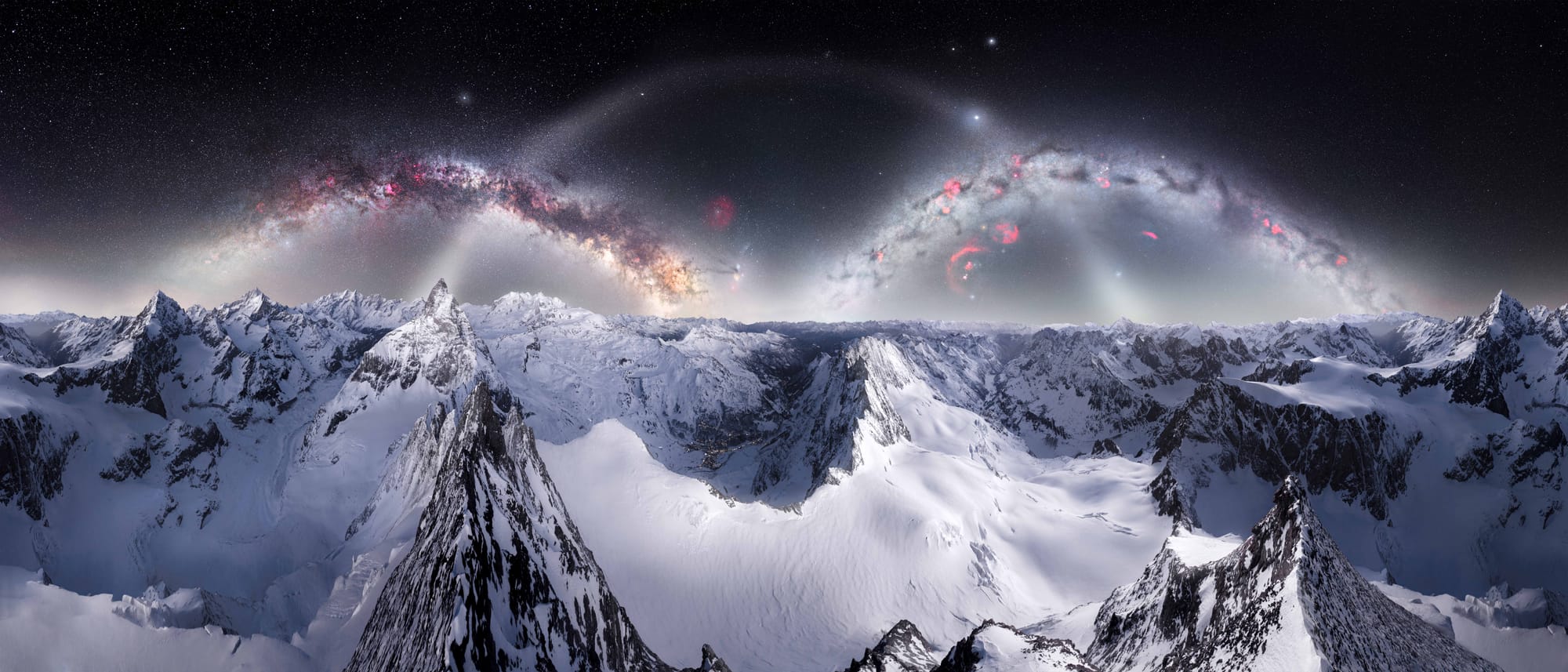
Astrophotographer Angel Fux captured a remarkable image of the Milky Way:
Once a year, in the northern hemisphere, something quietly extraordinary happens in the night sky. For a brief window of a few days each March, it becomes possible to witness both arms of the Milky Way above the horizon on the same night, not simultaneously, but within the same rotation of the Earth. The winter arch, a quieter, less dense band of stars, rises in the first half of the night. Then, as the Earth turns, the summer arch climbs from the other direction, carrying with it the galactic core, that unmistakable dense river of light. Together, they form what is called the double Milky Way arch.
Fux traveled via helicopter to the 4,200-meter (13,780-foot) summit of Dent d’Hérens, behind the Matterhorn on the Italian–Swiss border, and spent the night in temperatures of −25 to −28 degrees Celsius (−13 to −18 degrees Fahrenheit). Her plan was to photograph the double Milky Way arch from a never-before-seen vantage; she captured an even rarer triple arch:
While reviewing the winter arch panorama, I noticed a faint oval arch extending in the direction opposite to the sun, crossing the frame in a subtle but unmistakable gradient. This is called the Gegenschein, or counterglow, which is a diffuse brightening of the night sky caused by sunlight backscattering off interplanetary dust, directly opposite the sun’s position. It is extremely faint and rarely captured in photography. It was there, visible even in the unprocessed files, which told me immediately that the final image would contain more than I had planned for.
What I set out to make as a double arch became a triple arch: the Gegenschein, the winter Milky Way, and the summer Milky Way, all in a single frame of sky above the Alps.
Extraordinary effort and stunning results.