

This quiz created by Felicitas Strickmann has been floating around the socials since at least March, but is new to me:
18 statements. Just agree or disagree.
I’m pleased to say I am not a tech bro, with a score of 6%.
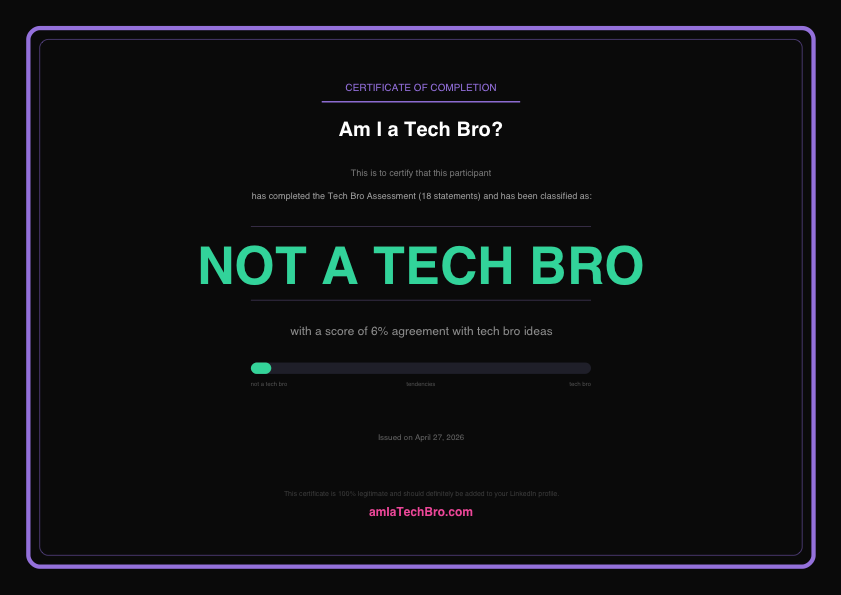
The one tech bro statement I agreed with? Disruption:
Sometimes existing industries and institutions need to be destroyed so something better can emerge.
Am I A Tech Bro? quotes the Cambridge Business English Dictionary’s definition of disruption: “The action of completely changing the traditional way that an industry or market operates by using new methods or technology”—a perfectly reasonable definition. The reason why agreeing with the Disruption statement gives a tech bro point is this:
Critics argue this narrative romanticizes destruction, ignoring the jobs lost, communities displaced, and regulations bypassed in the name of innovation.
Although I understand and somewhat agree with the critics, this argument doesn’t quite align with the definition or with the statement I agreed with, which starts with a qualifying “sometimes” and is vague about which industries and institutions are being destroyed.
Travis Kalanick (Uber), Mark Zuckerberg (Meta/Facebook), and Sam Altman (OpenAI) would likely also agree with the statement, yet they most certainly think about disruption quite differently from how I do.
Sometimes it is necessary for incumbent industries to be destroyed—supplanted, if you prefer—for new industries and ideas to emerge, and yes, that does, perhaps inevitably, lead to the elimination of entire classes of jobs and massive societal upheaval that can last for decades. Whether that’s good depends on who benefits from the disruption.
Slavery and the slave trade are institutions that needed to be destroyed. When it happened, it caused massive disruptions to society, with tremendous pain and suffering, the effects of which are still being felt generations later. Disruption is often deeply harmful and destructive as it’s happening, and positive only in retrospect.
Beyond that deliberately incendiary example, the list of obsoleted industries, technologies, and jobs is vast. Cars supplanted horse-drawn carriages. Refrigerators bested ice delivery. Oil, natural gas, and renewable energy are supplanting coal. The Pony Express, floppy disks, film projectionists, and switchboard operators… all gone because something better—disruptive—came along. Yet no one is suggesting we bring back the floppy or revive slavery or the coal industry. (Well, no one serious.)
The problem with tech bros and disruption is their belief that disruption is universally good, as long as the benefits accrue to them, with no nuance or consideration for those disrupted. (Unless, of course, the tech bros are the ones being disrupted.) Not all disruption is universally good. One example: Interstate freeways offered tremendous benefit to the country but disproportionately carved up poor and Black neighborhoods, stripping them of their home, churches, and untold generational wealth. Tech bros only consider the purported benefit, never the impact.
I might have received a point for agreeing with a tech bro sentiment, but tech bros and I are not alike.