

Fast, private email hosting for you or your business. Try Fastmail free for up to 30 days.
Apple Introduces iPhone 17e
Apple, via Newsroom, continues its “big week”:
Apple today announced iPhone 17e, a powerful and more affordable addition to the iPhone 17 lineup. At the heart of iPhone 17e is the latest-generation A19, which delivers exceptional performance for everything users do. iPhone 17e also features C1X, the latest-generation cellular modem designed by Apple, which is up to 2x faster than C1 in iPhone 16e. The 48MP Fusion camera captures stunning photos, including next-generation portraits, and 4K Dolby Vision video. It also enables an optical-quality 2x Telephoto — like having two cameras in one. The 6.1-inch Super Retina XDR display features Ceramic Shield 2, offering 3x better scratch resistance than the previous generation and reduced glare. With MagSafe, users can enjoy fast wireless charging and access to a vast ecosystem of accessories like chargers and cases. […]
iPhone 17e will be available for pre-order beginning Wednesday, March 4, with availability starting Wednesday, March 11. iPhone 17e will start at 256GB of storage for $599 — 2x the entry storage from the previous generation at the same starting price, and 4x more than iPhone 12 — giving users more space for high-resolution photos, 4K videos, apps, games, and more.
iPhone 17e introduces a new color to the lineup—soft pink—alongside black and white. In all of the ways that matter, the iPhone 17e significantly improves on last year’s iPhone 16e, and adopts several features of its older iPhone 17 sibling, but the most welcome addition is the return of MagSafe, which inexplicably went missing from iPhone 16e. I’m sure Apple heard plenty of feedback from its supposed target audience. (I neglected to mention it.)
The iPhone 17e shares the A19 chip with the iPhone 17 (one fewer GPU core—4 vs. 5—but it inherits the Neural Accelerators). It also gains Ceramic Shield 2 (for better drop and scratch resistance) and a somewhat improved camera system (no front-facing Center Stage, alas). It also doubles the starting storage, to 256GB, from 128GB.
(Which no doubt explains the iPhone 17e’s 2-gram (0.08-ounce) weight gain.)
To me, the iPhone 17e feels as much like a scaled-back iPhone 17 as it does an improved iPhone 16e. That’s a good thing.
Comparing storage to iPhone 12—a device released in 2020—is somewhat odd, but it helps explain who Apple believes is in the market for this phone: people upgrading from much older devices. The marketing page comparisons are limited to iPhone 11, iPhone SE 2nd gen, iPhone 12, and iPhone SE 3rd gen—all released between 2019 and 2022.
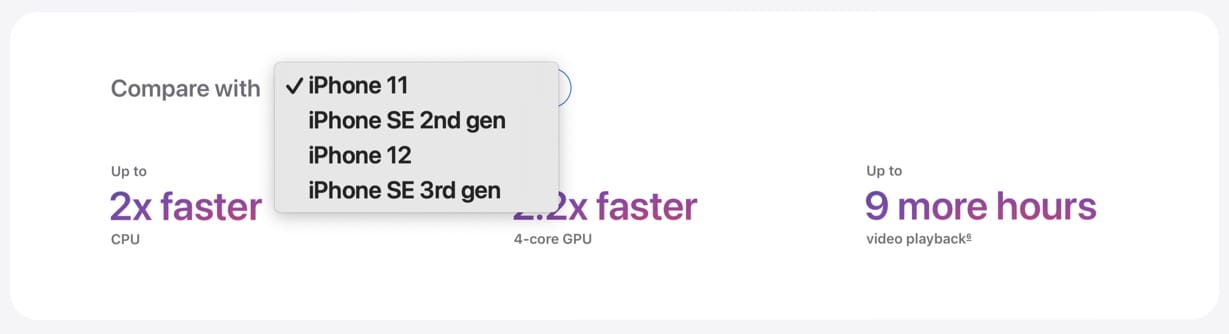
It’s actually rather disconcerting to see how little the iPhone has changed in the last five years. (That links to the full iPhone comparison page, set to iPhone 17e, iPhone 12, and iPhone 11; here’s one for iPhone 17e, iPhone 16e, and iPhone 17.)
One comparison Apple doesn’t make is to the iPhone 16, which remains available. iPhone 17e has double the starting storage, an improved chip, and better battery life—and is $100 less expensive than iPhone 16. The main advantages of iPhone 16? A slightly better camera system (including Camera Control), faster charging, and the vastly more interesting colors. Other than for those colors, I’m not sure why anyone would buy iPhone 16 today.